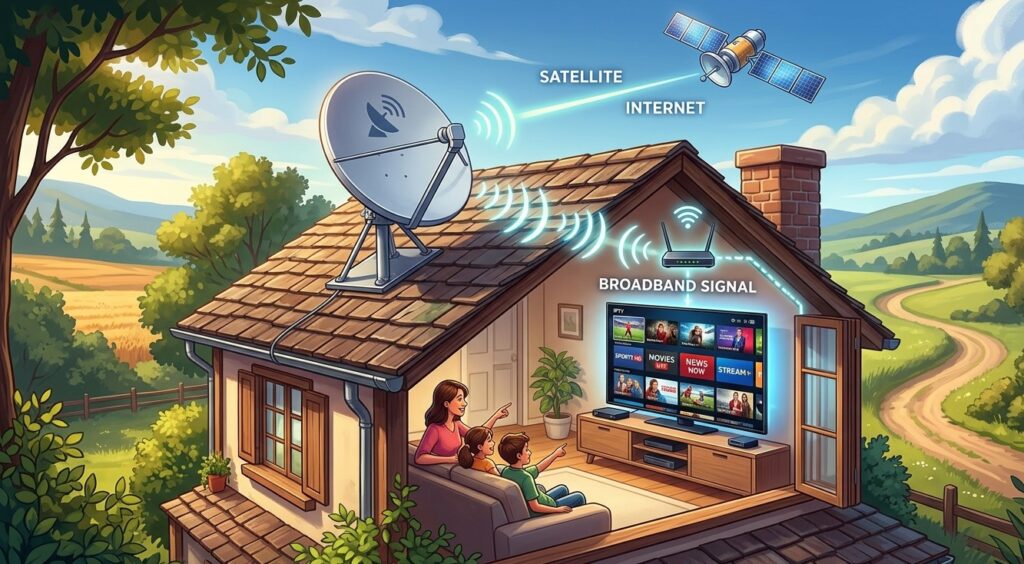
For those living in rural areas or locations without access to traditional cable or fiber broadband, satellite internet is often the only practical option. If you’re relying on this type of connection, you might be wondering whether it’s suitable for IPTV streaming. In this guide, we’ll explain how satellite internet performs with IPTV, what to expect, and how to make the most of your IPTV India subscription and Indian IPTV Box on this type of connection.
Table of Contents
- Can You Use IPTV with Satellite Internet?
- How Satellite Internet Differs from Other Connection Types
- Challenges Satellite Internet Presents for IPTV
- Data Caps and Satellite Internet Plans
- Tips for Streaming IPTV on Satellite Internet
- When Satellite Internet Might Not Be Ideal
- FAQs
Can You Use IPTV with Satellite Internet?
Yes, IPTV can work over satellite internet, since all that’s technically required is an active internet connection capable of streaming data. However, satellite internet has some unique characteristics compared to cable or fiber connections that can affect your overall IPTV India streaming experience, making it important to understand these differences before relying on it as your primary connection.
How Satellite Internet Differs from Other Connection Types
Satellite internet works by transmitting data between your home and an orbiting satellite, rather than through physical cables like traditional broadband. This introduces a few key differences:
- Higher latency – Since data must travel to and from a satellite in space, there’s typically more delay compared to fiber or cable connections
- Potential speed variability – Satellite speeds can sometimes be less consistent than wired connections
- Weather sensitivity – Unlike IPTV itself, satellite internet can occasionally be affected by severe weather conditions, since it relies on a clear signal path to the satellite
Challenges Satellite Internet Presents for IPTV
While satellite internet can support IPTV, a few specific challenges are worth understanding:
- Latency affecting live streaming – Higher latency can sometimes cause slight delays, which may be more noticeable during live sports or fast-moving content
- Data caps – Many satellite internet plans include data limits, which can be quickly consumed by regular video streaming
- Speed fluctuations during peak hours – Some satellite providers experience slower speeds during high-usage periods in their service area
- Weather-related disruptions – Heavy rain or storms can occasionally weaken the satellite signal, indirectly affecting your internet connection and, by extension, your IPTV streaming
Data Caps and Satellite Internet Plans
One of the most important factors for satellite IPTV users to consider is data usage:
- Many satellite plans have monthly data limits, unlike many wired broadband plans that offer unlimited data
- Video streaming consumes data quickly, especially at higher resolutions like HD or 4K
- Exceeding your data cap may result in reduced speeds or additional charges, depending on your specific plan
Before relying heavily on IPTV through satellite internet, it’s worth reviewing your plan’s data allowance and typical usage patterns to avoid unexpected overages.
Tips for Streaming IPTV on Satellite Internet
- Choose a lower streaming resolution if your plan has data caps, to help conserve your monthly allowance
- Stream during off-peak hours, if possible, when satellite speeds tend to be more consistent
- Monitor your data usage regularly through your provider’s tools or account dashboard
- Position your satellite dish properly and ensure it has a clear line of sight, as obstructions can affect overall connection quality
- Consider a wired connection between your router and your Indian IPTV Box, rather than relying on Wi-Fi, to minimize additional latency
When Satellite Internet Might Not Be Ideal
While satellite internet can work for casual IPTV viewing, it may not be the best fit if:
- You frequently watch high-demand live events, such as sports, where latency could be more noticeable
- Your household streams heavily across multiple devices, quickly consuming limited data allowances
- You require consistently high-resolution streaming, such as regular 4K content, which demands more stable bandwidth
In these cases, exploring alternative internet options, if available in your area, might provide a more reliable long-term solution for extensive IPTV use.
FAQs
1. Does satellite internet work well enough for IPTV streaming?
Yes, it can work for standard streaming needs, though higher latency and data caps may present some limitations compared to wired connections.
2. Will bad weather affect my IPTV streaming if I use satellite internet?
Indirectly, yes — severe weather can disrupt the satellite signal itself, which would then affect your internet connection and IPTV streaming.
3. Can I stream 4K content on satellite internet?
It’s possible if your plan supports sufficient speeds, though data caps often make sustained 4K streaming less practical on many satellite plans.
4. Should I use Wi-Fi or Ethernet with my Indian IPTV Box on satellite internet?
A wired Ethernet connection can help minimize additional latency, making it a generally better choice when using satellite internet.
5. Do all satellite internet providers have data caps?
Many do, though specific limits vary by provider and plan, so checking your specific plan’s details is important for managing IPTV usage.
Stream IPTV Wherever You Are
Even with satellite internet, you can still enjoy IPTV India with the right approach and expectations. Pair your subscription with a well-configured Indian IPTV Box and stream smart, wherever your location takes you. Explore our IPTV plans today and stay connected to your favorite channels.

