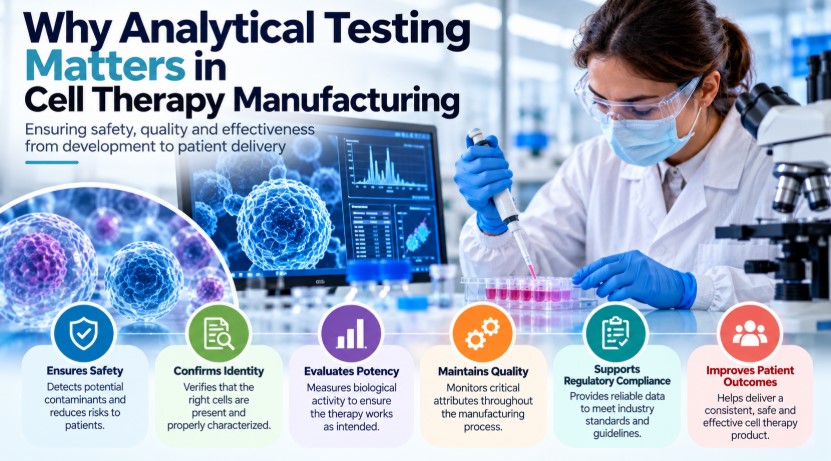
Cell therapies are transforming modern medicine by using living cells to address complex diseases and unmet medical needs. However, manufacturing these therapies involves challenges that differ significantly from those associated with conventional pharmaceutical products. Living cells can change in response to environmental conditions, processing methods, and storage parameters, making consistent product quality essential.
Cell therapy analytical testing helps manufacturers understand product characteristics, evaluate critical quality attributes, and determine whether a therapy meets predefined specifications. By integrating appropriate testing throughout development and manufacturing, developers can identify potential problems, improve process consistency, and generate the evidence needed to support clinical development and regulatory review.
What Is Cell Therapy Analytical Testing?
Cell therapy analytical testing involves scientific methods used to evaluate the identity, purity, potency, viability, safety, and other relevant characteristics of cell-based products. These methods help determine whether cells possess the properties required for their intended therapeutic application.
Testing strategies vary according to the cell type, manufacturing process, mechanism of action, and stage of product development. For example, an engineered immune-cell therapy may require assessments of genetic modification, target recognition, and functional activity. A stem cell product may require characterization of cell identity, differentiation potential, and unwanted cell populations.
Analytical methods provide measurable evidence about product quality. Manufacturers use these results to establish specifications, monitor manufacturing performance, investigate deviations, and support decisions about product suitability.
Why Analytical Testing Is Essential in Cell Therapy Manufacturing
1. Verifying Cell Identity and Purity
Cell identity confirms that a manufactured product contains the intended cell population. Purity testing evaluates the presence of unwanted cells, residual processing materials, or other impurities that could affect product quality.
Manufacturers may use flow cytometry, immunophenotyping, molecular assays, and other characterization techniques to assess specific cellular markers. The appropriate method depends on the biological properties of the product and the purpose of the test.
For example, engineered T-cell therapies require evidence that the intended T-cell population is present and that relevant product characteristics meet established criteria. Effective identity and purity testing helps developers detect inconsistencies before products advance through the manufacturing process.
2. Assessing Cell Viability and Potency
Cell viability measures the proportion of living cells in a sample, while potency evaluates the biological activity associated with a product’s intended function. Although these measurements can be related, they are not interchangeable. A cell may remain alive without demonstrating the required therapeutic activity.
Potency assays are therefore particularly important in cell therapy quality control. Depending on the product, these assays may measure target-cell killing, cytokine release, immune-cell activation, or another relevant biological response.
Developers should select potency methods that reflect the therapy’s mechanism of action as closely as practical. Reliable assays help manufacturers evaluate batch consistency and determine whether process changes affect biological performance.
3. Detecting Contamination and Safety Risks
Cell-based products require careful contamination control because microorganisms or unwanted biological materials can compromise product quality and patient safety.
Testing may include sterility assessments, endotoxin testing, mycoplasma detection, and other product-specific evaluations. Genetically modified cell therapies may also require testing for residual reagents, vector-related attributes, or other risks associated with the manufacturing process.
Analytical testing works alongside preventive controls, including aseptic processing, environmental monitoring, qualified equipment, and personnel training. Testing alone cannot eliminate contamination risks, so manufacturers must establish a comprehensive quality system that combines prevention, detection, investigation, and corrective action.
Key Analytical Methods Used for Cell Therapy Products
Flow Cytometry and Immunophenotyping
Flow cytometry measures cellular characteristics using fluorescent markers and light-based detection. It can help identify cell populations, evaluate marker expression, and assess viability using appropriate assay configurations.
Immunophenotyping is especially useful when manufacturers need to confirm that a product contains the expected cellular population. Consistent sample preparation, suitable controls, and validated analytical procedures help improve the reliability of results.
Molecular and Genetic Testing
Molecular methods can evaluate genetic characteristics, detect specific sequences, and assess relevant attributes of genetically modified cells. Depending on the product, testing may examine transgene presence, genetic modification efficiency, or other defined molecular characteristics.
These methods support product characterization and help manufacturers understand whether the manufacturing process produces the intended biological features.
Functional and Potency Assays
Functional assays measure biological responses linked to a therapy’s intended activity. Examples include target-cell killing assays for certain immune-cell products or cytokine measurements that indicate a relevant cellular response.
Because living cells are biologically complex, potency assay development can require substantial optimization. Developers must consider assay sensitivity, reproducibility, biological relevance, and suitability for routine manufacturing use.
Microbiological and Safety Testing
Microbiological testing helps detect contamination and assess specific safety attributes. Methods may include sterility tests, endotoxin assays, and mycoplasma testing, depending on the product and applicable requirements.
Manufacturers must establish appropriate sampling plans and testing strategies while accounting for the time required to obtain results. These considerations are particularly important for patient-specific therapies with limited manufacturing and administration windows.
Integrating Analytical Testing Into the Manufacturing Workflow
Analytical testing should begin during early process development rather than being introduced only at the final product stage. Early testing helps developers understand how processing conditions influence cellular characteristics and identify suitable parameters for monitoring production.
During process development, teams evaluate analytical methods, define critical quality attributes, and establish initial acceptance criteria. As manufacturing progresses, in-process testing can monitor selected parameters and reveal deviations before they affect later stages.
At the final testing stage, manufacturers assess whether the product meets its established release specifications. Testing requirements depend on the therapy, development phase, and applicable regulatory framework. Some tests may continue after product administration when justified by the manufacturing and regulatory strategy.
When developers change equipment, raw materials, or process parameters, they should evaluate whether those changes affect existing analytical methods or product specifications. Appropriate comparability studies and method assessments help determine whether the product continues to meet its intended quality requirements.
The Role of GMP and Analytical Method Validation
Good Manufacturing Practice (GMP) provides a framework for controlling manufacturing activities, documenting operations, and maintaining product quality. Analytical testing supports this framework by generating reliable data for quality decisions.
Analytical methods must be suitable for their intended purpose. Depending on the assay and its application, method validation or qualification may evaluate accuracy, precision, specificity, sensitivity, range, and robustness.
Documentation also plays a central role. Laboratories should maintain controlled procedures, equipment records, reference standards, sample traceability, and reviewable test results. When results fall outside established limits, documented investigations help identify potential causes and determine appropriate corrective actions.
Specialized analytical development and testing support can help cell therapy developers establish suitable methods, improve assay performance, and prepare for changing testing requirements as products progress from research into clinical manufacturing.
Common Challenges in Cell Therapy Analytical Testing
Cell therapy analytical testing presents several practical challenges. Biological variability can affect assay performance, while limited sample volumes may restrict the number of tests available for each batch. Short product shelf lives can also complicate testing schedules and release decisions.
Another challenge involves developing assays that reflect the product’s biological activity. Some therapies have complex mechanisms of action that cannot be captured by a single measurement. Developers may therefore need a combination of complementary assays to build an appropriate understanding of product quality.
Manufacturers can address these challenges by selecting fit-for-purpose methods, improving sample handling, standardizing procedures, and assessing analytical performance throughout development. Early collaboration between manufacturing, quality assurance, and analytical teams can also help prevent avoidable delays.
Conclusion
Cell therapy analytical testing is essential for understanding product characteristics, monitoring manufacturing consistency, and supporting quality and safety decisions. By evaluating cell identity, purity, viability, potency, and relevant safety attributes, manufacturers can build stronger evidence that their products meet established requirements.
Integrating suitable analytical methods throughout development and manufacturing also helps identify process problems, support regulatory documentation, and guide improvements. As cell-based treatments become more complex, robust testing strategies will remain central to reliable manufacturing and responsible clinical development. For developers seeking specialized expertise, a qualified cell therapy CDMO can help coordinate analytical method development, quality control testing, and manufacturing support in line with the product’s specific requirements.