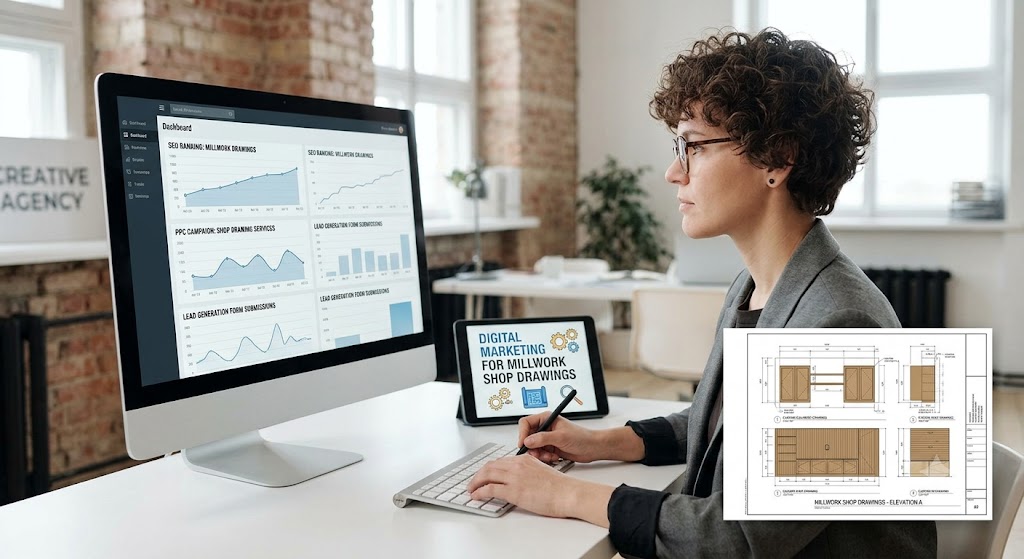
Construction companies operate in a highly competitive market where having a strong portfolio and delivering quality projects is no longer enough to consistently generate new business. General contractors, subcontractors, builders, and specialty contractors need to be visible when potential clients are actively searching for their services. Whether a contractor needs Millwork Shop Drawings services for a commercial project or is looking for a reliable subcontractor, digital marketing can help construction businesses connect with prospects at the right stage of the buying journey.
Unlike traditional advertising, digital marketing allows construction companies to target specific industries, locations, services, and project requirements. A well-planned strategy can help contractors attract architects, developers, property owners, general contractors, and other decision-makers who are more likely to become qualified leads.
Why Digital Marketing Matters for Construction Companies
The construction buying process is different from many consumer industries. A potential client may spend weeks or months researching contractors, reviewing portfolios, checking previous projects, comparing capabilities, and requesting estimates before making a decision.
This makes digital visibility particularly important.
When someone searches for terms such as:
- Commercial general contractor
- Construction company in New York
- Retail construction contractor
- Commercial millwork contractor
- Construction documentation services
- BIM services for contractors
- Restaurant construction company
- Tenant improvement contractor
The companies appearing prominently in search results have an opportunity to enter the consideration process early.
A strong digital marketing strategy helps construction businesses build visibility before a prospect is ready to submit an inquiry. It also provides evidence of expertise through project pages, educational content, case studies, testimonials, certifications, and technical resources.
1. Build a Website Around Services and Project Types
Your website should do more than display your company name, phone number, and portfolio.
It should clearly communicate:
- What services you provide
- Which project types you handle
- Which industries you serve
- Where you operate
- Who your ideal clients are
- What makes your company different
- How prospects can request a quote or consultation
Construction companies often serve multiple project categories. For example, a contractor might work on commercial offices, retail stores, restaurants, healthcare facilities, hospitality projects, and multifamily developments.
Instead of placing everything on one generic services page, create dedicated pages where there is enough meaningful information to justify them.
For example:
Commercial Construction Contractor
Explain the company’s experience, project scope, documentation process, coordination approach, and typical commercial project requirements.
Retail Construction
Discuss tenant improvements, store rollouts, coordination with designers, schedules, site conditions, and other relevant considerations.
Restaurant Construction
Focus on restaurant-specific requirements such as coordination between architectural, MEP, kitchen, millwork, and construction teams.
This structure makes the website easier for users to navigate while also creating more opportunities to target relevant search queries.
2. Use SEO to Capture High-Intent Construction Searches
Search engine optimization can become a long-term source of qualified traffic for construction companies.
However, ranking for broad terms such as “construction company” may not always produce the most relevant prospects.
Instead, focus on search intent.
Informational keywords
These are searches where users are looking for information.
Examples include:
- What are construction shop drawings?
- How does the construction submittal process work?
- What is BIM coordination?
- What are architectural drawings?
- What is the difference between construction drawings and shop drawings?
These keywords can be useful for attracting people earlier in the research process.
Commercial investigation keywords
These searches indicate that someone is comparing services or providers.
Examples include:
- Commercial construction contractors
- BIM services for construction companies
- Millwork drafting services
- Construction estimating services
- Commercial drafting services
Transactional keywords
These searches often indicate stronger buying intent.
Examples include:
- Hire commercial contractor
- Commercial contractor in Texas
- Millwork shop drawings services
- Construction subcontractor near me
- Request construction estimate
A successful SEO strategy should include a mixture of these search intents rather than publishing only informational blog posts.
3. Create Location-Specific Landing Pages
Construction services are frequently location-dependent.
A contractor operating across multiple states or metropolitan areas can create location pages that explain the company’s actual service coverage.
For example:
- Commercial Contractor in New York
- General Contractor in Texas
- Retail Construction Contractor in California
- Commercial Construction Services in New Jersey
But location pages should not simply replace the city name throughout the same paragraph.
Each page should provide useful local information, such as:
- Projects completed in the area
- Types of construction handled
- Local building considerations
- Service areas
- Relevant project examples
- Local client requirements
- Contact information
This approach creates genuinely useful landing pages rather than thin pages designed only for search engines.
4. Publish Content That Answers Real Construction Questions
Construction companies have access to valuable industry knowledge that can be turned into content.
Instead of publishing generic articles such as “5 Reasons to Choose Our Company,” create resources that answer questions prospects actually ask.
For example:
Construction documentation topics
- What Are Shop Drawings in Construction?
- Shop Drawings vs. Construction Drawings: What’s the Difference?
- What Information Should a Shop Drawing Include?
- How Does the Submittal and Approval Process Work?
Commercial construction topics
- How to Plan a Commercial Renovation Project
- Common Challenges in Retail Construction
- What Contractors Should Know Before Starting a Tenant Improvement Project
BIM topics
- How BIM Coordination Helps Reduce Construction Conflicts
- BIM vs. CAD: What Is the Difference?
- How Contractors Use BIM During Construction
Millwork topics
- What Contractors Should Check Before Approving Millwork Shop Drawings
- How Millwork Shop Drawings Support Construction Coordination
- Common Issues Found During Millwork Shop Drawing Review
This type of content demonstrates practical knowledge while creating opportunities to rank for long-tail search queries.
5. Demonstrate Experience Through Case Studies
One of the strongest ways for a construction company to demonstrate expertise is by showing how it handled real projects.
A useful case study should go beyond:
“We completed a 50,000-square-foot commercial project successfully.”
Instead, explain the project context.
A strong construction case study can include:
Project Type: Commercial Retail
Location: New York, NY
Scope: Interior construction and coordination
Challenge: Tight project schedule and multiple trades
Approach: Coordination between project stakeholders and construction teams
Outcome: Project delivered according to the agreed scope and schedule
Where appropriate, include project photographs, drawings, diagrams, plans, or other visuals.
Case studies provide evidence of experience while helping potential clients understand whether the company has handled projects similar to theirs.
6. Optimize Google Business Profile
For contractors serving specific geographic markets, Google Business Profile can be an important part of local search visibility.
Make sure the profile contains accurate:
- Business name
- Address or service area
- Phone number
- Website
- Business category
- Business hours
- Service information
- Project photographs
Regularly adding genuine project photographs can also help communicate what the company actually does.
Reviews are another important component.
Instead of simply asking every customer for a five-star review, ask satisfied clients to describe their actual experience. Specific reviews mentioning the project type, service, communication, or professionalism can provide more useful information to prospective customers.
7. Use LinkedIn to Reach Construction Decision-Makers
LinkedIn can be particularly useful for B2B construction marketing.
The objective should not be to constantly post promotional messages.
Instead, construction companies can share useful industry information such as:
- Completed projects
- Before-and-after transformations
- Construction details
- Project challenges
- Coordination insights
- Technical drawings
- BIM coordination examples
- Construction process explanations
- Industry updates
- Team expertise
Companies can also use LinkedIn to build relationships with:
- Architects
- Developers
- General contractors
- Construction managers
- Interior designers
- Subcontractors
- Property owners
- Procurement professionals
The goal is to establish professional credibility and create opportunities for conversations.
8. Use Google Ads for Immediate Lead Generation
SEO can take time to produce consistent results. Paid search can provide another acquisition channel when campaigns are structured around high-intent searches.
For example, a contractor might create campaigns around:
Commercial Construction
Keywords related to commercial contractors and construction services.
Retail Construction
Keywords related to retail build-outs and tenant improvements.
Specialized Services
Keywords related to specific construction capabilities.
The important point is to avoid sending every advertisement to the homepage.
A search for “commercial construction contractor” should ideally lead to a relevant commercial construction landing page.
A search for a specialized service should lead to a page specifically explaining that service.
This creates a closer relationship between:
Search → Advertisement → Landing Page → Inquiry
The closer this alignment is, the easier it is for prospects to understand what the company offers.
9. Create Dedicated Landing Pages for Paid Campaigns
A common mistake is sending paid traffic to a general homepage.
A dedicated landing page can focus on one service and one audience.
For example, a landing page could include:
Headline
Commercial Construction Services for Developers and Property Owners
Supporting Information
Explain the company’s capabilities, project types, geographical coverage, and experience.
Proof
Include relevant projects, testimonials, certifications, and measurable information where it can be verified.
Conversion Action
Provide a clear method for requesting an estimate or consultation.
Avoid filling the page with multiple unrelated calls to action. The visitor should immediately understand what action they can take.
10. Use Retargeting to Reconnect With Website Visitors
Not every website visitor will contact a contractor during their first visit.
Construction projects often involve multiple stakeholders and longer decision-making periods.
Retargeting can help businesses remain visible to people who previously interacted with their website, subject to applicable advertising and privacy requirements.
For example, someone who visits a commercial construction service page but does not submit a form may later see an advertisement highlighting:
- A relevant project
- A case study
- A service capability
- A consultation offer
This keeps the company visible during the research process.
11. Improve Lead Quality Instead of Chasing Lead Volume
Generating more leads is not necessarily the same as generating better leads.
A construction company receiving 100 inquiries from people who cannot afford its services may have a worse sales