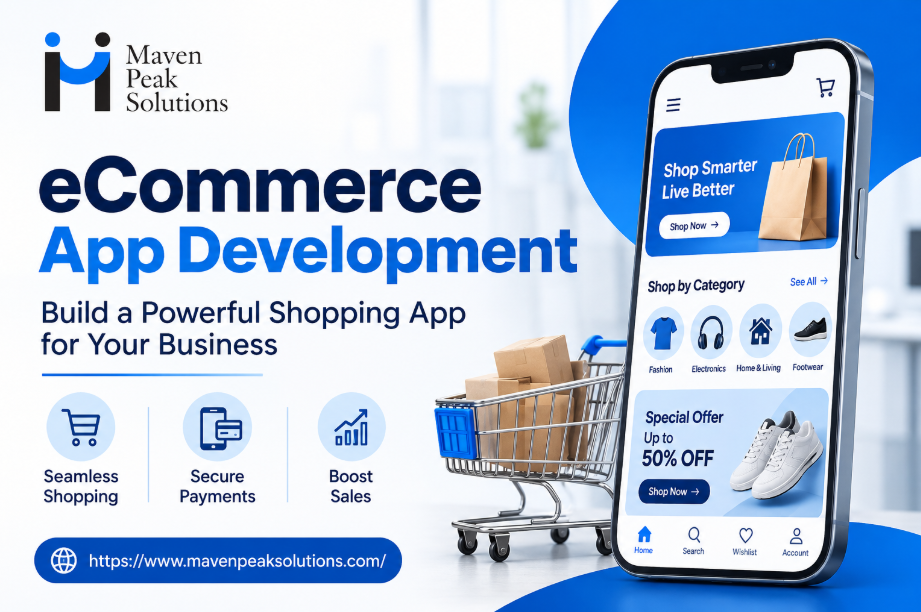
Online shopping has changed how customers discover products, compare prices, and make purchases. Across the United States, businesses are investing in mobile applications to provide convenient shopping experiences, improve customer engagement, and increase sales. A well-designed ecommerce application allows customers to browse products, manage their accounts, place orders, and make secure payments from their smartphones.
Professional eCommerce App Development helps businesses turn their online retail ideas into functional mobile shopping platforms. However, building a successful application requires more than an attractive interface. It involves understanding customer behavior, planning essential features, selecting suitable technologies, integrating payment systems, and maintaining application performance.
Whether you operate a startup, an established retail brand, or a growing online store, the right mobile application can support your business goals and create a more convenient shopping experience.
What Is eCommerce App Development?
eCommerce App Development is the process of designing, building, testing, and maintaining mobile applications that allow customers to purchase products or services online.
These applications generally include product catalogs, search filters, shopping carts, customer accounts, payment gateways, order tracking, and push notifications.
For example, a clothing retailer may need product categories, size selection, product images, discount codes, and order tracking. An electronics store may require product comparisons, warranty information, customer reviews, and delivery updates.
A properly developed shopping application connects these features within a simple interface, helping customers complete purchases with fewer steps.
Businesses planning a dedicated shopping platform can explore eCommerce App Development services to understand the technical and functional requirements involved.
Why US Businesses Are Investing in Ecommerce Mobile Apps
Mobile shopping gives customers the flexibility to browse and purchase products whenever they need them. For businesses, mobile applications provide another channel for reaching customers and maintaining ongoing engagement.
1. Convenient Shopping Experience
Customers can browse products, save favorites, add items to their carts, and complete purchases directly from their smartphones. Features such as saved payment methods and personalized product recommendations can make repeat purchases easier.
2. Better Customer Engagement
Push notifications can inform customers about order updates, new arrivals, special promotions, and abandoned shopping carts. When used appropriately, these notifications help businesses communicate relevant information without relying entirely on email.
3. Personalized Product Recommendations
An ecommerce application can use customer preferences and shopping activity to display relevant products. For example, a customer who regularly purchases fitness equipment may receive recommendations for related accessories.
Personalization should remain useful and respect customer privacy.
4. Direct Customer Communication
Mobile apps provide businesses with additional ways to communicate through order notifications, support features, and account updates. Customers can also access their order history and manage their preferences from one place.
5. Improved Brand Recognition
A branded application creates a consistent shopping environment. Its design, navigation, product presentation, and communication style can reinforce the company’s identity and make the experience familiar for returning customers.
Essential Features of a Successful Ecommerce Application
The right features depend on the products, target audience, and business model. However, several capabilities are important for most online shopping applications.
User Registration and Account Management
Customers should be able to create accounts, sign in securely, update personal information, manage addresses, and view previous orders. Simple registration options can reduce friction during the shopping process.
Product Catalog and Smart Search
A well-organized product catalog helps customers find items quickly. Categories, filters, sorting options, product descriptions, and high-quality images make product discovery easier.
Search functionality should support relevant product names and useful filters such as price, brand, size, and availability.
Shopping Cart and Secure Checkout
Customers should be able to review selected products, update quantities, apply discount codes, and see the total cost before placing an order.
A streamlined checkout process should support suitable payment options and provide clear confirmation after successful transactions.
Payment Gateway Integration
Payment integration allows customers to complete transactions securely. Depending on the target market, businesses may support credit and debit cards, digital wallets, and other payment methods.
Developers should consider payment security, transaction verification, failed payments, refunds, and payment status updates.
Order Tracking and Notifications
Customers appreciate knowing what happens after placing an order. Order tracking can display processing, shipping, and delivery information. Notifications can communicate important changes throughout the purchase journey.
Reviews and Ratings
Product reviews help customers understand product quality and make informed buying decisions. Businesses should provide appropriate moderation and reporting features to maintain useful customer feedback.
Custom Ecommerce App Development for Unique Business Requirements
Every retail business has different products, workflows, customer expectations, and operational requirements. A standard shopping template may be sufficient for a small store, but growing businesses may need more specialized functionality.
Custom Mobile App Development can help businesses build applications around their specific shopping experiences, branding, and operational processes.
For example, a grocery business may need delivery slot selection, location-based availability, and recurring orders. A fashion retailer may require size recommendations, wishlists, and personalized product collections. A wholesale business may need bulk ordering, customer-specific pricing, and account-based permissions.
Custom development gives businesses greater control over application features and integrations. However, the project should begin with clear requirements to avoid unnecessary development costs.
On-Demand Ecommerce Apps for Faster Customer Services
Some ecommerce businesses require more than a traditional shopping application. They may need platforms that connect customers with nearby stores, delivery partners, service providers, or vendors.
On-demand app development can support applications that involve real-time order placement, location tracking, service availability, and delivery coordination.
For instance, a grocery delivery platform may connect customers with local stores and delivery partners. Customers can select products, place orders, track deliveries, and receive status notifications.
Similarly, a restaurant ordering application may need menus, payment processing, delivery tracking, and order management.
The features should reflect the actual business model and the needs of each user group.
Choosing the Right Technology for Ecommerce App Development
Technology selection affects application performance, security, scalability, and maintenance. The best technology stack depends on the project’s complexity, required integrations, budget, and development goals.
Common technologies include:
- React Native: Supports cross-platform mobile application development.
- Flutter: Allows developers to build applications for multiple platforms using a shared codebase.
- Swift: Commonly used for native iOS application development.
- Kotlin: Commonly used for native Android development.
- Node.js and Python: Can support backend services, APIs, and application logic.
- PostgreSQL and MongoDB: Can be used for application data storage, depending on data requirements.
- AWS, Microsoft Azure, and Google Cloud: Provide infrastructure and cloud services for application deployment.
Technology should be selected based on business requirements rather than popularity alone. Developers should also consider payment integrations, inventory systems, security requirements, and future maintenance.
The Ecommerce Mobile App Development Process
A clear development process helps businesses manage requirements, budgets, and delivery expectations.
Step 1: Business Research and Planning
The team identifies the target audience, competitors, product categories, business model, and required features. This stage establishes the application scope and development priorities.
Step 2: UI/UX Design
Designers create wireframes and prototypes to plan the shopping journey. Product discovery, cart management, checkout, and account navigation should be easy to understand.
Step 3: Frontend and Backend Development
Developers build the mobile interface, backend systems, databases, APIs, and required application features. They may also integrate inventory management, payment services, and notification systems.
Step 4: Testing and Quality Assurance
Testing checks application functionality, device compatibility, loading speed, payment processes, account security, and order management. Identifying issues before launch helps improve reliability.
Step 5: App Launch
After approval, the application is prepared for deployment through the relevant app stores. Store listings, screenshots, descriptions, and application requirements should also be reviewed.
Step 6: Maintenance and Updates
After launch, regular monitoring, bug fixes, security updates, and feature improvements help maintain application quality.
How Much Does Ecommerce App Development Cost in the USA?
The cost of building an ecommerce application depends on its features, design complexity, integrations, technology stack, and development requirements.
A basic shopping app with product listings, accounts, a shopping cart, and payment processing generally requires less development work than a large marketplace with multiple vendors, advanced analytics, delivery tracking, and complex inventory management.
Businesses should consider the following expenses:
- UI/UX design and prototyping.
- Frontend and backend development.
- Payment gateway integration.
- Database and cloud infrastructure.
- Testing and security reviews.
- App store deployment.
- Ongoing maintenance and updates.
Request a detailed proposal that separates initial development costs from recurring expenses. Compare providers based on project scope, technical experience, communication, and post-launch support rather than price alone.
How to Choose the Right Ecommerce App Development Partner
Selecting the right development team is an important decision. Review previous mobile app projects, technical capabilities, industry experience, and communication practices.
Ask potential providers about their development process, testing methods, security practices, project timelines, and maintenance arrangements. Clarify source code ownership, documentation, third-party licenses, and responsibilities for future updates.
A suitable development partner should understand your retail business, recommend practical features, and explain technical decisions clearly.
Conclusion
eCommerce App Development helps businesses create mobile shopping experiences that support product discovery, secure transactions, customer engagement, and convenient order management.
Whether you are launching a new online store, expanding an existing retail business, or developing an on-demand shopping platform, begin with clear business objectives and a strong understanding of customer needs.
By prioritizing usability, performance, security, and scalable architecture, businesses can build ecommerce applications that serve customers effectively and support long-term growth in the US market.