Key Takeaways
- A fintech ERP is not a generic ERP with a finance tab. Multi-entity ledgers, payment reconciliation, and audit trails have to be there from day one.
- UAE e-invoicing is now a planning item. Larger businesses must appoint a service provider by 30 October 2026 and go live on 1 January 2027.
- Published UAE guides put the ERP software development cost in Dubai at AED 250,000+ for custom builds, so scope the capability before you request quotes.
- Shortlisting ERP development companies for fintech comes down to six checks: regulatory fluency, integrations, security, scalability, delivery model, and post-launch support.
Why Month-End Exposes the Gap
Month-end at a growing Dubai fintech often looks the same. Finance exports settlement files from three payment processors, operations pulls KYC counts from another tool, and someone rebuilds the ledger in a spreadsheet before the auditor calls. That’s not a people problem. It’s a systems gap.
Before you brief any ERP development company, it pays to understand what a fintech ERP actually does and how to scope it properly. Whether you’re comparing ERP companies in Dubai or a single ERP software development company in Dubai, this guide covers the capabilities that matter, the UAE rules shaping your build, realistic costs, and how to compare ERP development companies for fintech without drowning in feature lists.
What a Fintech ERP Actually Does
An ERP brings finance, compliance, operations, and customer data into one connected system. For a fintech, that means your payment gateway, KYC provider, core ledger, and accounting tool stop acting like four separate sources of truth.
Here’s the distinction that trips up most scoping calls. Your product platform is what customers touch. Your ERP is the back office that books, reconciles and reports what the platform does. Many teams pair a customer-facing build, such as custom fintech app development, with an ERP that carries the accounting and compliance load behind it. Write the two requirement lists separately and your scope gets sharper fast.
Timing matters too. The UAE fintech market is forecast to grow from $3.16 billion in 2024 to $5.71 billion by 2029, according to the Emirates NBD and PwC FinTech 2025 report. More licenses, more entities, and more transaction volume all land on your finance team first.
Capabilities Your Fintech ERP Must Cover
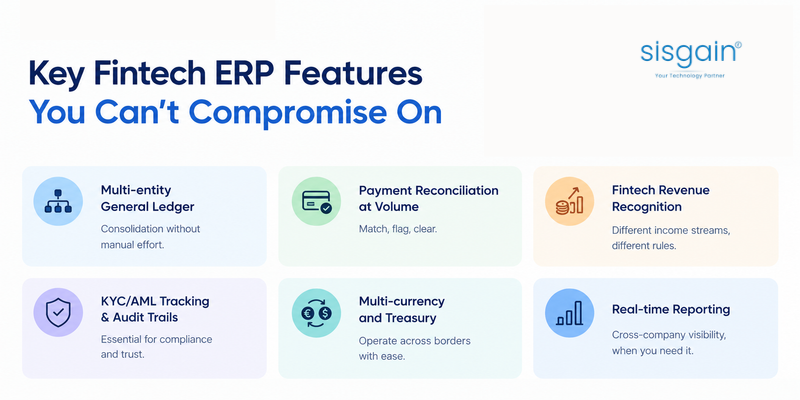
Not every module a vendor lists is relevant to a fintech. These decide whether the system holds up:
- Multi-entity general ledger. Holding structures with several licensed entities need consolidation without manual journals.
- Payment reconciliation at volume. Daily matching of bank, processor, and ledger records, with an exception queue your team can actually clear.
- Fintech revenue recognition. Interchange, subscription fees, float income, and referral fees each follow their own accounting rules.
- KYC/AML tracking and audit trails. Generic ERPs rarely ship these. They’re usually the first custom extension.
- Multi-currency and treasury. Essential once you settle in AED, USD, and beyond.
- Real-time reporting. According to ERP Research, missing cross-company reporting is the most common trigger behind fintech ERP projects.
Most new builds now go cloud-first. Cloud-based ERP development scales with transaction volume and lets you host in a UAE region such as AWS Middle East (UAE) or Azure UAE North, which keeps data-protection conversations simpler. It’s also why cloud-based ERP development should be a line item in every vendor proposal you request.
UAE Rules That Shape Your ERP
Three things belong in your requirements document before any vendor sees it.
Your regulator. Fintechs answer to the CBUAE at the federal level, the DFSA inside DIFC, or the FSRA inside ADGM. Your ERP’s reporting has to map to whichever one you report to.
E-invoicing. The Ministry of Finance has set a phased mandate on the Peppol-based framework. Businesses with revenue of AED 50 million or more must appoint an accredited service provider by 30 October 2026 and go live on 1 January 2027. Smaller businesses follow, with an appointment deadline of 31 March 2027 and go-live on 1 July 2027. Missing the appointment deadline carries a penalty of AED 5,000 per month. Some financial services are excluded, but platform fees, vendor invoices, and SaaS subscriptions usually aren’t, so confirm scope with your tax advisor.
Open finance. The CBUAE’s Open Finance Regulation, published in April 2024, pushes licensed institutions toward API-based data sharing. If that’s on your roadmap, review Open Finance solutions in the UAE before you freeze integration requirements.
Security belongs in the same conversation. Data residency, role-based access and audit logging are cheaper to design in than to retrofit, which is why secure application development uae practices should be in the brief from the start.
Custom ERP or Off-the-Shelf?
There’s no universal answer. ERP research points to NetSuite or Sage Intacct for SMEs and scaling fintechs, and SAP S/4HANA or Oracle Fusion for large and hypergrowth ones. Those platforms work well when your products fit standard modules.
Custom ERP software development earns its place when they don’t: unusual fee structures, bespoke settlement flows, or compliance workflows no vendor has built. One Dubai mid-market comparison puts the per-seat versus custom crossover at roughly 25 to 35 users over 36 months, though that figure isn’t fintech-specific. Plenty of teams land on a hybrid: standard accounting underneath, with custom ERP software development on top for what makes the business different.
Two adjacent decisions are worth making in the same planning cycle. If your roadmap points toward wallets, lending and rewards under one login, talk to a super app development company while the ERP is still on paper, because every new revenue stream becomes a ledger and reporting requirement. And if finance and compliance teams need fast access without a native app, pwa development services can deliver an installable portal on top of the ERP.
How to Compare ERP Development Companies for Fintech
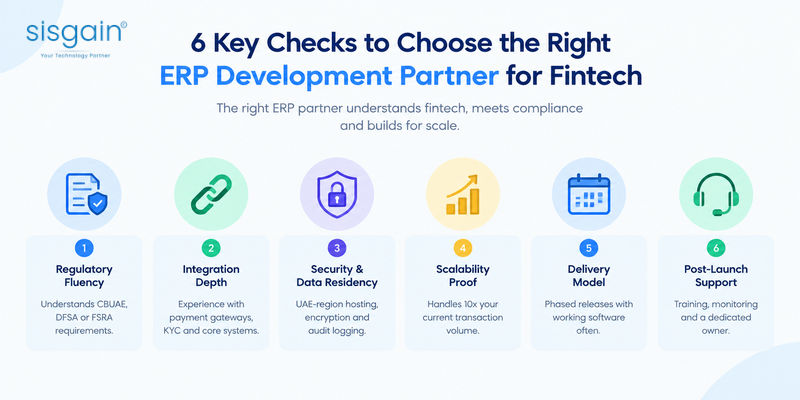
Searches for ERP companies in Dubai return a crowded field of generalists. Scaling fintechs needs a shorter filter for ERP development companies for fintech. Hold every vendor, us included, to these six checks:
- Regulatory fluency. Can they explain CBUAE, DFSA, or FSRA reporting and e-invoicing without a consultant translating?
- Integration depth. Ask for named experience with payment gateways, KYC providers, and core banking or ledger systems.
- Security and data residency. UAE-region hosting, encryption, and audit logging should be defaults, not add-ons.
- Scalability proof. Ask how the design handles ten times today’s transaction volume.
- Delivery model. Phased releases with working software every few weeks beat a nine-month reveal.
- Support after launch. Training, monitoring, and a named owner for the system.
Local presence matters, too. Among ERP companies in Dubai, an ERP software development company in Dubai can join your workshops, understand mainland, DIFC, and ADGM differences, and respond in your time zone. Ask for references from regulated clients, not just a portfolio.
Cost and Timeline: What to Budget
ERP software development costs in Dubai vary with modules, integrations, and user counts. One published UAE guide puts custom ERP and CRM builds at AED 250,000 to 600,000+, usually over 3 to 9 months, while another estimates each additional module at AED 11,000 to 36,500+. Fintech-specific rollouts commonly run 3 to 18 months.
Plan for overruns. Surveys cited by ERP Research find that 50 to 75% of ERP projects exceed their original budget, which is why phased delivery and a contingency line belong in the plan. For a wider view of what drives spend, read our breakdown of Fintech app development cost in 2026, then use the ERP fintech platform development guide to turn your requirements into a scoping checklist.
Scope Your Fintech ERP With SISGAIN
SISGAIN is an ERP software development company in Dubai that also builds fintech, mobile, and web platforms, so your ERP and product teams can plan together. We’d rather help you define the right system than sell you the biggest one, which is the standard we think all ERP development companies for fintech should meet. From workshops to custom ERP software development, we’ll map your modules, regulators, and integrations before you commit to a build.
Frequently Asked Questions
- Do fintech companies need an ERP?
Yes, once reconciling data across tools eats more hours than it should, or regulator questions take too long to answer. Before that point, accounting software may be enough. - When should a fintech move from QuickBooks or Xero to a dedicated ERP?
Move when you add entities, currencies, or high transaction volumes, or when an audit exposes gaps. Those are the most common triggers. - What is the ERP software development cost in Dubai for a fintech?
Published UAE guides cite AED 250,000 to 600,000+ for custom builds, depending on modules and integrations. A scoped estimate beats any generic range. - How long does fintech ERP development take?
Typically 3 to 18 months, depending on complexity and compliance needs. Phased cloud-based ERP development gets core finance live first. - Should we buy NetSuite or build a custom ERP?
Buy if your products fit standard modules; choose custom ERP software development when fee structures or workflows don’t. Many teams combine both. - Does our ERP need to support UAE e-invoicing?
Most likely for B2B invoices, with go-live on 1 January 2027 (AED 50M+ revenue) or 1 July 2027 (below). Some financial services are excluded, so confirm with your tax advisor.