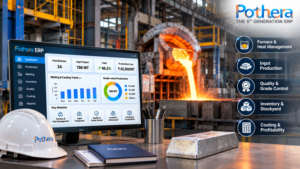
An ERP for induction furnace and ingot manufacturers should record the charge mix for every heat, track melt loss and power use, show cost per tonne of ingot or billet, and keep chemistry and dispatch records against heat numbers. Pothera ERP, built by Bsquare Solutions, connects inventory, production, quality and finance for Indian manufacturers, and runs on cloud or on-premise.
Why do induction furnace units need an ERP?
An induction furnace unit makes money on small margins per tonne, and those margins depend on charge mix, melt loss and power cost, which Tally and Excel cannot connect by heat. A single heat uses scrap, sponge iron, pig iron and alloys at different prices. It consumes thousands of units of electricity and loses weight as slag and burning loss. When these figures sit in separate registers, the true cost of each heat is guesswork.
An ERP puts every heat in one record, from charge to dispatch.
What does an induction furnace production cycle look like?
A typical cycle has six stages, and each is a place where weight, power or money can leak:
- Raw material receipt: scrap, sponge iron, pig iron and alloys are weighed and stored
- Charge preparation: the mix is decided and issued to the furnace
- Melting: power is consumed and burning loss occurs
- Chemistry check and adjustment: the spectrometer result decides alloy additions
- Tapping and casting: liquid metal becomes ingots or billets
- Dispatch or internal transfer: output goes to customers or to your own rolling mill
What features should an induction furnace ERP have?
Look for eight capabilities, and test each one in a demo.
| # | Feature | Why it matters |
| 1 | Heat-wise charge recording | Shows what went into each heat and what it cost |
| 2 | Melt loss and yield tracking | Separates burning loss, slag and rejections |
| 3 | Power consumption per heat | Links electricity units to tonnes produced |
| 4 | Cost per tonne by heat and grade | Reveals which heats and grades earn money |
| 5 | Scrap, sponge iron and alloy inventory | Weight-based stock with grade and supplier |
| 6 | Chemistry and test records | Keeps spectro results against each heat |
| 7 | Refractory and maintenance tracking | Monitors lining life and downtime cost |
| 8 | GST, e-invoicing and e-way bill | Keeps every dispatch compliant |
How does ERP track the charge mix and melt loss?
ERP records the weight and cost of each material charged into a heat and compares it with the good metal tapped, so melt loss is measured for every heat. Melt loss is the weight that does not become saleable metal (burning loss, slag and spillage). Seeing it by heat, by shift and by charge mix shows whether a high loss comes from the material, the operator or the furnace.
Use Pothera’s inventory management module to hold scrap, sponge iron and alloy stock by weight and supplier, so the charge you issue matches the stock you hold.
How does ERP calculate cost per tonne for ingots or billets?
Cost per tonne equals total material and conversion cost divided by good output in tonnes. Material includes scrap, sponge iron, pig iron and alloys. Conversion includes power, refractory, labour and overheads.
Illustrative example (not actual client data):
| Item | Value |
| Sponge iron | 50 tonnes × ₹25,000 = ₹12,50,000 |
| Scrap | 50 tonnes × ₹33,000 = ₹16,50,000 |
| Alloys and additives | ₹1,00,000 |
| Material Cost | ₹30,00,000 |
| Power | 58,500 kWh × ₹7.50 = ₹4,38,750 |
| Refractory and consumables | ₹60,000 |
| Labour and overheads | ₹1,00,000 |
| Total Cost | ₹35,98,750 |
| Melt loss (10%) | Good output: 90 tonnes |
| Cost per tonne (10% melt loss) | ₹39,986 |
| Melt loss (12%) | Good output: 88 tonnes |
| Cost per tonne (12% melt loss) | ₹40,895 |
(₹35,98,750 ÷ 90 = ₹39,986; ₹35,98,750 ÷ 88 = ₹40,895.) Two extra points of melt loss add about ₹909 per tonne, which is roughly ₹9 lakh on every 1,000 tonnes. The power, price and loss figures here are assumptions for explanation only.
How does ERP help control power cost per tonne?
ERP links electricity units to each heat, so you can see kWh per tonne by furnace, shift and charge mix. Power is usually the largest conversion cost in an induction furnace. When it is recorded per heat, a rise in kWh per tonne points to a cause, such as a worn lining, long holding time or a poor charge mix. Without heat-wise records, the electricity bill only tells you the total.
How does ERP manage chemistry, heat numbers and traceability?
ERP stores the spectro result and heat number against each batch of ingots or billets, so any customer query can be traced to the heat that produced it. This is useful when a customer questions chemistry, or when your own rolling mill needs the heat history before it rolls a billet. Ask any vendor to trace one dispatched lot back to its heat live in the demo.
How does ERP plan melting and production?
ERP turns sales orders and stock into a melting plan, so the furnace runs the right grade at the right time with the right material in hand. Use Pothera’s production and planning management to see demand, raw material stock and furnace capacity together. This reduces idle time and avoids melting a grade nobody has ordered.
Can ERP track refractory life and furnace maintenance?
Yes. A good ERP records heats per lining, breakdowns and maintenance cost, so you can see the cost of downtime and when a relining is due. This turns a guess about lining life into a number you can plan around.
How does ERP handle GST, e-invoicing and e-way bills for ingot sales?
ERP generates the tax invoice, e-invoice and e-way bill from the dispatch record, so the weight on paper matches the weight on the truck. Pothera ERP supports Indian GST compliance, including e-invoicing and e-way bills. Confirm the current setup in a demo and have your CA review the configuration.
What does ERP cost for an induction furnace unit?
Cost depends on users, modules and whether you choose cloud or on-premise. Get a range from the Bsquare ERP cost estimator. Most mid-size implementations take about 8 to 12 weeks, depending on data readiness.
How do the main ERP options compare for induction furnace units?
| Option | Best for | Watch out for |
| Pothera ERP | Small and mid-size Indian units wanting one integrated system | Verify melting-shop reports in a demo |
| SAP Business One | Larger groups with several plants | Higher cost and longer rollout |
| Odoo / ERPNext | Teams with in-house IT | Melting-shop setup often needs customisation |
| TallyPrime / Busy | Accounting and trading | No heat-wise costing or melt loss tracking |
For a wider comparison, read our guide to the best ERP software for steel manufacturers in India. If your plant also rolls bars, see ERP for TMT bar manufacturers in India.
How should you choose an ERP for an induction furnace unit? (5 steps)
- List your stages: charge, melt, chemistry, cast, dispatch.
- Score two or three vendors on the eight features above.
- Ask for a demo using one real heat from your own records.
- Check references from steel or other process manufacturers.
- Compare three-year total cost, including support and upgrades.
To see the full platform, visit Pothera ERP or Bsquare Solutions.
Frequently asked questions
- What is the best ERP for an induction furnace unit in India?
The best choice records heat-wise charge, melt loss, power use and cost per tonne, and fits your budget. Mid-size units often shortlist integrated, India-focused systems like Pothera ERP. - Can ERP track melt loss for each heat?
A melting-shop-ready ERP compares charged weight with tapped weight for every heat. Ask the vendor to show this live. - How does ERP calculate cost per tonne of ingot?
It divides total material and conversion cost by good output in tonnes, after removing melt loss and rejections. - Can ERP track power consumption per tonne?
Yes, if electricity units are recorded against each heat, an ERP can show kWh per tonne by furnace and shift. - Is Tally enough for an ingot manufacturer?
Tally handles accounts and GST, but not heat-wise costing, melt loss or charge-mix analysis. Growing units usually move to a full ERP. - How much does ERP cost for an induction furnace unit?
It varies with users, modules and deployment. The ERP cost estimator gives a range. - How long does ERP implementation take?
About 8 to 12 weeks for most mid-size manufacturers, depending on data readiness. - Should an induction furnace unit choose cloud or on-premise ERP?
Cloud suits owners who want remote access. On-premise suits plants with weak internet. Pothera supports both.
See it on your own heat data
Bring one real heat to a demo of Pothera ERP, or get a budget range from the ERP cost estimator.