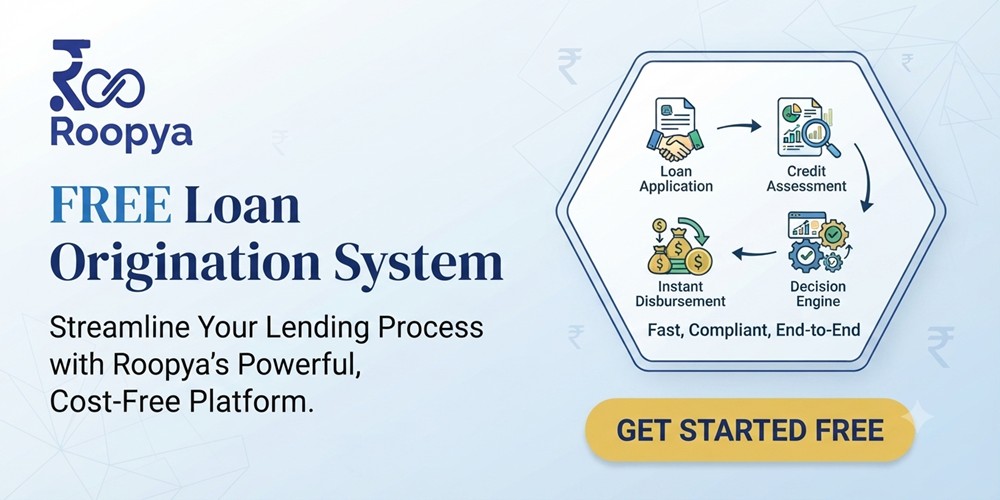
Launch and manage digital lending with Roopya’s free Loan Origination System. Automate applications, workflows, credit checks, documents and decisioning with a no-code, API-ready platform.
Build a Faster, Smarter Digital Lending Journey Without Traditional Platform Costs
Launching and scaling a lending operation should not require lenders to spend months building technology before they can process their first loan application. A modern lending business needs a reliable way to capture applications, verify borrower information, collect documents, evaluate creditworthiness, manage approval workflows and move eligible applications toward disbursement.
Roopya’s Free Loan Origination System (LOS) is designed to help lenders manage these stages through one unified, no-code lending infrastructure. Instead of relying on disconnected spreadsheets, emails and manual follow-ups, lending teams can create a more structured origination workflow that supports visibility, automation and operational control.
Whether you are an NBFC, bank, MFI, fintech lender, digital lending business or another financial institution, the goal is simple: make the journey from application to decision easier to manage while giving teams the flexibility to configure products, rules and workflows around their own lending operations.
What Is a Loan Origination System?
A Loan Origination System is software used to manage the journey of a loan application from initial customer engagement through key origination activities and, depending on the lender’s workflow, toward approval and disbursement.
A typical loan origination process may include:
- Lead and application capture
- Customer onboarding
- Digital application forms
- KYC and identity verification workflows
- Document collection and verification
- Credit bureau and other data checks
- Bank statement or financial data analysis
- Credit assessment and underwriting
- Business rule execution
- Approval and exception workflows
- Sanction documentation
- Disbursement coordination
- Application tracking and reporting
The exact workflow varies by lender and product. A personal loan may require a different journey from a business loan, MSME loan, microfinance product, vehicle loan or secured lending product. That is why configurability matters. The system should support the lender’s policies and processes rather than forcing every product into one rigid workflow.
Why Do Lenders Need a Free Loan Origination System?
The word “free” should not mean limited control or a difficult-to-use product. For lenders, the value of a free LOS is the ability to access a core lending technology foundation without beginning with a large platform licence or setup cost.
Traditional implementation approaches can create several challenges. Teams may need to coordinate multiple vendors, connect separate verification and data services, maintain custom workflows and wait through lengthy implementation cycles. A growing lender may also struggle when business teams depend on developers for every product, policy or workflow change.
A modern platform can reduce this complexity by bringing important origination capabilities together.
With Roopya, lenders can work toward a more connected origination environment where teams can manage applications, configure workflows and use pre-integrated services from a single platform. The approach is particularly useful for organisations that want to experiment with new loan products, digitise existing operations or scale processing capacity without rebuilding their technology foundation each time the business changes.
Key Benefits of Roopya’s Free Loan Origination System
1. Centralised Application Management
A single view of applications can make it easier for operations, credit and management teams to understand where each case stands. Teams can organise applications by status, product, pipeline or other workflow criteria and reduce the need to search across separate spreadsheets and communication channels.
2. Digital Application Forms
Digital forms can help lenders capture information in a structured format. Smart or conditional application logic can show relevant questions based on the borrower or selected product, helping reduce unnecessary steps and improving the quality of information collected at the start of the journey.
3. Configurable Lending Workflows
Different products need different journeys. A configurable LOS helps teams design stages, route cases and define operational processes around their requirements. This can support multi-level reviews, exception handling and product-specific approval journeys.
4. No-Code Business Configuration
Business and lending teams often need to adapt quickly. A no-code approach can allow authorised users to configure workflows, products, rules and other platform settings without requiring a development cycle for every operational change.
5. Credit Assessment and Decisioning Support
Loan decisions should reflect the lender’s own policies, risk appetite and approval framework. Roopya supports business-rule and credit decisioning workflows that can help lenders apply configured criteria consistently while keeping appropriate oversight over lending decisions.
6. Document Management and Digital Loan Files
Loan origination generates documents, data and decisions that need to be organised. A digital loan file can provide a structured place for application information, supporting documents and workflow history, making it easier for authorised teams to review cases.
7. Integration-Ready Lending Infrastructure
Modern lending depends on external services. Credit bureau checks, verification services, payment systems and other lending APIs often need to work together. A pre-integrated ecosystem can reduce the amount of separate technical coordination required to connect essential services.
8. Better Operational Visibility
A lending team should not have to wait until the end of the month to understand pipeline activity. Dashboards and reporting can help track application volumes, workflow stages, turnaround times and other business metrics relevant to the lender.
From Lead to Loan: A More Connected Origination Journey
A borrower journey may begin on a website, mobile application, branch channel, partner channel or another acquisition source. Once an application enters the system, the lender can move it through a defined process.
The journey may look like this:
Capture
Collect the lead or application through the appropriate channel.
Onboard
Gather borrower details and create a structured customer and application record.
Verify
Run the required identity, KYC and document verification steps based on the lender’s process and applicable requirements.
Assess
Collect relevant credit and financial information and evaluate the application according to the lender’s configured policies.
Decide
Use workflows and rules to route the case for approval, review, decline or additional information.
Document
Generate or manage the documentation needed for the next stage of the loan journey.
Disburse
Coordinate approved cases with the lender’s disbursement process.
This structure does not mean every loan follows the same path. One of the advantages of configurable origination software is the ability to create product-specific journeys.
Built for Different Lending Products
A flexible Loan Origination System can support a broad range of lending journeys. Roopya’s platform is positioned for lenders working across products such as personal loans, business and SME loans, MSME lending, microfinance, auto loans, gold loans, home loans and other customer journeys.
For example, a small-ticket digital loan may prioritise a fast, mobile-friendly application flow. A business loan may require additional financial information and more detailed underwriting. A secured product may introduce collateral-related steps. The platform should allow lenders to adapt their process accordingly.
The most useful LOS is therefore not simply one that offers many features. It is one that helps the lender combine relevant features into a workflow that matches the product and operating model.
Why No-Code Matters in Lending
Lending businesses operate in changing markets. Teams may need to update eligibility criteria, introduce a product, adjust an approval stage or improve a customer journey. When every change requires engineering work, operational improvement can become slower and more expensive.
A no-code environment gives business users greater flexibility to manage approved configuration changes. For example, lenders may be able to configure:
- Loan products
- Application forms
- Workflow stages
- Approval paths
- Business rules
- Credit policies
- Exception processes
- User roles and permissions
- Dashboards and reports
Governance still matters. Lenders should maintain appropriate controls, testing and approval procedures around changes. No-code does not remove the need for responsible technology and credit governance; it can make authorised configuration faster and easier to manage.
API Connectivity for the Lending Ecosystem
A loan application often requires information from multiple systems and service providers. Managing each connection separately can add implementation and maintenance complexity.
Roopya provides a lending infrastructure approach with a large set of pre-integrated APIs and services, including integrations relevant to credit bureaus, verification, payments and other lending workflows. The exact services used should depend on the lender’s requirements, product design and commercial arrangements.
Integration-ready architecture can help lenders focus more on designing their customer and credit journeys rather than rebuilding the same connections repeatedly.
Improve the Experience for Lending Teams and Borrowers
The best lending technology should support both sides of the process.
For borrowers, a digital experience can mean clearer application journeys, fewer unnecessary steps, easier document submission and better visibility into what information is required.
For operations teams, a structured workflow can reduce manual chasing and make case status easier to understand.
For credit teams, centralised application information can support more consistent reviews.
For leadership teams, dashboards and reporting can provide a clearer view of origination activity and operational performance.
Technology alone does not guarantee a better lending experience. The quality of the lender’s product design, credit policy, operations and customer communication remains important. However, the right platform can provide a stronger foundation for managing these processes.
Free Platform Access and Pay-for-Use Services
A practical technology model separates access to the core platform from charges associated with external or consumption-based services. This can help lenders avoid paying for a large software licence simply to maintain access to essential origination capabilities.
Roopya presents its platform with zero platform and setup fees for the free LOS/LMS offering, while usage-based costs may apply to services actually consumed. Lenders should review the applicable commercial terms, integrations and service pricing for their chosen configuration before implementation.
This model can be useful for early-stage lenders as well as established organisations evaluating new technology because it allows the business to align certain costs more closely with actual usage.
Security, Compliance and Responsible Implementation
Lending technology handles sensitive customer and financial information. Any LOS should therefore be evaluated not only for features but also for security, access controls, data practices, auditability, resilience and regulatory suitability.
Roopya positions its lending infrastructure around Indian lending requirements and includes compliance-oriented capabilities and integrations. However, every lender remains responsible for its own regulatory obligations, policies, vendor due diligence and implementation choices.
A reliable technology programme should include:
- Role-based access controls
- Appropriate data protection measures
- Audit and activity records where required
- Secure integration practices
- Change-management processes
- Testing before production deployment
- Business continuity and operational controls
- Regular review of applicable legal and regulatory requirements
Technology should support responsible lending rather than replace governance or human accountability.
Who Can Use Roopya’s Free Loan Origination System?
The platform can be relevant to different types of lending organisations, including:
NBFCs
Digitise origination workflows, launch products and manage growing application volumes.
Banks
Support structured origination processes and connect digital customer journeys with existing lending operations.
MFIs
Create workflows suited to product and customer requirements while improving process visibility.
Fintech and Digital Lenders
Build digital lending journeys without starting by developing every origination component from scratch.
Loan Service Providers and Lending Partners
Support structured lead and application flows where the operating model and permissions require collaboration.
Growing Lending Businesses
Move beyond manual processes and establish a more scalable operational foundation.
The right fit depends on the organisation’s licensing, regulatory position, lending model and technology requirements.
A Better Alternative to Disconnected Lending Operations
Many organisations do not begin with a single, unified lending stack. Processes may evolve through spreadsheets, shared folders, emails, point solutions and custom applications. These tools can work at a small scale but may become harder to control as application volumes, teams and products grow.
A unified LOS can help bring the process together. The objective is not merely to automate for the sake of automation. It is to make work more visible, repeatable and easier to manage.
By centralising key stages of origination, lenders can work toward:
- More consistent processes
- Faster information flow
- Reduced manual handoffs
- Better application tracking
- Easier reporting
- Greater workflow flexibility
- Improved readiness for growth
Actual results will depend on the lender’s configuration, processes, data quality and adoption.
Get Started with Roopya
Choosing a Loan Origination System is an important technology and business decision. Before implementation, lenders should define their products, customer journeys, credit policies, integration requirements, user roles and reporting needs.
Roopya can provide a starting point for organisations seeking a modern, no-code and API-ready lending infrastructure. The platform brings together loan origination capabilities with broader lending lifecycle solutions, allowing organisations to evaluate a more connected approach to lending operations.
If you are looking for a Free Loan Origination System for your lending business, explore Roopya’s platform, review the capabilities relevant to your operating model and request a product walkthrough to understand how the workflows can be configured for your requirements.
The goal is not simply to process more applications. It is to build a lending operation that can adapt, maintain visibility and provide a better foundation for responsible growth.
Frequently Asked Questions
What is a Loan Origination System (LOS)?
A Loan Origination System is software that helps lenders manage loan applications and related workflows from application intake through assessment, approval processes and, depending on the lender’s setup, disbursement.
Is Roopya’s Loan Origination System free?
Roopya presents a free LOS/LMS offering with zero platform and setup fees. Charges may apply for external, usage-based or other services actually consumed, depending on the selected configuration and commercial terms.
Who can use a Loan Origination System?
LOS software can be used by eligible banks, NBFCs, MFIs, fintech lenders and other lending organisations, subject to their business model, regulatory requirements and implementation needs.
Can the LOS support different loan products?
A configurable LOS can support different workflows for products such as personal, business, SME, MSME, microfinance, auto and other lending products.
Does Roopya support no-code configuration?
Roopya describes its platform as a no-code lending infrastructure that supports configuration of workflows, products, rules and other operational elements through its platform capabilities.
Can a Loan Origination System automate workflows?
Yes. LOS software can help automate routing, data collection, verification steps, rule-based processing, approvals and other configured workflow activities. The level of automation depends on the lender’s setup.
Can the platform connect with external lending services?
Roopya offers an API-oriented platform with pre-integrated services relevant to lending workflows. The exact integrations available and selected should be confirmed based on the lender’s requirements.
Does an LOS replace credit and compliance teams?
No. Technology can support automation and consistency, but lenders remain responsible for credit policy, governance, regulatory compliance and appropriate human oversight.
How quickly can a lender start using Roopya?
Roopya promotes rapid onboarding and go-live capabilities. Actual implementation time will depend on the chosen configuration, integrations, data migration, testing and the lender’s operational requirements.
How do I get started?
Review your lending workflow requirements and request a Roopya product demo or walkthrough to evaluate the relevant platform capabilities.