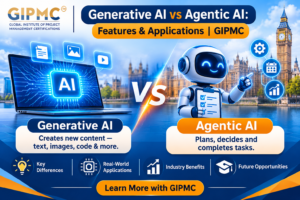
Generative AI vs Agentic AI influences how people work, learn, and decide. AI is becoming part and parcel of people’s lives by facilitating various activities, including composing written texts. Two types of AI that people should look out for are Generative AI and agentic AI.
Both generative and agentic AI use artificial intelligence (AI) but have different applications. It is important for students, professionals, and businesses to know the basics of Generative AI vs Agentic AI to understand their potential and embrace their benefits.
Let us look at their applications and differences with examples.
Explore Generative AI vs Agentic AI, their key features, real-world applications, industry benefits, and the future of artificial intelligence with GIPMC.
What Is Generative AI?
Generative AI is a kind of artificial intelligence that can produce new content. This new content can be in the form of text, images, videos, music, and computer codes.
Let us look at an example. Imagine a product marketer who wishes to create an Instagram post for a new product. They can use Generative AI to create an Instagram post for them.
Examples of its use are
- Writing articles, blogs, and other types of online content.
- Creating images and other designs.
- Handling customer service through chatbots.
- Assisting programmers with code.
- Utilizing generative AI in finance to perform document analysis and other financial activities.
Generative AI takes user commands and provides responses.
What Is Agentic AI?
Agentic AI is able to set and achieve goals and make decisions and can act in a specific way to complete a task. It can examine a situation and make decisions on what actions to take and what it has to do to achieve goals.
Let’s imagine an online shopping business where hundreds of orders are placed every day. An Agentic AI system can examine the orders to determine delivery delays and updates. It can coordinate different actions based on its permissions.
Frequent uses of agentic AI include:
- Automating business processes.
- Managing workflows and customer requests.
- Facilitating data analysis and helping in decision-making.
- Helping in business process management.
- Powering an AI-powered banking assistant to assist customers in more complicated banking tasks.
While an agentic AI system can make decisions in some cases, such as in business operations, sensitive situations require oversight by a person. For example, deciding whether or not to release funds in a financial situation requires human oversight.
Generative AI vs Agentic AI: Key Differences
Both technologies are useful, but their working approaches are different.
| Feature | Generative AI | Agentic AI |
| Main purpose | Creates new content | Completes specific goals |
| Working style | Responds to prompts | Plans and performs tasks |
| Decision-making | Primarily generates suggestions | Can make decisions within defined permissions |
| Human involvement | Usually requires user instructions | Can work with limited supervision |
| Example | Writing an email | Drafting, organizing, and sending an email with authorization |
In simple terms, Generative AI helps create something, while agentic AI helps get something done.
What are the uses of these technologies in different sectors?
Both technologies are gaining increasing adoption across industries.
1. Finance & Banking
Generative AI can evaluate financial documents, summarize reports, and support generative AI in finance. Agentic artificial intelligence can help with multi-step processes, like looking over transaction information and escalating anomalous activity for human investigation.
2. Security 3.
Generative artificial intelligence can help explain security alerts and help prepare reports. Agentic artificial intelligence is able to monitor selected security events, investigate suspicious patterns, and suggest or take approved actions. Professionals are able to understand these applications by learning through a relevant Cybersecurity Course.
3. Business & Education
Generative AI helps with content creation, learning materials, and research. Agentic AI is able to schedule, manage workflows, and coordinate tasks.
Why Should Professionals Be Aware of Generative AI and Agentic AI?
With artificial intelligence (AI) technology continuing to evolve, it is important for professionals to understand how these tools work and how to use them responsibly.
AI Governance is especially important as organizations need to deal with data privacy, transparency, security, and ethical concerns. AI governance officer: A person assigned specific responsibilities for AI governance, such as risk assessment, policy creation, compliance monitoring, and responsible AI deployment.
People interested in this field can explore AI Certification, Professional Courses, and online certifications to develop relevant knowledge.
For those looking to build their knowledge of Generative AI, GIPMC offers Generative AI Associate Professional (GAAP) certification. You can also explore AI governance risk and compliance certification pathways to build knowledge relevant for becoming an AI governance expert if you want to specialize even further.
Frequently Asked Questions (FAQs)
1. What’s the difference between Generative AI and agentic AI?
Generative AI produces content such as text, images, and code. Agentic AI is able to plan actions and carry out tasks to accomplish particular goals.
2. Can Generative AI and Agentic AI work together?
Yes. Generative AI is able to generate information or content. Agentic AI is able to use that information to do tasks and manage workflows.
3. Is Generative AI weaker than Agentic AI?
Agentic AI offers new capabilities for planning and taking action. But the two technologies have different roles and can work in concert.
4. What is the importance of AI governance?
AI Governance helps organizations manage risks related to privacy, security, transparency, fairness, and responsible AI usage.