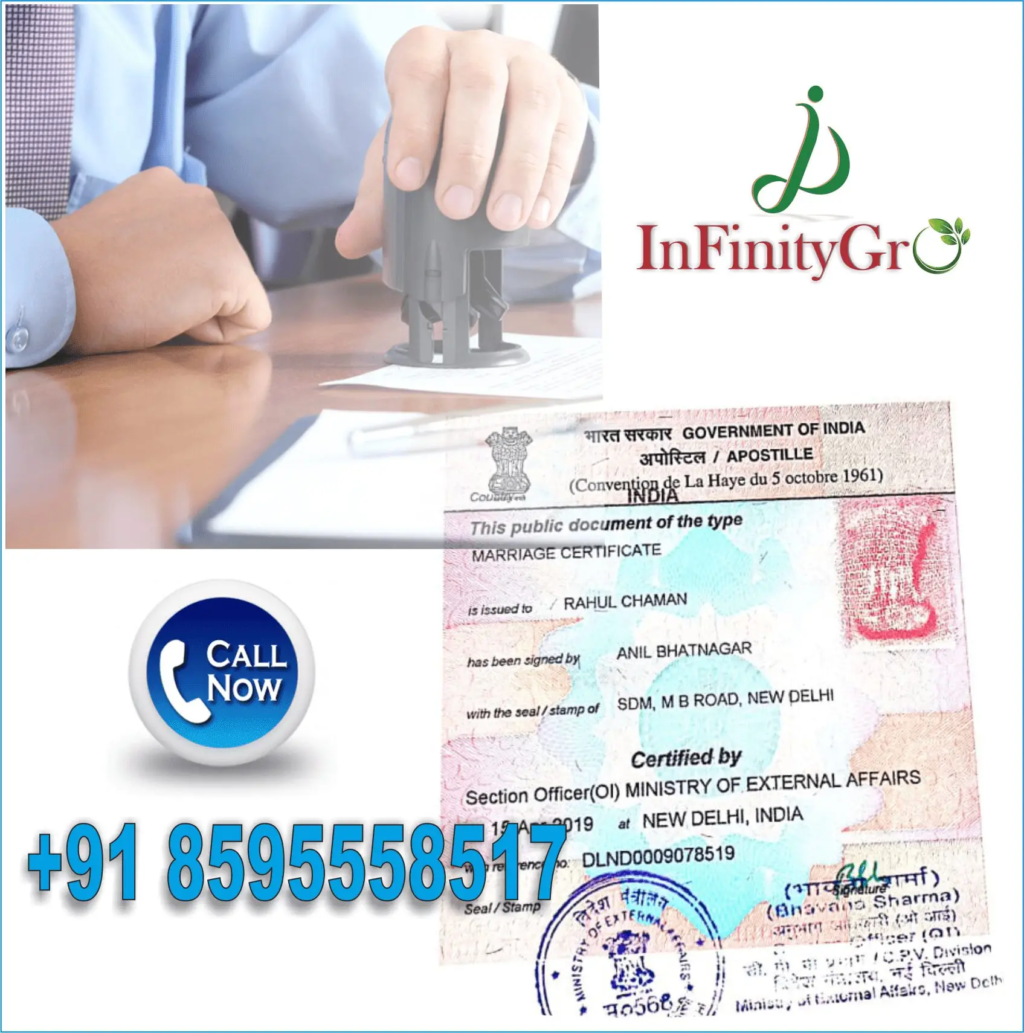
Marriage Certificate Apostille
Introduction
Marriage Certificate Apostille usually shows up when you’re already handling something bigger. Spouse visa. Family migration. Maybe dependent relocation for a job abroad.
At that point, you don’t want surprises. But this is exactly where many applicants get stuck.
Not because the process is complicated. It’s because the document itself often carries inconsistencies. Small ones. But enough to slow everything down.
So instead of repeating general definitions, this guide focuses on how Marriage Certificate Apostille actually works in India, where delays come from, and what you can control before submitting.
What Apostille Confirms for a Marriage Certificate
A marriage certificate proves a legal relationship. Apostille does not re-verify the marriage.
It only confirms that the issuing authority is valid and the document is authentic.
That means if there’s any mismatch in details, apostille won’t fix it. It will simply stop the process until the issue is resolved.
This is the first thing to understand.
Why Marriage Certificates Are More Error-Prone
Compared to documents like PCC Apostille or Degree Certificate Apostille, marriage certificates have more variables.
Two names. Sometimes changed after marriage. Sometimes formatted differently across documents.
Add to that variations in registration formats across states, and you get a document that often needs closer validation.
For example, applicants handling Marriage Certificate Apostille along with PCC Apostille Service in Tamil Nadu or Degree Certificate Apostille in Utter Pradesh often notice that the marriage certificate takes longer. This is not accidental. It’s due to detail verification.
Step-by-Step Process in India
The process begins with checking the issuing authority. The certificate must be issued by a recognized registrar.
Then comes state-level authentication. This confirms the document’s legitimacy before it moves forward.
After that, the document is submitted to the Ministry of External Affairs for apostille.
If the destination country is not part of the Hague Convention, the process does not end here. Embassy Attestation is required after authentication.
Each step depends on the previous one being accurate.
Where the Process Slows Down
Delays usually start with mismatched details.
Name differences between passport and certificate are the most common issue.
Sometimes the format of the certificate itself causes delays. Older certificates or non-standard formats may require additional validation.
Another trigger is unclear stamps or signatures.
Once any of these issues appear, the document is held for verification before moving to apostille.
Documents Required
Original marriage certificate is required.
Passport copies of both individuals are needed for identity matching.
In some cases, additional proof may be requested if there is inconsistency in details.
If you are submitting other documents like Birth Certificate Apostille or Degree Certificate Apostille in Uttarakhand, remember that each follows a separate verification route.
Timeline Based on Real Processing
If the certificate is clear, matches passport details, and is issued in a standard format, apostille can be completed within a few working days.
If verification is required, the timeline increases.
Applicants often compare timelines with PCC Apostille Service in Karnataka or PCC Apostille Service in Telangana, but those documents have fewer variables.
Marriage certificates require detail-level validation, which affects processing time.
Cost Factors Explained
Cost varies based on handling and urgency.
Standard timelines cost less.
Urgent processing costs more due to priority handling.
Additional verification steps may also increase cost.
There is no single flat rate for all cases.
Common Mistakes That Lead to Delays
Name mismatch is the most frequent issue.
Submitting a certificate that is not registered with a recognized authority creates immediate problems.
Using damaged or unclear documents can slow down verification.
Assuming apostille will fix document errors is another mistake.
It does not.
Practical Approach That Works
Check your certificate against your passport before applying.
Ensure names are consistent.
If the document is old or unclear, consider obtaining a fresh certified copy.
Understand whether your destination country requires apostille or Embassy Legalization.
If you’re handling multiple documents like Diploma Certificate Apostille or Marksheet Apostille, plan timelines separately.
Real Use Cases
Marriage Certificate Apostille is required for spouse visa applications.
It is also needed for family immigration and dependent visas.
In these cases, authorities require a verified proof of relationship that can be legally accepted.
That is why authentication becomes necessary.
Verification Logic Simplified
The system follows a simple rule.
If the document is clear and consistent, it moves forward.
If not, it pauses for verification.
That’s it.
Understanding this removes most of the confusion.
About INFINITYGRO
INFINITYGRO
C – 5 A/2 New Ashok Nagar, Delhi – 110096
Phone: +91 8595558517
FAQs
Why do marriage certificates take longer for apostille
Because they require detailed validation of names and issuing authority.
Can apostille correct errors in certificate
No, corrections must be done before submission.
Is a new certificate better for apostille
Yes, updated and clear documents are easier to process.
Do both spouses need to provide documents
Yes, identity verification requires both details.
Is apostille enough for all countries
No, some countries require Embassy Attestation instead.
Conclusion
Marriage Certificate Apostille in India is not difficult, but it is detail-sensitive.
Most delays come from mismatches and document format issues.
If your certificate is clear, consistent, and properly issued, the process moves smoothly.
If not, verification steps will slow things down.
Understanding this before applying helps you avoid delays and complete the process efficiently.