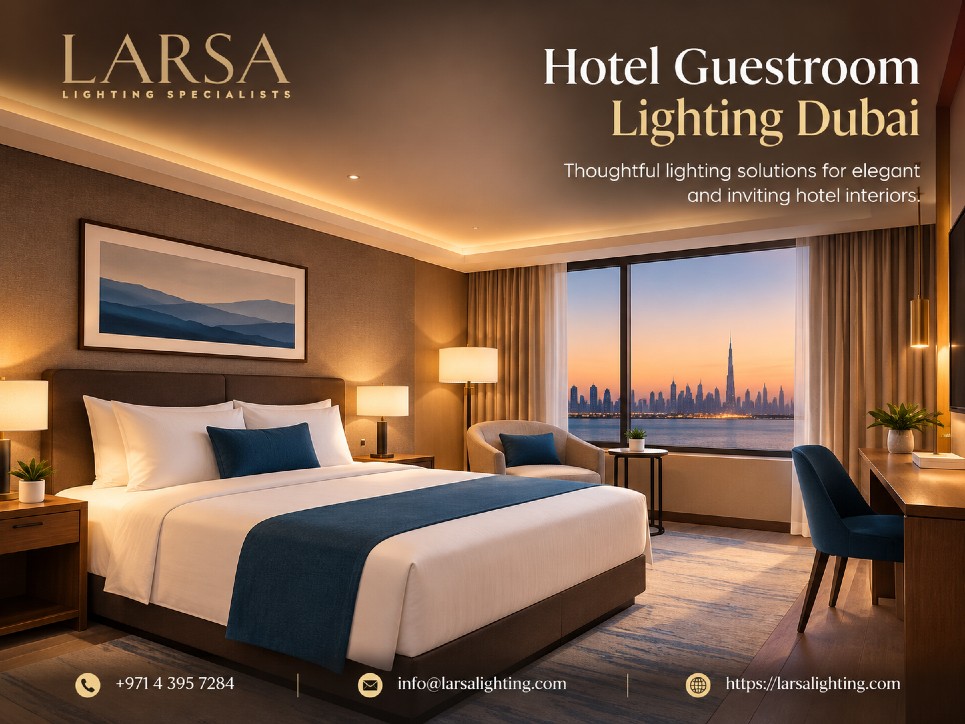
Hotel guestroom lighting plays an important role in shaping the comfort, functionality, and overall atmosphere of a hotel. In Dubai, where hospitality interiors range from contemporary business hotels to luxurious resorts, lighting must balance visual appeal with practical performance. A well-planned lighting scheme helps guests navigate the room, work comfortably, read in bed, and relax at the end of the day.
Hotel Guestroom Lighting Dubai solutions should consider the room layout, interior finishes, guest expectations, energy efficiency, and maintenance requirements. Instead of relying on a single decorative fixture, modern guestrooms benefit from layered lighting, intuitive controls, and carefully selected luminaires that support different activities throughout the day.
1. Create a Welcoming First Impression
The guest experience begins when someone enters the room. Entry lighting should provide sufficient visibility for guests to locate switches, access the wardrobe, and place their luggage without difficulty.
Recessed downlights, adjustable spotlights, and concealed LED strips can illuminate entryways and storage areas without overwhelming the interior. Their placement should prevent harsh shadows and direct glare.
For modern hotel interiors, lighting should complement the materials and architectural details. Warm illumination can enhance timber, textured wall panels, and natural stone, creating an inviting atmosphere. Decorative pendants or wall lights can add character when their brightness and placement are coordinated with the surrounding architectural lighting.
2. Use Layered Lighting for Greater Flexibility
A successful guestroom lighting plan combines multiple lighting layers rather than depending entirely on ceiling fixtures.
Ambient lighting provides general illumination for movement and everyday activities. Dimmable downlights and concealed linear LEDs are common options that create a balanced foundation.
Task lighting supports specific activities, including reading, working, and grooming. Adjustable bedside lights and desk luminaires provide focused illumination where it is needed.
Accent lighting highlights artwork, textured surfaces, headboards, and decorative features. Carefully directed spotlights or concealed LED strips add depth and visual interest.
Combining these layers allows guests to adjust the room to their preferences. This flexibility is particularly useful in Dubai hotels serving business travellers, families, and international visitors with different routines.
3. Choose Comfortable Light Colours and Quality
Colour temperature affects how a guestroom feels. Warm white lighting, typically around 2700K to 3000K, often works well in bedrooms because it creates a relaxed and comfortable atmosphere. A consistent colour temperature across coordinated fixtures helps maintain visual harmony.
Colour rendering is equally important. High-colour-rendering light, such as CRI 90 or above where appropriate, can help guests see clothing, skin tones, furniture finishes, and decorative materials more naturally.
The selection should also account for daylight entering through large windows, which are common in many contemporary hotel rooms. Lighting designers should evaluate how artificial light interacts with daylight at different times of day to avoid uncomfortable contrasts and uneven brightness.
4. Improve Bedside and Work Area Lighting
The bed and work desk require separate lighting considerations. Bedside reading lights should direct illumination onto a book or device without disturbing the person on the other side of the bed. Independent controls allow each guest to adjust their own light.
Wall-mounted reading lights and adjustable luminaires can be effective where space is limited. Positioning is essential: fixtures should be accessible from the bed while avoiding glare when guests are lying down.
For work areas, a dedicated task light can improve visibility for reading documents or using a laptop. The light should minimise reflections on screens and avoid creating strong shadows across the desk. In rooms designed for business travellers, the desk lighting should be considered alongside power outlets, furniture placement, and available natural light.
5. Integrate Smart Controls and Energy Efficiency
Modern Hotel Guestroom Lighting Dubai projects increasingly benefit from intuitive lighting controls. Simple switching and dimming arrangements allow guests to change the atmosphere without navigating complicated control panels.
Preset scenes can make everyday activities easier. An arrival scene can provide comfortable general illumination, while a relaxation scene can dim ambient lighting and retain soft accent light. A night-time setting can switch off unnecessary fixtures while maintaining a low-level route to the bathroom.
Energy efficiency is another important consideration. LED luminaires, suitable dimming systems, occupancy-based controls, and automatic shut-off functions can help reduce unnecessary electricity consumption.
However, energy-saving features should be designed around guest comfort. Control settings must be predictable, and lighting should not switch off unexpectedly while the room is occupied.
6. Consider Bathroom and Wardrobe Lighting
Bathrooms and wardrobes need dedicated lighting solutions because their functions differ from those of the sleeping area.
Mirror lighting should illuminate the face evenly and minimise shadows. Vertical lighting positioned beside the mirror can provide more balanced facial illumination than a single overhead downlight. Fixtures in showers and other moisture-exposed areas must have suitable protection ratings and comply with applicable electrical safety requirements.
Wardrobe lighting improves visibility when selecting clothes or using storage compartments. Integrated LED strips with door sensors can be practical, provided that wiring, heat management, driver access, and maintenance are considered during the design stage.
These details make the guestroom more convenient while supporting a consistent interior design.
7. Prioritise Maintenance and Long-Term Performance
Hotel lighting must withstand frequent use and remain straightforward to maintain. Selecting durable fittings, accessible LED drivers, compatible dimming equipment, and standardised components can simplify servicing and replacement.
Before installation across an entire property, a guestroom mock-up allows designers, operators, and contractors to assess brightness, glare, colour consistency, switching logic, and the appearance of materials under actual lighting conditions.
Larsa Lighting approaches hospitality lighting as a combination of technical planning and design coordination. By considering architectural fixtures, decorative luminaires, concealed lighting, and control systems together, projects can achieve a cohesive result that supports both guest expectations and operational needs.
Conclusion
Well-designed hotel guestroom lighting combines comfort, functionality, visual consistency, and energy efficiency. From welcoming entryways to precise bedside lighting and practical bathroom illumination, every layer should serve a clear purpose.
For hotel owners, designers, and consultants, the key is to coordinate fixtures, controls, finishes, and maintenance requirements early in the project. With thoughtful planning, Hotel Guestroom Lighting Dubai solutions can create modern rooms that feel inviting, work efficiently, and provide guests with a comfortable stay.