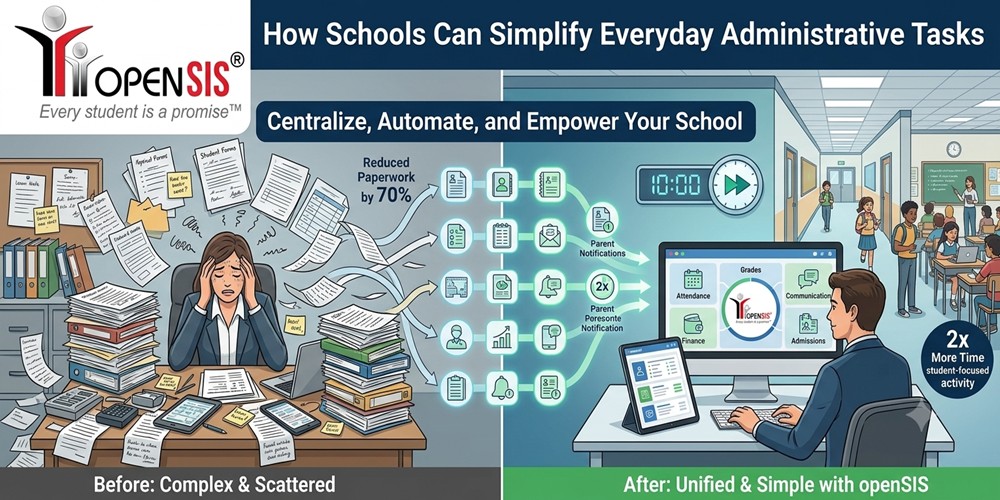
Discover how schools can simplify everyday administrative tasks with a modern SIS. Streamline student records, attendance, scheduling, reporting, communication, and more.
Running a school is not only about teaching and lessons. It seems so from a distance. However, school operations encompass a larger parameter that covers more than classroom studies. Since the morning, administrators and operations staff members labor over student data, student records, and schedules to make the school operate without any hassle. Schools that are operating without School ERP for Private Schools, often face a huge workload at the end of the school term. It is the time when everything receives a deadline, and everything becomes urgent. This is why, as school terms near the final exam date, everyone begins to prepare for the usual chaos to break free.
While this normalization of hassle has been going on for a long time, the modern era, dominated by AI and digitization, demands something better, something that will erase the delays and confusion. However, you must understand that better does not mean complex or expensive. In fact, a better solution will never overcomplicate the operations. A modern Student Management Platform like openSIS can bring a set of features that will reduce repetitive tasks and free your teachers to manage the students. Simplification is the main objective of any software implementation.
What Challenges Schools Are Facing?
Operational challenges don’t build in one day. They develop with time. The gradual building often goes unnoticed due to the lack of urgency at the beginning. People tend to overlook the first delay or the one missing piece of information. However, with time, that one piece of information often turns into a pile of files. You can try to sort things out with –
- Proper spreadsheets for attendance tracking
- Paper files for enrollment documentation
- Email threads for communication with parents and other departments
If you look closely, you will see that each one of these tools solves some major problem. Indeed, these are powerful enough to support your school operations. However, for smoother operations, a digital tool may prove to be a bigger support. If you don’t manage them carefully, they will end up scattering your whole data system.
And when the school year ends, you will run around looking in different places for one single piece of data. That’s not how modern schools should operate, because a lot has changed during the past few years. You need a sleek digital tool like a Student Management Platform to run your administrative system.
Manual systems not only create data fragmentation, but they also create unnecessary data entry work.
- Teachers mark the attendance, then enter the data in a spreadsheet
- The finance team signs a form, then enters the data in software
- Administrators then copy the same data into their master files
- School management often copies the master file and creates a separate file
So, you see, it is like a cycle, constantly evolving around the same task. This is why modern systems see the need to include a digital platform that reduces the need to perform repetitive tasks.
However, this does not mean including complex software with heavy installation requirements. These systems add to the complexities of the operation. A software may offer a long list of features. But if you need extensive training sessions to use those software systems, you are going to lose valuable time. The idea is to make your staff members comfortable with the set of work, not to overwhelm them with expensive digital tools.
Outdated tools bring their own set of challenges. These systems may not offer you real-time data access or flexible reporting. These systems will not be able to accommodate the expansive nature of the education landscape.
What Modern Student Information System Brings
Modern student information systems come with various features. Most of these features are for removing repetitive tasks from the administrators and teachers. Imagine how far your education process can go if you just give the teachers some extra hours to spend with students or create courses.
Modern SIS brings three excellent features that can transform your whole management system and support your strategic growth.
- Data centralization
- Automated reporting
- Real-time data visibility
These features may look simple, but when put together, they can streamline your workflow and support the growth of your institute. Consider this –
- You no longer have to run around looking for data
- You no longer have to wait for hours to create a report
- You no longer have to wait for data verification to make a decision
These three features, teamed with others like communication and data analysis, can help you create personalized educational experiences for students and less repetitive tasks for administrators. A well-implemented School ERP for Private Schools can bring transformation through automation.
Lastly,
School ERP for Private Schools reduces repetitive data entry by automating the data storage process. School ERP system makes data visibility easier as well. You can access stored data anytime you want for strategic decision-making. However, this does not mean everyone can see everything. Modern SIS platforms like openSIS filter data access authorization for security reasons.
FAQ
1.What is a Student Information System?
A Student Information System centralizes student and administrative data to simplify school operations.
2. How can an SIS reduce administrative workload?
It automates and streamlines repetitive tasks such as attendance, record management, and reporting.
3. What are the problems with manual school administration?
Manual processes can consume staff time, create data-entry errors, and make information difficult to access.
4.How does a Student Management Platform improve data management?
It keeps essential student information organized and accessible through a centralized platform.
5. Can an SIS simplify attendance management?
Yes, schools can digitally record, access, manage, and report attendance more efficiently.
6.How can a School ERP for Private Schools improve efficiency?
It connects core administrative processes and reduces the need to manage information across disconnected systems.
7.Can an SIS improve school reporting?
Yes, centralized data makes it easier for administrators to access information and generate useful reports.
8.Why should schools replace outdated software?
Modern systems can provide better usability, accessibility, reporting, and support for connected workflows.