Search for an Opia kratom tablets review and you’ll find two kinds of pages: hype and panic. Neither helps much if you’re trying to decide whether a product is worth buying.
Opia tablets sit in one of the most closely watched corners of the kratom market. Some Opia products are standard kratom extracts. Others are built around concentrated 7-hydroxymitragynine, usually shortened to 7-OH. That difference matters for quality, safety and, increasingly, legality.
This guide gives you a practical checklist. You’ll learn what Opia is, how to read a label, which questions to ask any seller, and what the current U.S. rules look like.
What Is Opia? A Quick Answer
Opia is a kratom-based brand that sells tablets, shots and related products. Its lineup has included chewable extract tablets as well as formulas built around concentrated 7-OH. One independent review describes blister packs of four tablets at 150 mg of extract each, alongside isolated 7-hydroxymitragynine formulas and liquid shots. Formulas change, so always go by the label on the pack in your hands.
If you’re asking “what is Opia” because you saw a friend’s pack or an online ad, the key point is this. “Opia” is a brand name, not a single product. Two Opia packs can have very different alkaloid profiles, so the product name and lab report matter more than the logo.
What Is 7-OH, and Why Does It Come Up in Every Opia 7OH Review?
7-OH is an alkaloid that occurs naturally in kratom leaf, but only in tiny amounts. Products sold as “7-OH tablets” contain far more than the leaf does. FDA has said that 7-OH products have not shown premarket safety, and the agency stated there are no FDA-approved 7-OH drugs, that 7-OH isn’t lawful in dietary supplements, and that it can’t be lawfully added to conventional foods.
Any honest Opia 7OH review has to start there. It’s a potent compound, and it deserves more caution than ordinary leaf powder or capsules.
Opia Kratom Tablets Review: 7 Tips Before You Buy
We’re a retailer, and we won’t pretend to give you lab results we haven’t run. What follows is the checklist we’d use to evaluate any tablet. The seven tips are in the order we think they matter.
Tip 1: Identify Exactly Which Opia Product You’re Looking At
Start with the product page, not the brand. Is it a standard kratom extract tablet, a 7-OH tablet, or a blend? Many opia tablets reviews online lump everything together, which makes them unreliable. A glowing comment about one formula tells you nothing about another.
Write down the full product name, flavor, tablet count and milligrams per tablet before you compare prices.
Tip 2: Ask for a Current Certificate of Analysis (COA)
A COA is a third-party lab report. It should list the batch number, the lab’s name, the date and the alkaloid results. Here is what a trustworthy one looks like:
- Batch match: The batch number on the report matches the number on your pack.
- Recent date: Reports older than a year deserve a question.
- Independent lab: The lab isn’t owned by the brand.
- Contaminant screening: Heavy metals, microbes and pesticides are tested, not just alkaloids.
If a seller can’t produce one, move on.
Tip 3: Read the 7-OH and Alkaloid Numbers Carefully
Look at the mitragynine and 7-OH percentages. A 2025 study cited by the same Opia review found that many “kratom extract” products carry 7-OH levels that don’t match natural leaf chemistry, which suggests the compound was added or concentrated.
Check the COA for mitragynine pseudoindoxyl (MGPI) as well. DEA temporarily placed MGPI, MGM-15 and MGM-16 into Schedule I on August 26, 2026. A product containing those compounds is a problem, whatever the label says.
Tip 4: Compare Price per Tablet, Not Price per Pack
A $15 pack of four and a $30 pack of ten aren’t priced the same way. Divide the cost by the tablet count, then by the milligrams if the label lists them. Be wary of prices far below the market. Cheap tablets often mean skipped testing.
Tip 5: Buy From a Retailer With Clear Policies
Look for visible contact details, a shipping policy, a return policy and age verification. At KratomPoint, for instance, orders ship in plain packaging through USPS, and checkout is restricted in states where kratom is regulated. A seller that ships everywhere without asking questions is a red flag, not a perk.
Tip 6: Respect Your Own Limits
Follow the label’s serving guidance and don’t stack products. Tablets are easy to take mindlessly, because they’re small and flavored. Concentrated products can build tolerance quickly, and some people report dependence. FDA hasn’t approved any kratom product for treating any condition, so don’t buy one to self-treat pain, anxiety or withdrawal. Talk to a licensed healthcare provider for that.
Kratom isn’t for anyone under 21 (or the minimum age in your state), pregnant or nursing people, or anyone mixing it with alcohol, opioids or sedatives.
Tip 7: Check Your State’s Law Before You Click “Buy”
This is the tip that changes fastest, so it gets its own section below.
Is Opia Legal in the U.S.? Where Things Stand
Short answer: it depends on the product and your state.
Federal level. Natural kratom leaf isn’t federally scheduled. For 7-OH, the picture is moving. As of October 22, 2026, 7-OH was not federally scheduled, and DEA filed a new notice of intent after an updated HHS recommendation, with the earliest possible new order date of November 13, 2026. If DEA issues that order, concentrated 7-OH above the stated threshold would become Schedule I, which would directly affect Opia’s 7-OH products.
State level. Rules vary widely. As of July 2026, nine states ban kratom outright: Alabama, Arkansas, Connecticut, Indiana, Kansas, Louisiana, Tennessee, Vermont and Wisconsin. Others restrict concentrated 7-OH specifically while leaving leaf products legal, and the list keeps growing.
What to do: Check your state’s attorney general or pharmacy board website the day you order. Don’t rely on a blog post, including this one, because laws can change within weeks.
How Opia Compares With Standard Kratom Products
People often ask whether Opia is “stronger” than ordinary kratom. In general, concentrated extracts and 7-OH tablets deliver much more of the active alkaloid per serving than leaf powder or capsules. That’s the appeal, and it’s also the reason for the added caution.
A simple way to think about it:
- Leaf powder or capsules: Lowest concentration, long history of use, least regulatory scrutiny.
- Extract tablets or shots: Higher concentration, standardized to certain alkaloids, more variation between brands.
- 7-OH-enriched tablets: Highest potency, most regulatory attention, and the greatest need for lab proof.
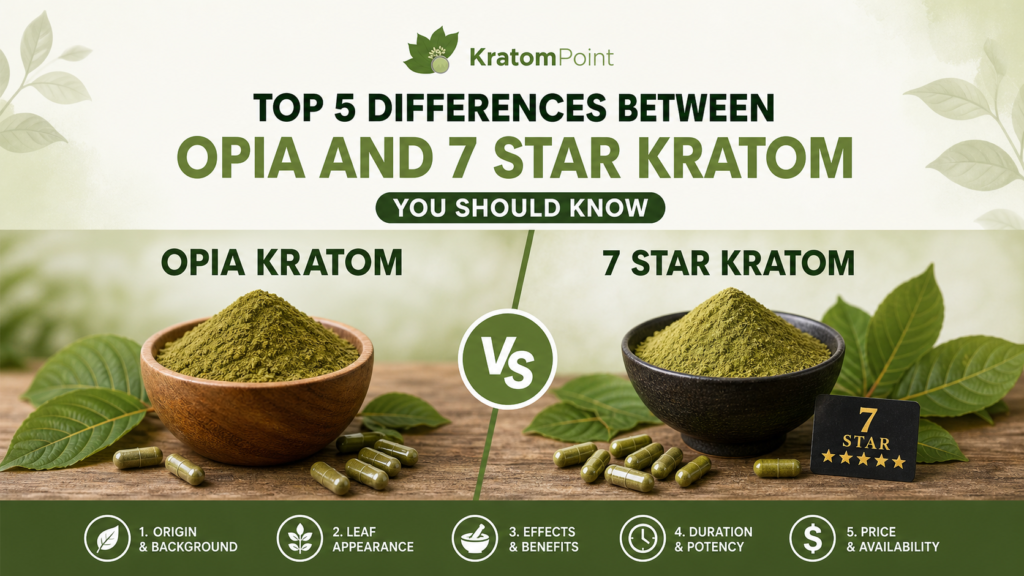
If you’re new to kratom, starting at the leaf end and working your way up is the more conservative path. For a comparison with another popular brand, see our guide on the top 5 differences between Opia and 7 Star kratom.
Red Flags to Walk Away From
Skip any listing that shows one or more of these:
- Health claims such as “treats pain” or “helps you quit opioids”
- No batch number, or a COA that doesn’t match the pack
- No age verification at checkout
- Unusually low prices and no return policy
- Vague ingredient lists that skip the milligram amounts
Frequently Asked Questions
What is Opia kratom?
Opia is a kratom brand that sells tablets, shots and other formats. Some of its products are standard extracts, and others are built on concentrated 7-OH. Read the specific product label and COA before you buy.
Are Opia tablets safe?
No kratom product is risk-free, and FDA hasn’t approved kratom or 7-OH for any medical use. Concentrated 7-OH products carry the most risk, including tolerance and dependence. Use only as labeled, avoid mixing with other substances, and speak with a healthcare provider if you have health conditions or take medication.
Is Opia 7-OH legal?
Not in every state. As of late October 2026, 7-OH wasn’t federally scheduled, but DEA had a notice of intent pending and some states already restrict it. Confirm both federal and state rules on the day you order.
How do I know if an Opia tablet is real?
Match the batch number on the pack to a third-party COA, buy from an established retailer, and be skeptical of social media sellers or marketplace listings with no paperwork.
Do Opia tablets work better than regular kratom?
They’re more concentrated, so effects are typically stronger per serving. “Stronger” isn’t automatically “better,” because potency raises the stakes on dosing, quality and legality.
Final Thoughts: Choose Slowly, Verify Everything
A good Opia kratom tablets review shouldn’t push you toward a purchase. It should help you ask better questions: which exact product is this, what does the lab report say, is it legal where I live, and am I using it responsibly?
If the answers are clear, you can buy with confidence. If they aren’t, wait. Shipping delays cost you a few days, but a bad batch costs more.
Ready to shop with a seller that values transparency? Browse the kratom tablets collection at KratomPoint, or contact our support team at 866-455-5728 (Monday to Friday, 10 am to 4 pm CST) with questions about lab reports, shipping or state restrictions. If you or someone you know is struggling with kratom use, SAMHSA’s free helpline at 1-800-662-4357 can point you toward support.
This article is for educational purposes only and isn’t medical or legal advice. These statements have not been evaluated by the FDA, and kratom products aren’t intended to diagnose, treat, cure or prevent any disease.