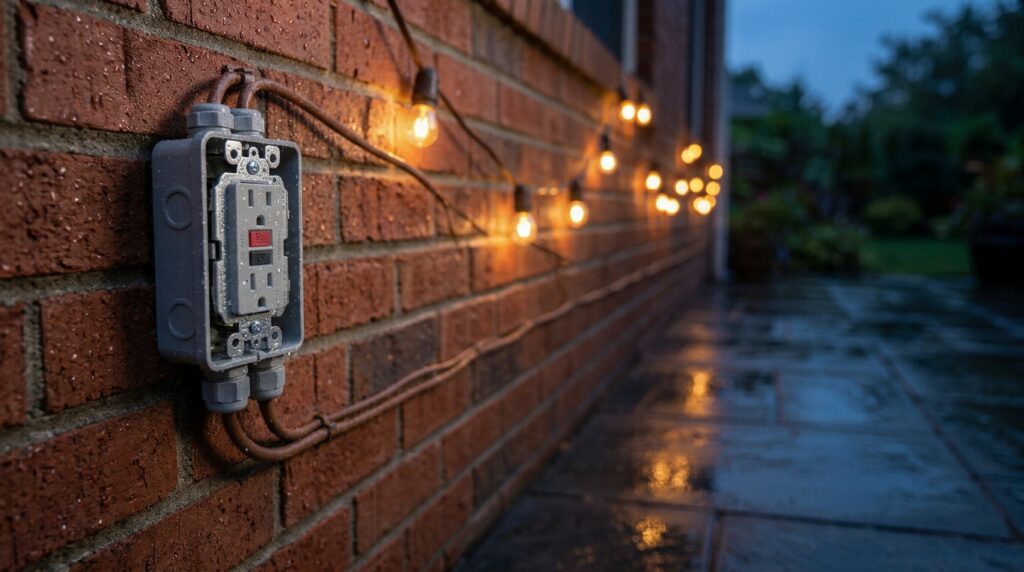
Weather-resistant GFCI outlet with a closed in-use cover on a wet brick patio wall at dusk, a reminder when installing ground fault circuit interrupter outlets outdoors
Most people don’t think about ground fault protection until something goes wrong or an inspector points at a bare outlet. The idea is easier to understand through situations than through definitions. So instead of a technical walkthrough, here are seven ordinary moments where installing ground fault circuit interrupter outlets makes a real difference, followed by what the job involves and when to hand it to a professional.
This article is general information, not a wiring manual. Local code, the manufacturer’s instructions, and a qualified electrician’s judgment always come first.
The One-Minute Version
A ground fault circuit interrupter (GFCI) outlet compares the electricity going out with the electricity coming back. If some goes missing, it may be flowing through water, a damaged appliance, or a person. The outlet reacts by cutting power very quickly. It is designed to protect people, which is a different job from the breaker’s job of protecting wiring from overloads.
Scenario 1: The Wet-Handed Phone Charger
You’re rinsing dishes, your phone hits 3%, and you plug the charger in at the nearest outlet without drying your hands. It happens daily in kitchens. A GFCI receptacle is there for the moment something goes wrong, not for careful moments.
Scenario 2: The Dropped Hair Dryer
Bathrooms combine small appliances, wet surfaces, and bare feet. If a plugged-in dryer slips into water, fast ground fault detection is exactly what these devices exist for. This is why bathroom GFCI outlets are among the most widely expected installations in homes.
Scenario 3: The Garage Freezer and the Leaky Floor
Garages tend to collect extension cords, a second fridge, and the occasional puddle. Concrete floors conduct well when damp. Outlets in these spaces are worth checking, particularly in older homes where standard receptacles were common.
Scenario 4: The Holiday Lights in the Rain
Outdoor outlets live a hard life. Sprinklers, storms, and seasonal cords all test them. Outdoor GFCI receptacles should be weather-resistant and paired with a cover suited to the location, because a protective device behind a cracked or missing cover won’t last long.
Scenario 5: The Basement Workshop
Power tools plus a damp lower level is a classic combination. If you use a table saw or sander near an unfinished basement wall, check whether the outlet feeding it offers ground fault protection, and test it before you start.
Scenario 6: The Outlet That Won’t Reset
You press RESET and nothing happens, or it trips the moment you plug something in. Sometimes the device has worn out. Sometimes the cause is moisture, a faulty appliance, or a wiring problem. Replacing the outlet again and again can hide a real fault, so persistent tripping is a good reason to call a professional.
Scenario 7: The Home Inspection Surprise
Buyers and sellers often meet GFCI questions during inspections. A report may note missing protection in a bathroom, garage, or exterior outlet. That is a useful prompt to learn what you have, rather than a reason to rush into repairs.
What the Job Actually Involves
Here is the high-level picture, which applies whether you do the work or watch someone else do it:
- Confirm the circuit. Panel labels are often wrong, so the right breaker has to be verified.
- Turn the power off and prove it’s off. A qualified person uses a proper tester, checked on a known live source first.
- Understand the wiring before changing it. Incoming power and downstream outlets connect to different terminals, and mixing them up can leave an outlet powered but unprotected.
- Choose the right device. Amperage, weather resistance for outdoor and damp locations, and box size all matter.
- Install it per the manufacturer’s directions, with secure terminals and no overstuffed box.
- Test the result with the built-in TEST and RESET buttons and a receptacle tester.
Electrical mistakes can cause shock, burns, or fire, and they don’t always show up right away. Never work on an energized circuit.
Quick Self-Check: DIY or Pro?
Ask yourself honestly:
- Can I identify the correct circuit and verify it’s dead?
- Do I understand the difference between the incoming and downstream connections?
- Does my local area require a permit or a licensed professional?
- Is the wiring modern and in good condition, with a ground wire present?
If any answer is “no” or “not sure,” hire a licensed electrician. The same goes for aluminum wiring, scorch marks, new circuits, outdoor work, or a device that keeps tripping.
After Installation: Habits That Keep It Working
- Test GFCI outlets regularly, often monthly, following the manufacturer’s instructions.
- Check outdoor units after storms.
- Replace any device that fails to trip, won’t reset, or looks damaged.
- Don’t tape over or disable a device that trips often. Find out why.
Fast Answers
1.Does a GFCI replace a ground wire?
No. It can improve shock protection in some situations, but it doesn’t create a ground.
2.Will one GFCI protect other outlets?
It can, depending on how the circuit is wired, so confirm it by testing or with an electrician.
3.Is a GFCI the same as a circuit breaker?
No. A breaker guards against overloads and short circuits, while a GFCI is built to catch leakage that can injure people.
4.Do I need a permit?
It depends on your location and the scope of the work, so check with your local building authority.
Final Thoughts:
The seven scenarios above share one thing: they are ordinary moments, not rare accidents. Installing ground fault circuit interrupter outlets is about protecting those moments, in the rooms where water, tools, and electricity share space. Walk through your home, test the GFCIs you have, and note any outlet that looks old, damaged, or unprotected. If anything is unclear, bring that list to a qualified electrician.
Bobs Electrical Services
100 Main Street, Suite A Birmingham, Alabama (AL), USA 35203
24 Hour Emergency Services
+1 (888) 217-2561
https://www.bobselectricalservices.com