LED lights have become an important part of modern lighting because they provide bright illumination while using less energy than many traditional lighting technologies. From homes and offices to warehouses, parking areas, streets, retail stores, and industrial facilities, LED lighting can support a wide range of everyday and commercial applications.
The growing demand for efficient lighting has encouraged businesses and property owners to replace older lighting systems with LED solutions. Better energy efficiency, long operating life, flexible designs, and improved lighting performance make LEDs a practical option for many environments.
What Are LED Lights?
LED stands for Light Emitting Diode. Unlike traditional incandescent bulbs that produce light by heating a filament, LEDs create illumination when electrical current passes through a semiconductor material.
This technology allows LED fixtures to produce light efficiently while generating considerably less heat. LEDs are available in many shapes, sizes, wattages, color temperatures, and fixture designs, making them suitable for both small and large lighting projects.
Modern LED products can be designed for general illumination, focused lighting, decorative applications, outdoor areas, industrial spaces, and specialized commercial environments.
Why LED Lighting Is Becoming Popular
One of the biggest reasons for the popularity of LED lighting is energy efficiency. Lighting can contribute significantly to electricity consumption in commercial and industrial properties. Switching to efficient LED fixtures can help reduce the amount of electricity required to achieve suitable illumination.
LED lights also provide consistent performance and are available in different brightness levels. This allows users to select lighting based on the size and purpose of a particular area.
Another advantage is the variety of available designs. LED technology is used in bulbs, tubes, panels, flood lights, high bay fixtures, wall packs, canopy lights, street lights, and many other products.
Energy Efficiency of LED Lights
Energy consumption is an important consideration when selecting lighting for a building or outdoor area. LED fixtures are designed to convert a greater portion of electrical energy into useful light compared with many older lighting technologies.
Lower energy consumption can be especially valuable in facilities where lights operate for extended periods. Warehouses, offices, parking lots, factories, retail spaces, and outdoor areas may require lighting for many hours each day.
Choosing an appropriately rated LED fixture can help provide the required brightness without unnecessarily increasing electricity usage.
Long Operating Life
LED lights are also known for their long operating life. A quality LED fixture can operate for many thousands of hours, depending on its design, operating conditions, thermal management, and usage.
A longer service life can reduce the frequency of replacements. This is particularly useful in locations where changing fixtures is difficult, expensive, or requires specialized equipment.
For example, high-mounted fixtures in warehouses or industrial buildings may require lifts or maintenance equipment for replacement. Longer-lasting lighting can help reduce maintenance interruptions.
Different Types of LED Lights
LED technology is available in many fixture categories. Each type is designed for particular lighting requirements.
LED Bulbs
LED bulbs are commonly used in homes, offices, stores, and other general-purpose applications. They are available in different shapes, bases, wattages, and color temperatures.
They can replace many conventional bulbs while providing efficient illumination for everyday spaces.
LED Tube Lights
LED tube lights are frequently used in offices, schools, workshops, retail stores, garages, and commercial buildings. They are commonly designed to replace traditional fluorescent tubes.
Their linear shape makes them suitable for fixtures that require broad and even illumination.
LED Panel Lights
LED panel lights are popular in offices, classrooms, hospitals, retail environments, and modern commercial interiors. Their slim construction provides a clean appearance while distributing light across a relatively wide area.
Panel lights are often selected for spaces where uniform ceiling illumination is important.
LED Flood Lights
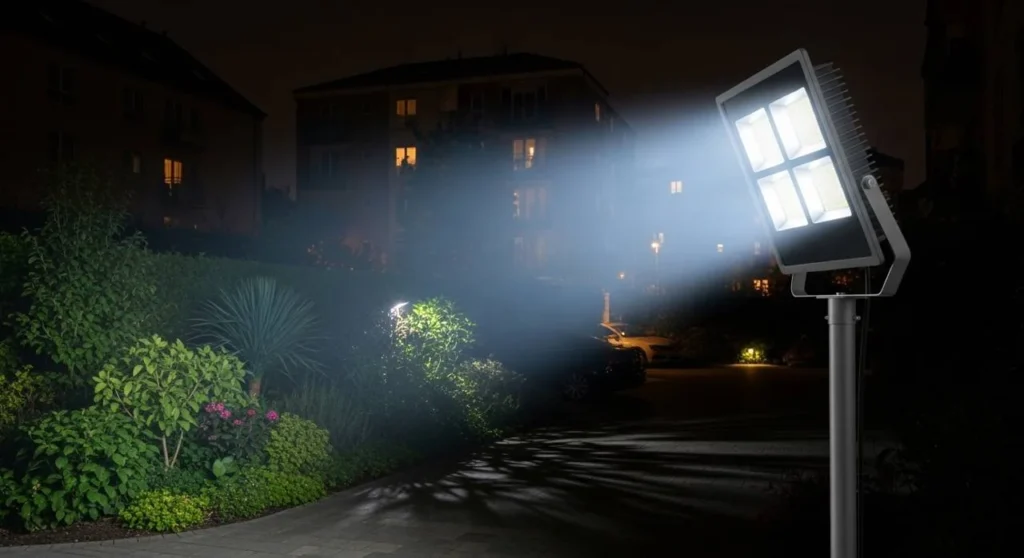
LED flood lights are designed to illuminate large outdoor or indoor areas. They can be used for building exteriors, warehouses, sports areas, construction sites, parking areas, and security lighting.
Flood lights are available in different beam angles and wattages, allowing users to choose a configuration based on the required coverage.
LED High Bay Lights
High bay LED lights are designed for areas with high ceilings, such as warehouses, factories, distribution centers, and industrial facilities.
Because these spaces require strong illumination from significant mounting heights, high bay fixtures are engineered to deliver substantial light output while maintaining efficient operation.
LED Canopy Lights
LED canopy lights are commonly installed under covered structures such as parking garages, gas station canopies, building entrances, and covered walkways.
They provide downward illumination and can improve visibility in areas that need dependable lighting throughout the day or night.
LED Wall Pack Lights
LED wall pack fixtures are generally mounted on exterior walls to illuminate pathways, building perimeters, entrances, loading areas, and other outdoor spaces.
Their directional illumination can help improve visibility around commercial and industrial properties.
LED Shoebox Lights
LED shoebox lights are commonly used for parking lots, roadways, campuses, commercial properties, and outdoor areas.
Their fixture design allows lighting professionals to direct illumination across parking spaces, driveways, and pedestrian areas while selecting appropriate mounting heights and distributions.
LED Lights for Commercial Buildings
Commercial buildings often require reliable lighting throughout working hours. Offices, stores, restaurants, warehouses, and service facilities may have different lighting requirements depending on their layouts and activities.
LED lighting can be selected according to ceiling height, room dimensions, desired brightness, color temperature, and operating schedule.
For example, an office may benefit from uniform panel lighting, while a warehouse may require high bay fixtures. Exterior walls can use wall packs, while parking areas may use shoebox fixtures.
Using the appropriate fixture for each application can improve lighting performance and avoid unnecessary energy consumption.
LED Lighting for Industrial Facilities
Industrial environments often require durable and powerful lighting. Factories, workshops, warehouses, and manufacturing facilities may have high ceilings, large floor areas, machinery, storage racks, and demanding operating schedules.
LED industrial lighting can provide high levels of illumination while supporting long operating periods. High bay fixtures are particularly useful for high-ceiling spaces because they can deliver substantial light output from elevated mounting positions.
The fixture should be selected based on mounting height, required illumination, beam distribution, environmental conditions, and the nature of the work performed in the area.
Outdoor LED Lighting
Outdoor lighting serves many purposes, including visibility, navigation, property illumination, and general safety.
LED technology can be used for parking lots, pathways, building exteriors, loading areas, streets, campuses, and public spaces.
Outdoor fixtures should be selected according to environmental exposure. Weather-resistant construction, suitable ingress protection, mounting requirements, and appropriate light distribution can all influence the performance of an outdoor lighting installation.
Choosing the Right LED Light
Selecting an LED fixture involves more than simply comparing wattage. Several specifications should be considered.
Lumens
Lumens indicate the amount of visible light produced by a fixture. A higher lumen rating generally means greater light output.
When replacing an older fixture, comparing lumens can provide a more useful indication of brightness than comparing wattage alone.
Color Temperature
Color temperature is measured in Kelvin and describes the appearance of the light.
Lower Kelvin values generally produce warmer-looking light, while higher values create cooler or daylight-like illumination.
Warm lighting can work well in comfortable indoor environments, while cooler lighting may be preferred in offices, workshops, warehouses, and certain outdoor applications.
Beam Angle
Beam angle determines how widely light is distributed. A narrow beam can concentrate illumination in a smaller area, while a wider beam can cover more space.
Choosing the correct beam distribution is important for achieving consistent illumination without excessive dark or overly bright areas.
Color Rendering
Color rendering describes how naturally objects appear under a particular light source. A higher Color Rendering Index, commonly called CRI, generally indicates that colors appear more naturally under the light.
This can be especially important in retail stores, workshops, design spaces, and environments where accurate color recognition matters.
Wattage
Wattage represents the electrical power consumed by the fixture. It should not be considered independently from lumen output.
Two fixtures with the same wattage may have different light outputs depending on their design and efficiency. Comparing wattage alongside lumens provides a better understanding of performance.
Installation and Maintenance
Proper installation is important for achieving reliable LED performance. Fixtures should be installed according to the manufacturer’s specifications and connected to compatible electrical systems.
Thermal management is another important consideration. Although LEDs generally produce less heat than many conventional lighting technologies, heat still needs to be managed properly. Quality fixtures typically incorporate appropriate heat sinks or thermal designs.
Regular inspection can also help identify damaged fixtures, loose connections, dirt accumulation, or other issues that could affect lighting performance.
LED Lights and Sustainability
Energy-efficient lighting can contribute to lower electricity consumption, which can support broader energy management goals. Longer service life can also reduce the frequency of fixture replacement.
Businesses seeking to improve operational efficiency may consider LED upgrades as part of a broader building improvement strategy. Lighting controls, occupancy sensors, daylight harvesting, and scheduling can further improve energy management when they are compatible with the lighting system.
The Future of LED Lighting
LED technology continues to develop as manufacturers improve efficiency, optical performance, controls, and fixture design.
Smart lighting systems can provide additional control through sensors, timers, dimming systems, and network-connected solutions. These technologies can allow lighting to respond to occupancy, schedules, or environmental conditions.
As commercial and industrial facilities continue to focus on efficient building operations, LED lighting is likely to remain an important part of modern lighting infrastructure.
Conclusion
LED lights offer a versatile solution for residential, commercial, industrial, and outdoor lighting applications. Their energy efficiency, long operating life, flexible designs, and wide range of available fixture types make them suitable for many different environments.
From LED bulbs and tube lights to flood lights, high bays, canopy fixtures, wall packs, and shoebox lights, each product category serves a specific purpose. Choosing the right fixture requires careful consideration of lumens, wattage, color temperature, beam angle, installation height, environmental conditions, and the intended application.
With proper product selection and installation, LED lighting can provide dependable illumination while supporting efficient and practical lighting management for years to come.