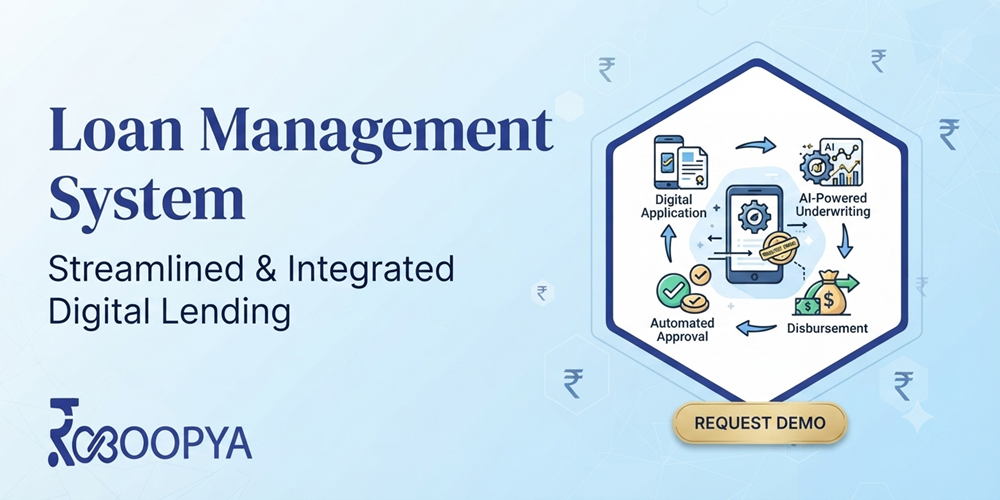
What is a Loan Management System and why do banks & NBFCs need one in 2026? Explore features, benefits, RBI compliance, and how to choose the right LMS.
Lending has changed faster in the last five years than in the previous twenty. Borrowers now expect a loan decision in minutes, not weeks. Regulators expect every rupee disbursed to be traceable, auditable, and reported on time. And lenders — whether a public sector bank, a small-town cooperative bank, or a fast-growing NBFC — are expected to do all of this at scale, without ballooning headcount or operational risk.
A Loan Management System (LMS) is the piece of technology infrastructure that makes this possible. It is the software backbone that tracks a loan from the moment it is disbursed to the day it is fully repaid (or written off), and increasingly, it is being asked to do a lot more than that — credit monitoring, collections, regulatory reporting, and portfolio analytics, all in one place.
This guide walks through what a Loan Management System actually does, why manual or fragmented processes fall short, the features that matter in 2026, and how a bank or NBFC should go about choosing one.
What Is a Loan Management System?
A Loan Management System is a software platform that automates and manages the entire post-disbursement lifecycle of a loan. Once a loan origination system (LOS) has approved and disbursed a loan, the LMS takes over — generating repayment schedules, tracking EMI collections, calculating interest and penalties, managing renewals or restructuring, handling delinquency and recovery workflows, and producing the reports lenders need for internal decision-making and regulatory compliance.
In simpler terms: if the Loan Origination System is responsible for deciding whether to lend and how much, the Loan Management System is responsible for everything that happens after the money leaves the lender’s account.
For decades, many smaller lenders in India managed this process through a combination of core banking modules, spreadsheets, and manual follow-ups by branch or field staff. That approach breaks down quickly once loan volumes grow, products diversify, or a regulator asks for a portfolio-level audit trail. A purpose-built LMS exists precisely to remove that fragility.
The Loan Lifecycle a Modern LMS Manages
To understand why an LMS matters, it helps to walk through the stages of a loan’s life that the system is responsible for:
- Loan Account Setup — Once a loan is approved, the LMS creates a digital loan account, capturing the sanctioned amount, tenure, interest rate, repayment structure, and applicable charges.
- Repayment Scheduling — The system automatically generates an amortization schedule, whether the loan is on EMI, bullet repayment, flexible, or seasonal repayment terms.
- Disbursement Tracking — For loans disbursed in tranches (such as construction finance or working capital lines), the LMS tracks each disbursement against sanctioned limits.
- Interest & Charge Computation — Interest accrual, processing fees, late payment charges, and foreclosure charges are calculated automatically based on the loan’s terms.
- Collections & Repayment Processing — Payments received via UPI, NACH, eNACH, net banking, or cash collection by field agents are reconciled against the borrower’s account.
- Delinquency & NPA Management — Overdue accounts are flagged, bucketed by days-past-due, and routed into collection workflows, with NPA classification handled per regulatory norms.
- Restructuring & Renewals — When a borrower needs a revised repayment plan, or a working capital facility needs renewal, the LMS updates the loan terms while preserving the audit trail.
- Closure & Reporting — On full repayment, the account is closed, a no-dues certificate is generated, and the loan’s complete history is archived for compliance and credit bureau reporting.
Every one of these steps, done manually across hundreds or thousands of loan accounts, is where errors, delays, and compliance gaps creep in. Automating them is the core value proposition of an LMS.
Why Spreadsheets and Manual Processes Don’t Scale
It’s common for smaller NBFCs and cooperative banks to start with spreadsheets, and for a portfolio of a few hundred loans, that can work. The trouble starts when:
- Loan volumes cross a threshold where a single missed reminder or miscalculated EMI translates into real financial loss.
- Product lines diversify — a lender offering personal loans, gold loans, and MSME credit lines cannot realistically maintain separate ad-hoc trackers for each without data inconsistency.
- Multiple people touch the same data — reconciliation errors multiply when relationship managers, collections agents, and finance teams are all updating different versions of the truth.
- Regulators ask for an audit trail — a spreadsheet history rarely holds up to scrutiny the way a system-generated, timestamped log does.
- Co-lending or partnership models are involved — when two institutions each hold a portion of a loan on their books, their systems need to agree, in real time, on the outstanding balance, EMI schedule, and prepayment status. Manual reconciliation across two organizations is where audit trails break down and collections start chasing the wrong amounts.
A dedicated LMS isn’t a luxury at this stage — it’s what keeps operational risk, compliance risk, and reputational risk in check.
Core Features to Look for in a Loan Management System
Not every LMS is built the same way, and the right feature set depends on the size and complexity of the lending business. That said, a handful of capabilities separate a genuinely useful LMS from a glorified spreadsheet with a login page.
1. End-to-End Loan Servicing
The system should handle the full servicing lifecycle described above — from account setup through closure — for every loan product the lender offers, without requiring separate tools per product.
2. Flexible Repayment & Interest Configuration
Lenders rarely offer just one kind of loan. A good LMS supports multiple interest calculation methods (flat, reducing balance), multiple repayment frequencies, moratoriums, step-up/step-down EMIs, and part-prepayment handling — configurable without needing a developer for every new product variant.
3. Automated Collections and Reminders
Late payments are often a communication problem as much as a willingness problem. Automated reminders via SMS, WhatsApp, and email — combined with digital payment links (UPI, NACH, eNACH) — measurably reduce delinquency compared to manual follow-up calls alone.
4. Delinquency Management and NPA Tracking
The system should automatically bucket overdue accounts by days-past-due, apply the correct NPA classification rules, and route accounts into the right collections workflow — from soft reminders to field agent visits to legal recovery.
5. Field Collections Support
For lenders with feet-on-street collections, mobile apps that let agents record cash or cheque collections, issue digital receipts, and update loan status in real time close the loop between the field and the back office.
6. Compliance and Regulatory Reporting
For Indian banks and NBFCs, this means built-in support for RBI reporting formats, KYC and AML checks, fair practices code adherence, and audit-ready logs of every transaction and communication. As digital lending regulation tightens, the ability to generate compliance reports on demand — rather than reconstruct them manually before an audit — is increasingly non-negotiable.
7. Real-Time Dashboards and Analytics
Portfolio health, collection efficiency, NPA trends, product-wise performance, and branch or agent-level productivity should all be visible on a live dashboard, not compiled into a monthly PDF after the fact.
8. API-First Architecture
A modern LMS should expose APIs for integration with core banking systems, payment gateways, credit bureaus, KYC providers, and — increasingly — Account Aggregator frameworks for consent-based data sharing. This is especially important for lenders in co-lending partnerships, where two institutions’ systems need to stay synchronized on a single loan’s status.
9. Cloud-Native and Scalable Infrastructure
Cloud deployment allows lenders to scale loan volumes up or down without provisioning new hardware, and typically shortens the time to launch a new loan product.
10. Security and Data Protection
Given the sensitivity of financial and personal data involved, role-based access control, encryption, and audit logging are baseline requirements, not add-ons.
Loan Origination System (LOS) vs. Loan Management System (LMS): What’s the Difference?
The two terms are often used together, and for good reason — most lenders need both, and many platforms now offer them bundled. But they serve different purposes:
- A Loan Origination System manages everything before disbursement: the application, document collection, KYC, credit underwriting, approval workflow, and sanction.
- A Loan Management System manages everything after disbursement: servicing, repayment, collections, and closure.
Some lenders use a single integrated LOS+LMS platform; others use best-of-breed systems for each and integrate them via APIs. Either approach can work, but the two systems must stay tightly synchronized — a loan that looks “disbursed” in the LOS but hasn’t been set up correctly in the LMS is a recipe for missed EMIs and reconciliation headaches.
Key Benefits of Implementing a Loan Management System
Operational Efficiency: Automating repayment scheduling, interest calculation, and reminders removes hours of manual work per loan account, freeing staff to focus on collections strategy and customer relationships rather than data entry.
Improved Collection Efficiency: Automated, multi-channel reminders combined with easy digital payment options consistently reduce the number of accounts that slip into serious delinquency.
Lower Cost Per Loan: As loan books grow, the marginal cost of servicing each additional loan drops sharply when the process is automated rather than headcount-dependent.
Stronger Compliance Posture: System-generated audit trails, automated NPA classification, and ready-to-export regulatory reports reduce the time and risk associated with RBI audits and internal compliance reviews.
Better Portfolio Visibility: Real-time dashboards let management see portfolio health, concentration risk, and collection performance as it happens, rather than reconstructing it from monthly reports.
Faster Time-to-Market for New Products: A configurable LMS lets a lender launch a new loan product — a new interest structure, a new repayment cadence, a new fee schedule — through configuration rather than custom development.
Better Borrower Experience: Self-service portals, instant payment confirmations, and clear repayment schedules reduce borrower complaints and improve retention — increasingly important as borrowers compare lenders on experience, not just interest rate.
Trends Shaping Loan Management Systems in 2026
The LMS category itself is evolving quickly. A few shifts worth watching:
- AI-assisted underwriting and risk monitoring are increasingly built into the servicing layer, not just the origination stage — flagging early warning signs of stress in a borrower’s repayment behavior before an account turns delinquent.
- Account Aggregator (AA) adoption is making consent-based, verified cash-flow data available directly from the source bank, reducing reliance on manually uploaded statements and the risk of document manipulation.
- Co-lending data synchronization is becoming a hard technical requirement, not a nice-to-have, as co-lending partnerships between banks and NBFCs scale under RBI’s formalized framework — both partners’ systems need to agree on outstanding balance, EMI schedule, and prepayment status in real time.
- Embedded finance is pushing loan servicing capability into third-party apps and platforms via APIs, meaning an LMS needs to support headless, API-first operation, not just a standalone dashboard.
- Cloud-native and no-code/low-code configuration are lowering the barrier for smaller NBFCs and cooperative banks to deploy a modern LMS without large engineering teams, and shortening go-live timelines significantly.
- WhatsApp and multi-channel communication have become standard for reminders and collections outreach, given how much higher engagement rates are on messaging apps compared to email or IVR calls.
How to Choose the Right Loan Management System
For a bank or NBFC evaluating LMS platforms, a few questions cut through most of the noise:
- Does it support your specific loan products — gold loans, MSME credit, vehicle finance, personal loans, microfinance — with the interest and repayment logic each requires?
- How RBI-compliant is it out of the box, and how quickly can it adapt when regulatory requirements change?
- Can it integrate with your existing core banking system, payment gateways, credit bureaus, and KYC/AA providers via APIs?
- Is it cloud-based and scalable, so growth in loan volume doesn’t require a re-platforming exercise?
- What does implementation actually look like — weeks or months? Who owns data migration?
- What collections tooling does it include — automated reminders, digital payment links, field agent apps — versus what you’d need to build or buy separately?
- What’s the total cost of ownership, including licensing, implementation, and ongoing support — not just the headline price?
- What do existing customers of a similar size and lending focus say about post-implementation support and system reliability?
The right answer is rarely “the platform with the most features.” It’s the platform whose feature set, compliance posture, and integration capability match your specific lending business today, with enough flexibility to grow into tomorrow.
A Loan Management System has moved from being a back-office convenience to a strategic necessity for any bank or NBFC serious about scaling responsibly. It’s the system that keeps repayment schedules accurate, collections efficient, compliance audit-ready, and portfolio risk visible — all at a cost per loan that keeps falling as volumes grow. As lending in India becomes more digital, more data-driven, and more tightly regulated, the lenders who invest in the right LMS today are the ones best positioned to scale confidently tomorrow.
At Roopya, we work with banks and NBFCs to help them navigate exactly this decision — from understanding LMS fundamentals to evaluating platforms that fit their lending model and compliance needs.
Frequently Asked Questions
1. What is a Loan Management System (LMS)? A Loan Management System is software that automates the post-disbursement lifecycle of a loan — repayment scheduling, interest calculation, collections, delinquency tracking, and regulatory reporting — for banks, NBFCs, and other lenders.
2. What is the difference between a Loan Origination System (LOS) and a Loan Management System (LMS)? An LOS manages the loan application, underwriting, and approval process before disbursement. An LMS takes over after disbursement, handling servicing, repayments, collections, and closure.
3. Do small NBFCs need a Loan Management System, or can spreadsheets work? Spreadsheets can work for very small loan books, but they quickly become error-prone and non-compliant as loan volumes, product types, and regulatory reporting requirements grow. Most NBFCs outgrow manual processes well before they expect to.
4. Is a Loan Management System required to be RBI-compliant? Yes, for Indian banks and NBFCs, an LMS should support RBI-mandated reporting formats, fair practices code requirements, NPA classification norms, and audit trail standards as part of its core functionality.
5. Can a Loan Management System handle multiple loan products? A well-designed LMS supports configurable interest structures, repayment schedules, and fee rules, allowing a single platform to manage diverse products such as personal loans, gold loans, MSME credit, and vehicle finance.
6. How does an LMS improve loan collections? By automating multi-channel reminders (SMS, WhatsApp, email), offering digital payment options (UPI, NACH, eNACH), and providing collections dashboards that flag overdue accounts early, an LMS typically reduces delinquency rates compared to manual follow-up.
7. What should a bank or NBFC look for when choosing an LMS? Key considerations include product and interest-structure flexibility, RBI compliance readiness, integration capability via APIs, cloud scalability, collections tooling, implementation timeline, and total cost of ownership.
8. Is a cloud-based Loan Management System secure? Reputable cloud-based LMS platforms use encryption, role-based access control, and audit logging to protect sensitive financial and personal data, often meeting or exceeding the security standards of on-premise systems.