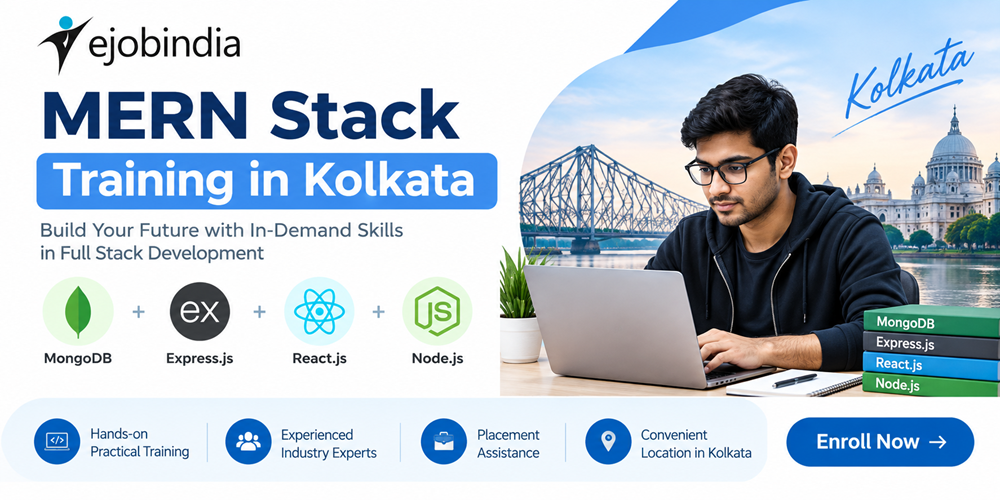
Learn MERN Stack (MongoDB, Express, React, Node.js) in Kolkata with hands-on projects and placement support. Explore curriculum, duration, and career paths at eJobIndia.
Kolkata’s IT and software services sector has grown steadily over the past decade, and with that growth has come rising demand for full-stack developers who can build complete web applications from front end to back end. Among the technology stacks driving this demand, MERN — MongoDB, Express.js, React, and Node.js — has become one of the most widely used combinations for building modern, scalable web applications using a single language, JavaScript, across the entire stack.
If you’re a student, a working professional looking to switch into tech, or a developer wanting to move from front-end or back-end specialization into full-stack development, MERN stack training in Kolkata offers a practical, job-focused path into this field. This guide walks through what the MERN stack actually is, what a good training program should cover, who it’s suited for, what career outcomes look like locally, and what to check before enrolling — so that whether you choose eJobIndia or compare it against other options, you’re making an informed decision.
What Is the MERN Stack?
MERN is an acronym for four technologies that work together to build full-stack web applications:
- MongoDB — A NoSQL, document-oriented database that stores data in flexible, JSON-like documents rather than rigid tables, making it well-suited to applications with evolving data structures.
- js — A lightweight web application framework for Node.js that simplifies building server-side APIs and handling routing, requests, and responses.
- React — A front-end JavaScript library, maintained by Meta, used to build interactive, component-based user interfaces with efficient rendering through a virtual DOM.
- js — A JavaScript runtime that allows developers to run JavaScript on the server side, enabling a single language across both client and server.
Because all four layers use JavaScript, developers trained in MERN can move fluidly between front-end and back-end work without switching languages or mental models, which is a major reason the stack has become popular with startups, product companies, and service-based IT firms alike.
Why Learn MERN Stack in 2026?
A few structural reasons explain why MERN remains a strong choice for aspiring developers:
Single-language efficiency. Using JavaScript across the entire application reduces context-switching and makes it easier for small teams to build and maintain projects end to end.
Strong hiring demand. Full-stack developer roles, particularly those involving React and Node.js, continue to appear frequently in job postings from startups, product companies, and IT services firms, including those operating out of Kolkata’s growing tech parks like Sector V and Rajarhat.
Open-source and well-documented. All four technologies are open source with large communities, extensive documentation, and a steady stream of updates, which lowers the barrier to learning and troubleshooting.
Scalability. MongoDB’s flexible schema and Node’s non-blocking, event-driven architecture make the stack suitable for applications that need to scale, from early-stage MVPs to larger production systems.
Transferable skills. Even if you later work with a different stack, the concepts learned in MERN — REST APIs, component-based UI design, state management, database modeling — transfer well to other frameworks and languages.
Who Should Take MERN Stack Training?
MERN stack training is relevant for a range of learners:
- Freshers and final-year students from computer science, IT, or related backgrounds who want practical, job-ready skills beyond what’s covered in a typical academic curriculum.
- Working professionals in non-tech or adjacent roles (such as manual testing, technical support, or front-end-only development) who want to move into full-stack roles.
- Front-end or back-end specialists who already know one half of the stack and want to become full-stack developers to increase their range and employability.
- Career switchers from non-IT backgrounds who are starting from fundamentals and want a structured path from basics of programming through to building deployable applications.
- Freelancers and entrepreneurs who want to build and ship their own web applications without depending entirely on hired developers.
Most quality MERN programs assume basic familiarity with HTML, CSS, and JavaScript fundamentals, though many training providers, including foundational-level programs, build these up from scratch before moving into the MERN-specific curriculum.
What a Good MERN Stack Curriculum Should Cover
Not all “MERN stack courses” are structured the same way. A well-rounded curriculum typically progresses through these stages:
- Web development fundamentals — HTML5, CSS3, responsive design principles, and core JavaScript (ES6+ features like arrow functions, promises, async/await, destructuring, and modules) that everything else is built on.
- Front-end development with React — Components and props, state and hooks (useState, useEffect, and beyond), conditional rendering, forms and controlled components, React Router for navigation, and state management approaches such as Context API or Redux for larger applications.
- Back-end development with Node.js and Express — Setting up a Node.js server, building RESTful APIs with Express, middleware, routing, error handling, authentication and authorization (including JSON Web Tokens), and connecting the back end to a database.
- Database design with MongoDB — Document-based data modeling, CRUD operations, schema design with Mongoose (an ODM for MongoDB), indexing basics, and aggregation queries for more complex data retrieval.
- Full-stack integration — Connecting a React front end to an Express/Node back end via APIs, handling asynchronous data fetching, managing application state across the stack, and structuring a project for maintainability.
- Tools and deployment — Version control with Git and GitHub, using npm/yarn for package management, environment variables and configuration, testing basics, and deploying applications to platforms such as Render, Vercel, Netlify, or a cloud provider, along with basic CI/CD concepts.
- Projects and portfolio building — Hands-on projects such as an e-commerce application, a task manager, a blogging platform, or a booking system that combine all four technologies and give you something concrete to show in interviews.
- Career preparation — Resume building focused on technical roles, GitHub profile preparation, mock technical interviews, and guidance on common full-stack interview questions and coding assessments.
A training program that skips the fundamentals or jumps straight into building projects without explaining the underlying concepts may get you through a course quickly, but it often leaves gaps that show up during technical interviews.
Typical Course Duration and Format
MERN stack training programs generally run anywhere from two to six months, depending on depth and pace:
- Fast-track programs (6–10 weeks): Intensive, best suited for learners who already have programming fundamentals and want to specialize quickly.
- Standard programs (3–4 months): Cover fundamentals through advanced topics at a steady pace with regular projects, suitable for most beginners.
- Extended programs (5–6 months): Include deeper project work, additional topics like TypeScript or testing frameworks, and more extensive placement preparation.
Training in Kolkata is typically offered in classroom, online-live, and hybrid formats, which matters if you’re balancing training with college, a job, or family responsibilities. When comparing formats, check whether “online” means live instructor-led sessions or only pre-recorded content, since the two have very different levels of interactivity and doubt-resolution support.
MERN Stack Career Opportunities in Kolkata
Kolkata’s IT sector, anchored by hubs like Sector V (Salt Lake) and the Rajarhat/New Town corridor, hosts a mix of IT services companies, product startups, and captive development centers of larger organizations. Full-stack developers with MERN skills are commonly hired for roles such as:
- Full-Stack Developer — building and maintaining complete web applications across front end and back end
- Front-End Developer (React) — focused specifically on building user interfaces and client-side logic
- Back-End Developer (Node.js) — focused on APIs, server logic, and database interactions
- Software Engineer — broader development roles at product or services companies that use JavaScript-based stacks
- Freelance Web Developer — building applications independently for clients across India and internationally
Salary outcomes for MERN developers vary widely based on experience, project complexity, company type, and specific skill depth (for instance, familiarity with TypeScript, testing, or cloud deployment tends to command a premium). Rather than relying on a single figure, it’s worth researching current listings on job portals and asking any training provider for verifiable placement data — actual placed-candidate salaries and companies — rather than broad claims.
What to Look for in a MERN Stack Training Institute
Before enrolling anywhere, it’s worth evaluating a few concrete factors:
Curriculum depth and structure. Ask for a detailed, module-by-module syllabus rather than a marketing summary. Check whether it covers authentication, deployment, and real API integration, not just static UI building.
Instructor experience. Instructors with real industry experience building and shipping full-stack applications generally teach practical problem-solving better than those teaching purely from slides.
Project-based learning. Look for programs where you build multiple real, deployable projects — not just following along with a video — since building from a blank file is what actually prepares you for real development work.
Batch size and interactivity. Smaller batches or programs with dedicated doubt-clearing sessions tend to produce better learning outcomes than large, one-way lecture formats.
Placement support specifics. Ask what “placement assistance” actually includes: resume reviews, mock interviews, referrals to hiring partners, or a formal placement guarantee with defined terms. Vague promises without specifics are worth double-checking.
Verifiable outcomes. Look for reviews, LinkedIn profiles of past students, or direct references you can contact, rather than relying solely on testimonials shown on the training provider’s own website.
Certification value. A completion certificate is useful for your resume, but it’s your project portfolio and interview performance that most employers actually evaluate.
Fee transparency. Make sure there are no hidden costs — clarify what’s included (projects, doubt sessions, placement support) versus what might be charged separately.
How to Prepare Before You Start
- Brush up on JavaScript basics — variables, functions, arrays, objects, and basic DOM manipulation — even if the course starts from fundamentals, having some familiarity helps you move faster.
- Get comfortable with a code editor, such as VS Code, including basic extensions and keyboard shortcuts.
- Create a GitHub account and learn basic Git commands (clone, commit, push, pull, branch) since version control is used throughout any real training program.
- Set realistic weekly time commitments — full-stack development is cumulative, and consistent weekly practice matters more than occasional long sessions.
- Identify your goal — job placement, freelancing, or building your own product — since this can shape which projects and electives are most useful for you.
Common Mistakes to Avoid
- Skipping fundamentals to rush into frameworks, which often creates gaps that surface during technical interviews.
- Only watching tutorials without building independently — recognition is not the same as recall when you’re asked to solve a new problem.
- Ignoring the back end and treating MERN as “React plus a bit of extra,” when strong back-end fundamentals are often what differentiates candidates in interviews.
- Not building a portfolio — a GitHub profile with a few well-documented, deployed projects is often more persuasive to employers than a certificate alone.
- Choosing a program based on price alone without checking curriculum depth, instructor quality, or actual placement outcomes.
Conclusion
MERN stack training in Kolkata can be a genuinely effective route into full-stack web development, provided the program you choose goes beyond surface-level tutorials and actually builds your ability to design, build, debug, and deploy real applications. Look past marketing claims to the specifics: curriculum depth, instructor experience, hands-on project work, and verifiable placement outcomes. Whether you’re starting from scratch or upgrading existing skills, a well-structured MERN program — paired with consistent practice and a genuine project portfolio — can meaningfully improve your readiness for full-stack developer roles in Kolkata’s growing tech ecosystem and beyond.
Frequently Asked Questions (FAQ)
Q1. What is the MERN stack?
MERN stands for MongoDB, Express.js, React, and Node.js — four JavaScript-based technologies used together to build full-stack web applications, covering the database, back end, and front end using a single programming language.
Q2. Do I need prior programming experience to join MERN stack training?
Basic familiarity with HTML, CSS, and JavaScript is helpful, but many programs, including foundational tracks, start from the basics and build up to MERN-specific topics, so complete beginners can typically join as well.
Q3. How long does MERN stack training usually take?
Most programs run between two and six months, depending on intensity and depth. Fast-track programs can run six to ten weeks for learners with existing programming fundamentals.
Q4. Is MERN stack training available in both online and classroom formats in Kolkata?
Yes, most training providers offer classroom, live online, and hybrid formats. It’s worth confirming whether “online” means live instructor-led sessions or pre-recorded content only, since these differ significantly in interactivity.
Q5. What kind of projects will I build during MERN stack training?
A well-structured program typically includes multiple hands-on projects such as an e-commerce application, task management tool, blogging platform, or booking system that combine MongoDB, Express, React, and Node.js.
Q6. What job roles can I apply for after MERN stack training?
Common roles include Full-Stack Developer, Front-End Developer (React), Back-End Developer (Node.js), and Software Engineer at IT services firms, product companies, and startups.
Q7. Does MERN stack training include placement assistance?
Many training providers offer placement support, but the specifics vary — ask whether it includes resume reviews, mock interviews, and referrals to hiring partners, and request verifiable outcomes from past students.
Q8. Is a certificate from a MERN stack training program valuable on its own?
A certificate supports your resume, but most employers place more weight on your project portfolio, GitHub profile, and performance in technical interviews than on the certificate alone.
Q9. Can working professionals join MERN stack training alongside a job?
Yes, many programs offer weekend or evening batches specifically designed for working professionals who want to upskill without leaving their current job.
Q10. What should I check before enrolling in a MERN stack course?
Review the detailed curriculum, instructor experience, project depth, batch size, specifics of placement support, and verifiable outcomes from past students before making a decision.