Agriculture has always played an essential role in supporting human civilization, but the way food is produced is changing rapidly. Growing populations, climate challenges, limited natural resources, and increasing food demand are encouraging farmers to adopt smarter and more efficient approaches. Technology is now becoming an important part of everyday farming, helping producers improve productivity while using resources more responsibly.
Modern Farming Methods of Agriculture are transforming traditional agricultural practices by combining technology, scientific knowledge, automation, and sustainable techniques. From precision farming and drip irrigation to hydroponics and smart machinery, these approaches are helping farmers make better decisions and achieve more consistent results.
What Are Modern Farming Methods?
Modern farming refers to agricultural practices that use advanced technologies, improved equipment, scientific techniques, and efficient resource-management strategies. Modern Farming Methods Of Agriculture combine these innovations to improve productivity, efficiency, and sustainability. Unlike conventional farming, which may depend heavily on manual labor and traditional knowledge, these modern approaches use data and technology to improve different stages of crop production while making better use of resources.
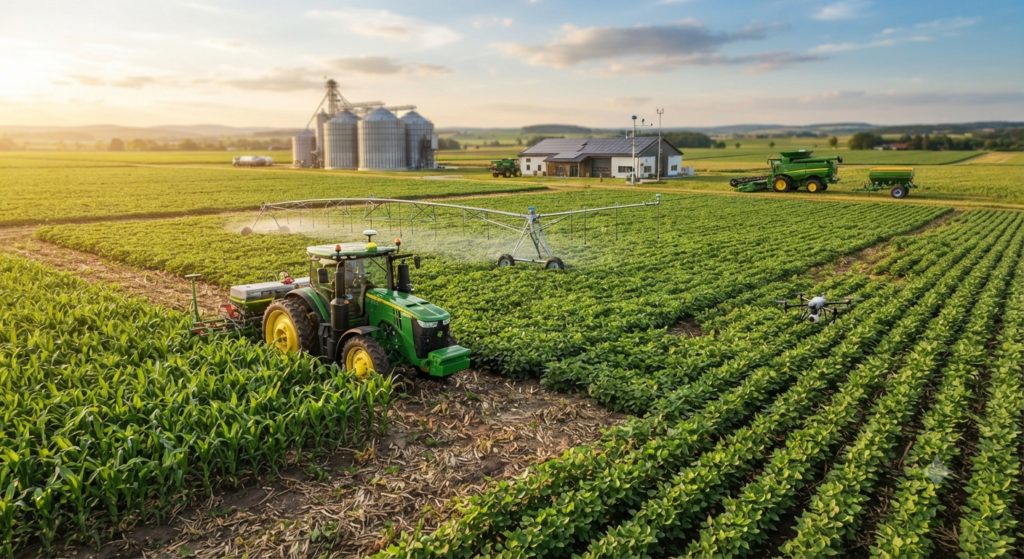
Farmers can now monitor soil conditions, track weather patterns, identify crop diseases, and manage irrigation with greater accuracy. Technologies such as sensors, drones, GPS systems, artificial intelligence, and automated machinery are making farms more productive and easier to manage.
These developments are not simply about replacing traditional farming. Instead, they aim to combine agricultural experience with modern tools so farmers can produce more food while reducing unnecessary costs and resource consumption.
Key Technologies Transforming Agriculture
1. Precision Farming
Precision farming is one of the most significant developments in modern agriculture. It uses data and technology to understand variations within a field and apply resources according to specific crop requirements.
GPS technology, satellite imagery, soil sensors, and data analytics allow farmers to determine where crops need additional water, nutrients, or protection. This targeted approach can reduce waste and improve overall farm efficiency.
Instead of treating an entire field in the same way, farmers can make decisions based on the specific conditions of different areas. This can result in better resource utilization and healthier crops.
2. Smart Irrigation Systems
Water is one of agriculture’s most valuable resources, making efficient irrigation essential. Traditional irrigation methods can sometimes result in excessive water use, particularly when crops receive more water than they require.
Smart irrigation systems use soil-moisture sensors, automated controllers, weather information, and drip irrigation technology to provide water when it is needed. These systems can help reduce water waste while maintaining suitable moisture levels for crops.
As water scarcity becomes a growing concern in many regions, efficient irrigation is expected to become an increasingly important part of sustainable agriculture.
3. Agricultural Drones
Drones are giving farmers a new way to observe and manage their fields. Equipped with cameras and sensors, agricultural drones can capture aerial images that reveal crop stress, pest activity, irrigation problems, and variations in plant growth.
Regular aerial monitoring allows farmers to identify potential problems earlier. Instead of inspecting large fields manually, farmers can focus their attention on areas that require immediate action.
Drones can also support crop mapping, spraying, and field assessment, reducing the time and labor required for certain agricultural activities.
4. Artificial Intelligence and Data Analytics
Artificial intelligence is becoming increasingly useful in agriculture. AI-based systems can analyze large amounts of information related to weather, soil, crop conditions, pests, and historical production.
These insights can help farmers predict potential problems and make more informed decisions. For example, predictive systems may provide information about suitable planting periods or identify conditions that could increase the risk of crop disease.
Data-driven agriculture enables farmers to move from reactive decision-making toward more proactive farm management.
How Modern Farming Methods Improve Productivity
One of the biggest advantages of Modern Farming Methods of Agriculture is their potential to improve productivity. Farmers can monitor crops more closely, identify problems earlier, and apply inputs more accurately.
Automation can also reduce the amount of repetitive manual work required on farms. Tractors, harvesters, robotic equipment, and automated systems can perform tasks with greater consistency and speed.
Improved productivity does not necessarily mean simply producing more crops. It also means making better use of available land, water, energy, labor, fertilizers, and other resources.
Supporting Sustainable Agriculture
Sustainability has become a major priority for the agricultural industry. Farmers need to produce sufficient food while protecting soil, water, biodiversity, and other natural resources.
Modern Farming Methods of Agriculture can contribute to this objective through more precise application of fertilizers and pesticides, efficient irrigation, soil monitoring, renewable-energy solutions, and reduced waste.
For example, precision technologies can help farmers apply fertilizers only where they are required. This may reduce unnecessary chemical use and minimize the potential environmental impact of agricultural operations.
Crop rotation, conservation agriculture, protected cultivation, and integrated pest management can also complement technology-driven farming systems.
The Rise of Protected and Soilless Farming
Modern agriculture is not limited to open-field cultivation. Protected farming methods such as greenhouses, vertical farms, hydroponics, and aeroponics are creating new opportunities for food production.
Hydroponic systems grow plants without conventional soil, while vertical farms use stacked growing systems to maximize production in limited spaces. Controlled environments can regulate factors such as temperature, humidity, light, and nutrient delivery.
These approaches can be particularly useful in urban areas or regions where agricultural land is limited. They also provide greater control over growing conditions and can support year-round production for certain crops.
Improving Farm Management and Profitability
Technology can also change the financial side of agriculture. Farmers can use digital platforms to track expenses, monitor production, analyze market information, and manage inventories.
Better data can support more informed decisions about what to grow, when to plant, and how to allocate available resources. Reducing unnecessary input use can also contribute to improved profitability.
Digital agricultural platforms are making farming information more accessible. Organizations such as F2DF can be part of a broader agricultural ecosystem that helps connect modern farming practices with farmers seeking practical information and solutions.
However, technology adoption also comes with challenges. Advanced equipment can require significant initial investment, and farmers may need training to use new systems effectively. Reliable internet connectivity, technical support, and access to financing can also influence adoption.
The Role of Farmers in Agricultural Transformation
Although technology is changing agriculture, Modern Farming Methods Of Agriculture are designed to support farmers rather than replace them. Farmers remain at the center of the industry, using their experience and knowledge alongside modern technology to make better decisions. Technology is most effective when it complements farmers’ expertise and helps improve productivity, efficiency, and sustainability.
Farmers understand their land, local climate, crops, and production challenges. Modern tools provide additional information that can strengthen those existing skills.
Training and education will therefore be essential as agriculture becomes increasingly digital. Farmers who understand how to interpret data and operate modern equipment can make better use of technological investments.
The future of farming will likely involve a combination of human knowledge, automation, data, and sustainable agricultural practices.
Future Trends in Modern Agriculture
The agricultural industry is expected to become even more connected in the coming years. Autonomous machinery, AI-powered crop monitoring, advanced robotics, satellite technology, biotechnology, and Internet of Things devices could further transform farm management.
Farmers may increasingly rely on connected systems that collect information continuously and provide recommendations in real time. Automation could handle more repetitive tasks, while data analysis could support decisions involving planting, irrigation, crop protection, and harvesting.
At the same time, sustainability will remain an important consideration. Future technologies will need to improve productivity without placing unnecessary pressure on natural resources.
The growing availability of digital agricultural solutions from organizations such as F2DF reflects the wider movement toward more informed, technology-enabled farming.
Conclusion
The agricultural industry is moving toward a more connected, precise, and sustainable future. Modern Farming Methods of Agriculture are helping farmers improve productivity, conserve resources, manage risks, and respond to changing environmental and economic conditions.
Precision farming, smart irrigation, drones, artificial intelligence, protected cultivation, and automated machinery are only some of the technologies reshaping agriculture. While challenges such as cost, training, and infrastructure remain, the long-term potential of these innovations is significant.
As technology continues to develop, successful agriculture will depend on finding the right balance between innovation and practical farming knowledge. By adopting suitable technologies and sustainable practices, farmers can build more efficient operations and contribute to a more resilient food system.
FAQs
Q1. What are Modern Farming Methods of Agriculture?
Modern Farming Methods of Agriculture are advanced agricultural practices that use technology, scientific techniques, improved machinery, automation, and efficient resource-management systems to improve farming productivity and sustainability.
Q2. How does technology benefit modern agriculture?
Technology helps farmers monitor crops, manage irrigation, analyze soil conditions, predict weather-related risks, automate repetitive tasks, and use fertilizers and pesticides more efficiently. These benefits can improve productivity and reduce unnecessary resource use.
Q3. Is modern farming environmentally friendly?
Many modern farming techniques are designed to support sustainability. Precision agriculture, smart irrigation, conservation practices, and controlled-environment farming can help reduce water consumption, input waste, and environmental pressure when implemented appropriately.
Q4. What is precision farming?
Precision farming is a data-driven approach that allows farmers to manage different areas of a field according to their specific requirements. GPS, sensors, satellite imagery, drones, and data analytics can help determine where crops need water, nutrients, or other inputs.
Q5. What is the future of modern agriculture?
The future of agriculture is likely to involve greater use of artificial intelligence, robotics, automation, sensors, connected devices, precision technologies, and sustainable production systems. These innovations can help farmers produce food more efficiently while managing limited resources responsibly.