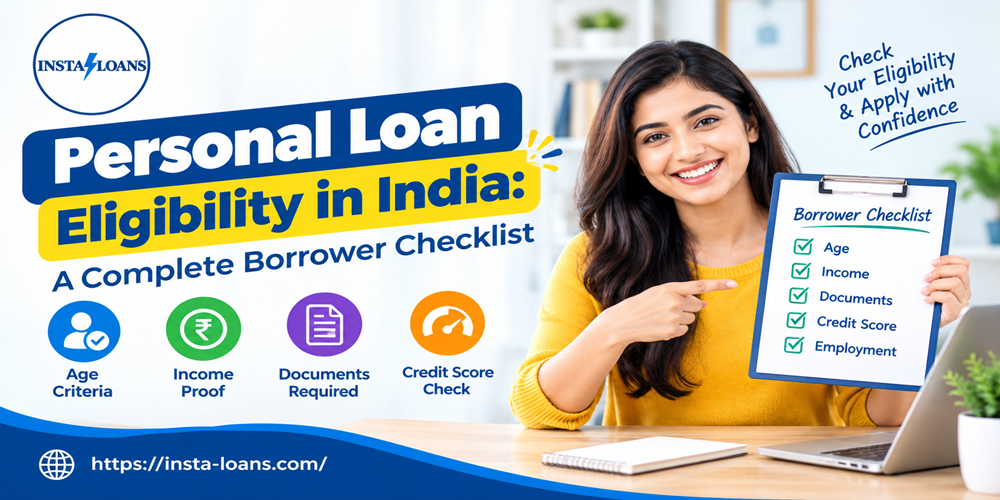
Check personal loan eligibility in India: age, income, CIBIL score, FOIR, documents and tips to improve approval chances. Use our borrower checklist.
Applying for a personal loan without knowing whether you qualify is one of the quickest ways to collect a rejection and a dent in your credit profile. Each formal application triggers a credit enquiry that is recorded in your credit report, and several enquiries in a short period can make lenders cautious. A smarter approach is to check your personal loan eligibility first, fix any gaps, and then apply to the right lender with the right documents.
This guide is a complete borrower checklist for India. It explains the criteria banks and NBFCs commonly use, including age, income, credit score, employment and existing obligations. It shows how lenders work out how much you can borrow, lists the reasons applications get rejected, and gives practical steps to improve your chances. The figures below are typical industry ranges. Every lender sets its own policy, so always confirm exact criteria in the lender’s Key Fact Statement before you apply.
Personal Loan Eligibility at a Glance
Use this table as a quick self-assessment. If you meet most of these benchmarks, your chances of approval are generally stronger.
| Criteria | Typical requirement (varies by lender) |
| Age | 21 to 60 years at application (some lenders accept 18 or go up to 65 at loan maturity) |
| Residency | Indian resident with valid address proof |
| Employment | Salaried with a private or public employer, or self-employed with a stable business |
| Minimum monthly income | Roughly ₹15,000 to ₹25,000 for salaried applicants; higher in metros and for larger loans |
| Credit score | 700 or above; 750 and above usually earns better rates |
| Work experience | 1 to 2 years total for salaried; 2 to 3 years of business vintage for self-employed |
| FOIR (fixed obligations to income) | Usually 40% to 50% of net monthly income including the new EMI |
| Documents | PAN, Aadhaar or other KYC, income proof, bank statements |
What Is Personal Loan Eligibility, and Why Does It Matter?
Personal loan eligibility is the set of conditions a lender uses to decide whether to approve your application, and for how much. A personal loan is unsecured, which means you pledge no collateral such as a house or gold. Because the lender’s only protection is your promise and track record of repaying, it examines your income, credit history and existing debt closely.
Knowing your eligibility in advance helps in three ways. It prevents avoidable rejections and unnecessary credit enquiries. It lets you choose a loan amount and tenure you can actually afford. And it gives you time to improve weak areas, such as a low score or high card utilisation, before you apply.
The 10-Point Personal Loan Eligibility Checklist
1. Age
Lenders want to be sure you will be earning for the full loan tenure. Most set a minimum age of 21 and a maximum of 58 to 60 at application, or 60 to 65 at the time the loan ends. Self-employed applicants sometimes have a slightly higher upper limit. If you are close to retirement, a shorter tenure improves your chances.
2. Nationality and Residency
Personal loans are generally offered to Indian residents. You will need a verifiable current address and, in most cases, proof that you have lived at your present address or in your city for a minimum period. Some lenders only serve certain pin codes, so check coverage before you apply.
3. Employment Type and Stability
Salaried applicants working for well-known corporates, government bodies or established companies are usually considered lower risk, which can lead to faster approval and sharper rates. Self-employed professionals and business owners are assessed on income tax returns, bank statements and business continuity. Frequent job changes within a short period can weaken an otherwise good profile.
4. Minimum Monthly Income
Every lender sets a floor for monthly income, and the floor is often higher in metro cities. As a rough guide, many lenders look for at least ₹15,000 to ₹25,000 net monthly income for salaried borrowers. Income is not only a pass or fail test. It also drives the maximum loan amount you can be offered, because your EMI must fit comfortably within your earnings.
5. Credit Score
Your credit score, issued by bureaus such as CIBIL, Experian, Equifax and CRIF High Mark, is a three-digit number between 300 and 900 that summarises how you have handled credit. A score of 750 or higher is generally seen as strong. A score between 700 and 749 may still be approved, often at a higher rate. Below 650, many mainstream lenders decline or ask for extra safeguards. You are entitled to a free credit report from each bureau once a year, so check yours for errors before you apply.
6. Credit History and Repayment Behaviour
Beyond the score, lenders read your credit report line by line. They look for missed or late EMIs, written-off or settled accounts, high credit card utilisation (above roughly 30% to 40% of the limit is a warning sign) and a large number of recent enquiries. A clean history of timely payments is often more persuasive than a high score alone.
7. Existing Debts and FOIR
FOIR, or Fixed Obligations to Income Ratio, measures how much of your monthly income already goes towards fixed commitments such as home loan EMIs, car loan EMIs and credit card minimum dues. Most lenders prefer total obligations, including the new loan, to stay within about 40% to 50% of net income. The more existing debt you carry, the lower the loan you will be offered.
8. Work Experience or Business Vintage
Salaried applicants typically need one to two years of total work experience, with some lenders asking for at least six months to a year in the current job. Self-employed applicants usually need two to three years of business continuity, supported by ITR filings. Longer stability signals dependable income.
9. Employer Category and Location
Many lenders maintain internal lists that categorise employers by size, reputation and financial strength. Working for a listed company, a multinational or a government department can ease approval. Your city also matters because income thresholds and risk assessments differ between metros, tier-2 cities and smaller towns.
10. Complete and Consistent Documentation
Even a strong profile can stall if documents are missing or contradictory. A name spelt differently on your PAN and bank account, or an address that does not match across documents, is a common cause of delay. Typical documents include:
- Identity proof: PAN card (mandatory in most cases), Aadhaar, passport, voter ID or driving licence
- Address proof: Aadhaar, utility bill, rental agreement or passport
- Income proof for salaried borrowers: last 2 to 3 salary slips and 3 to 6 months of salary account statements
- Income proof for self-employed borrowers: last 2 to 3 years of ITR with computation of income, and 6 to 12 months of bank statements
- Recent passport-size photograph and, where required, a video KYC or e-sign confirmation
Eligibility for Different Types of Borrowers
Salaried Employees
If you are salaried, lenders focus on your employer, your net take-home pay and how long you have been working. Salary credited to the same bank account every month makes verification straightforward. Applying through the bank where you hold your salary account can sometimes speed up processing.
Self-Employed Professionals and Business Owners
Doctors, chartered accountants, consultants and shop or business owners are assessed on average income over the past two to three years rather than a single month. Consistent tax filing, healthy balances in your current account and low cheque bounces all help. If your declared income is low because of heavy deductions, your eligible loan amount will be low as well.
First-Time Borrowers With No Credit History
If you have never taken a loan or credit card, your report may show no score at all, often described as NTC, or new to credit. Some lenders do approve such applicants on the strength of income and bank statements, usually for smaller amounts. Building history through a secured card or a small, well-repaid loan will widen your options over time.
Borrowers With a Low Credit Score
A score below 650 does not mean you can never borrow, but it limits choices and raises cost. Expect smaller amounts, higher interest rates and possibly a request for a co-applicant or guarantor. Spend a few months repairing your score before applying again rather than collecting rejections.
How Lenders Decide How Much You Can Borrow
Approval is only half the story. The amount you are offered depends mainly on your income, existing EMIs, the interest rate and the tenure. A simple way to estimate it is to work out the EMI your income can support and then convert that into a loan amount.
Example: Suppose your net monthly income is ₹50,000 and the lender allows a FOIR of 50%. Your total monthly obligations can then reach ₹25,000. If you already pay ₹8,000 in EMIs, the maximum new EMI is ₹17,000. At an assumed interest rate of 14% per annum over 3 years, an EMI of about ₹10,250 corresponds to roughly ₹3 lakh of loan. A ₹17,000 EMI therefore supports a loan of about ₹4.97 lakh. Your actual offer will differ with the lender’s rate, fees and policy.
The standard EMI formula is EMI = P × r × (1 + r)^n ÷ ((1 + r)^n − 1), where P is the principal, r is the monthly interest rate (annual rate divided by 12 and by 100) and n is the number of monthly instalments. Use an online EMI calculator to test different amounts and tenures before you commit.
Common Reasons Personal Loan Applications Are Rejected
- Low credit score, or missed and late payments on existing loans and cards
- High FOIR because too much income is already committed to EMIs
- Income below the lender’s minimum requirement
- Too many recent loan or credit card enquiries
- Unstable employment or frequent job changes
- Mismatched or incomplete documents, including different names or addresses across records
- Working for an employer the lender does not approve, or living in a non-serviceable pin code
- Errors in your credit report that were never disputed
If you are rejected, ask the lender for the reason, check your credit report for mistakes and wait before reapplying. Repeated applications in quick succession usually make things worse.
How to Improve Your Personal Loan Eligibility
- Check your credit report first. Dispute wrong entries with the bureau and the lender directly.
- Pay every EMI and card bill on time. Set up auto-debit to avoid slips.
- Reduce credit card utilisation. Paying down balances before applying can lift your score within a few billing cycles.
- Clear or consolidate small loans to bring down your FOIR.
- Add a co-applicant with stable income if your own income is borderline.
- Choose a realistic amount and a longer tenure to keep the EMI manageable, while remembering that a longer tenure costs more in total interest.
- Avoid applying to many lenders at once. Use eligibility checkers that run a soft enquiry where available.
- Keep your KYC details consistent across PAN, Aadhaar, bank and employer records.
Protect Yourself: Choose a Genuine, Regulated Lender
Eligibility is only useful if the lender itself is trustworthy. Before you share documents or personal data, run through these checks:
- Confirm that the lender is a bank or an NBFC registered with the Reserve Bank of India, and that any app or platform you use is a disclosed partner of such a regulated entity.
- Ask for the Key Fact Statement. Under RBI’s digital lending framework, borrowers should receive a clear summary of the loan amount, interest rate, annual percentage rate, fees and repayment schedule before the loan is disbursed.
- Read about the cooling-off or look-up period that lets you exit a digital loan within a stated window, subject to paying back the principal and proportionate interest.
- Be cautious of anyone who asks for an upfront fee to guarantee approval. Genuine lenders deduct disclosed processing fees from the loan or charge them transparently, and they do not promise approval without checking your profile.
- Do not grant unnecessary phone permissions such as access to contacts or photos.
- Never share your OTP, PIN or card details with anyone claiming to process your loan.
Final Borrower Checklist: Tick Before You Apply
- I am within the lender’s age limits for the full loan tenure
- My net monthly income meets the lender’s minimum requirement
- I have checked my credit score and report and corrected any errors
- My total EMIs including the new loan stay within about 40% to 50% of my income
- I have kept recent credit enquiries to a minimum
- My PAN, Aadhaar, bank and address details match across all documents
- I have my income proofs and bank statements ready
- I have compared the interest rate, processing fee and APR across at least two or three lenders
- I have read the Key Fact Statement and understand prepayment and late payment charges
- I am borrowing only what I need and can repay comfortably
Personal loan eligibility in India rests on a handful of clear factors: your age, income, credit score, employment stability, existing debt and the quality of your documents. If you check these before applying, you can avoid rejections, protect your credit score and borrow on better terms. Take a few weeks to strengthen weak spots, compare lenders honestly, and borrow only what fits your budget. A personal loan should solve a problem, not create a bigger one.
Disclaimer: This article is for general information only and is not financial advice. Eligibility criteria, interest rates and fees vary by lender and change over time. Please verify current terms directly with the lender before applying.
Frequently Asked Questions (FAQ)
What is the minimum income required for a personal loan in India?
There is no single national figure. Many lenders ask for a net monthly income of roughly ₹15,000 to ₹25,000 for salaried applicants, and the requirement is often higher in metro cities or for larger loan amounts. Check the specific lender’s criteria before applying.
What credit score is needed for a personal loan?
A score of 700 or above is commonly expected, and 750 or above usually gives you better approval odds and lower interest rates. Some lenders consider scores below 700 or applicants with no credit history, but usually at a higher cost or for smaller amounts.
What is the age limit for a personal loan?
Most lenders accept applicants between 21 and 60 years of age, and some extend the upper limit to 65 at the time the loan matures. The exact limits differ by lender and by whether you are salaried or self-employed.
Can I get a personal loan if I am self-employed?
Yes. Self-employed professionals and business owners can get personal loans, but lenders usually ask for 2 to 3 years of business continuity, income tax returns and 6 to 12 months of bank statements to verify income.
How does FOIR affect my loan eligibility?
FOIR is the share of your monthly income that goes to fixed obligations such as EMIs. Lenders generally prefer it to stay around 40% to 50% after the new EMI is added. A higher FOIR reduces the amount you can borrow or can lead to rejection.
Can I get a personal loan with no credit history?
It is possible but harder. Some lenders approve first-time borrowers based on income and bank statements, usually for smaller amounts. Building a record with a small loan or secured credit card improves your chances later.
Which documents are needed to apply for a personal loan?
You will typically need PAN, Aadhaar or other KYC, address proof, recent salary slips and bank statements if salaried, or ITR and bank statements if self-employed. Some lenders complete verification digitally through video KYC and e-sign.
Does checking my eligibility affect my credit score?
Using an eligibility checker that runs a soft enquiry generally does not affect your score. A formal loan application involves a hard enquiry, and several of these in a short time can lower your score temporarily, so apply selectively.
How can I increase my chances of loan approval?
Check your credit report and fix errors, pay all dues on time, reduce credit card balances, lower your existing EMIs, keep your KYC details consistent and apply for an amount that fits your income. Adding a co-applicant with stable income can also help.
Why was my personal loan application rejected?
Common reasons include a low credit score, high existing debt, income below the minimum, too many recent enquiries, unstable employment and document mismatches. Ask the lender for the reason, correct the issue and wait before applying again.