Predictive Analytics in Business
Businesses make decisions every day. Some involve customer demand, while others concern sales, inventory, staffing and operating costs.
Making these decisions without reliable information can create problems. A company may order too much stock, underestimate customer demand or overlook changing market conditions.
Historical reports help explain what has already happened. However, businesses also need to prepare for what could happen next.
This is where predictive analytics in business becomes useful.
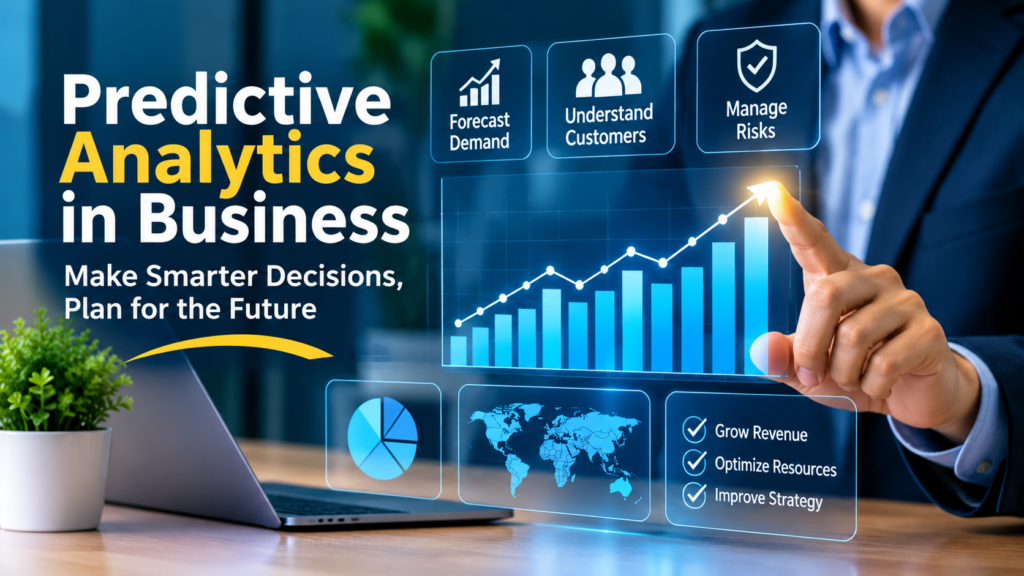
Predictive analytics uses historical data, statistical techniques and machine learning to estimate possible future outcomes. It helps companies identify patterns, assess risks and make informed plans.
For example, an online retailer can analyse previous orders and seasonal buying patterns. This information can help estimate which products customers may purchase during an upcoming sales period.
Predictive analytics does not guarantee accurate predictions. Its results depend on data quality, suitable models and changing business conditions.
However, when used correctly, it gives decision-makers a stronger basis for planning.
Let’s explore how predictive analytics works, where businesses use it and how companies can start applying it.
1. What Is Predictive Analytics in Business?
Predictive analytics in business refers to the use of data and analytical models to estimate future events or outcomes.
It examines historical information to identify patterns that may continue or develop under similar conditions.
Businesses use these insights to plan activities, manage resources and assess potential risks.
For example, a retail company may analyse its sales records from previous years. It can compare product demand across different months, locations and customer groups.
The analysis may reveal that certain products sell more during festive periods. The company can use this pattern when planning inventory for the next season.
Predictive analytics can help answer questions such as:
- Which products may experience higher demand?
- Which customers may stop purchasing?
- How much inventory might a business require?
- Which sales opportunities deserve attention?
- When might equipment require maintenance?
- Which transactions may need additional fraud checks?
These predictions are estimates, not guaranteed outcomes. Businesses should review them alongside current market information and human judgement.
How Is Predictive Analytics Different From Traditional Reporting?
Traditional reporting focuses on past and present performance. It shows revenue, expenses, website visits, customer orders and other business measurements.
Predictive analytics uses this information to estimate what may happen next.
Consider an online store that recorded lower sales last month.
A traditional report shows the decline. Predictive analytics may examine customer visits, product availability, advertising activity and previous purchasing patterns to estimate future sales.
Both approaches are useful. Reporting explains business performance, while predictive analytics supports forward planning.
2. How Does Predictive Analytics Work?
Predictive analytics follows a structured process. Businesses collect relevant information, prepare it for analysis and apply suitable models.
The process can vary depending on the business problem and the available technology.
Step 1: Collect Relevant Business Data
The first step involves gathering information from different sources.
A business may collect data from:
- Sales and transaction records
- Customer relationship management systems
- Website and mobile app activity
- Inventory management platforms
- Marketing campaigns
- Financial reports
- Customer support interactions
For example, an online retailer may collect product views, shopping cart activity, completed orders and customer purchase history.
The selected data should relate directly to the question the business wants to answer.
Step 2: Clean and Organise the Data
Raw data often contains missing values, duplicate records and incorrect entries.
These problems can affect analytical results.
Businesses need to check their datasets before using them. This includes correcting inconsistent formats, removing duplicate records and handling missing information appropriately.
Data preparation also involves checking whether the information is relevant and reliable.
A sales prediction model built using incomplete order records may produce misleading estimates.
Step 3: Identify Patterns and Relationships
Analysts examine the prepared information to understand how different factors relate to business outcomes.
For example, a company may compare monthly sales with pricing changes, promotional campaigns and seasonal demand.
It may discover that certain products sell more during specific periods.
These relationships help analysts select relevant variables for predictive modelling.
A relationship does not always prove that one factor causes another. Businesses must avoid treating every observed pattern as a direct explanation.
Step 4: Build a Predictive Model
A predictive model uses selected data to estimate future outcomes.
Depending on the problem, analysts may use statistical methods or machine learning algorithms.
For example, a retailer may build a model to estimate weekly product demand.
The model examines previous sales and other relevant factors. It then produces demand estimates for upcoming weeks.
Step 5: Test the Model
A model should be tested using data that was not used to train it.
This helps businesses understand how well it performs on information it has not previously seen.
Analysts can compare predicted results with actual outcomes.
If the model regularly produces large errors, the team may need to review the data, variables or modelling approach.
Step 6: Apply Insights to Business Decisions
The final step is using predictions in practical business activities.
A company may use demand forecasts to adjust inventory orders. A sales team may prioritise leads with a higher estimated likelihood of conversion.
Predictions become valuable when they help people take appropriate action.
Businesses should also monitor model performance over time. Customer preferences and market conditions change, so older models may need updating.
3. Key Technologies Used in Predictive Analytics
Predictive analytics combines several technologies. Each one supports a different part of the process.
Artificial Intelligence and Machine Learning
Artificial intelligence and machine learning help systems identify patterns within large datasets.
Machine learning models can learn from historical examples and use those patterns to make predictions.
For instance, an online payment platform can analyse previous transactions to identify behaviour associated with fraudulent activity.
The model can flag unusual transactions for further review. Human investigators or additional security checks can then assess the cases.
Statistical Analysis
Statistical methods help analysts understand relationships between different variables.
Regression analysis, time-series analysis and probability models are common techniques.
A business may use time-series forecasting to estimate monthly revenue based on previous sales patterns.
The method should match the type of data and the business question.
Big Data Platforms
Large businesses may collect information from thousands of transactions, customers and connected systems.
Big data platforms help store, process and organise these datasets.
They allow analysts to work with information from multiple sources without relying on separate manual reports.
Cloud Computing
Cloud platforms provide computing resources for storing data and running analytical models.
Businesses can access these resources without maintaining every server locally.
Cloud services can also make it easier for teams in different locations to work with shared datasets and analytical tools.
Data Visualisation Tools
Charts, dashboards and reports help employees understand predictive results.
For example, a sales dashboard may show estimated monthly revenue alongside actual performance.
Visual reports make it easier for managers to identify changes and discuss possible actions.
Business Intelligence Software
Business intelligence platforms combine reporting, data analysis and visualisation.
Some platforms also support forecasting and predictive modelling.
They help businesses connect information from sales, finance, marketing and operations.
4. Practical Applications of Predictive Analytics Across Industries
Predictive analytics has applications across many business functions. Its usefulness depends on the quality of available information and the decisions a company needs to make.
Here are seven practical applications.
1. Sales Forecasting
Sales forecasting helps businesses estimate future revenue and product demand.
A company can analyse previous sales, customer orders, seasonal patterns and pricing changes.
For example, a clothing retailer may notice that winter jackets sell more during certain months.
It can use this information to estimate future demand and plan purchasing activities.
Sales teams can also use predictive insights to set realistic targets and review expected revenue.
However, forecasts should account for unexpected events such as supply shortages, competitor activity and sudden changes in customer preferences.
2. Customer Behaviour Analysis
Understanding customer behaviour helps businesses improve their products and services.
Predictive analytics can examine purchase history, browsing activity and customer interactions.
For example, an online store may identify customers who frequently purchase skincare products.
It can use this information to recommend relevant products or create suitable marketing campaigns.
Businesses can also estimate customer churn, which refers to customers who may stop using a service.
A subscription company might identify accounts showing declining engagement. Its customer support team can then investigate the reasons and offer appropriate assistance.
Customer data should be handled responsibly. Businesses need suitable privacy controls and consent practices.
3. Inventory and Supply Chain Management
Inventory planning involves balancing product availability with storage and purchasing costs.
Ordering too much stock can increase storage expenses. Ordering too little can lead to missed sales.
Predictive analytics helps businesses estimate demand using previous orders, seasonal trends and current inventory information.
For example, a food distributor may analyse sales patterns before a festive season. It can use these estimates to plan stock requirements and coordinate supplier orders.
Companies can also examine transportation delays and supplier performance.
Technology already plays an important role in connecting suppliers, inventory systems and delivery operations. Businesses can explore how technology supports a more efficient supply chain to understand the wider role of connected systems in logistics management.
4. Financial Planning and Risk Assessment
Finance teams use predictive analytics to estimate revenue, expenses and cash flow.
They can examine historical financial records, payment patterns and operating costs.
For example, a company may analyse customer payment behaviour to estimate how much money it is likely to receive over the next few months.
This can help finance managers plan expenses and identify possible cash flow gaps.
Predictive models can also support credit risk assessment. Financial institutions may examine repayment history and other permitted information when estimating the likelihood of missed payments.
These models need regular testing to identify errors and unfair outcomes.
5. Marketing Campaign Optimisation
Marketing teams often work with information from advertising platforms, websites, email campaigns and customer databases.
Predictive analytics can help estimate which audiences may respond to a campaign.
For example, an online retailer may compare previous campaign performance with customer purchase behaviour.
The analysis may identify audience groups that are more likely to purchase particular products.
Marketers can use these insights to plan campaign budgets, choose relevant offers and improve audience targeting.
Businesses can also connect predictive insights with wider digital commerce strategies. Read more about the future of B2C e-commerce and emerging business opportunities to understand how changing customer expectations are shaping online businesses.
6. Predictive Maintenance
Equipment failures can interrupt production and increase repair costs.
Predictive maintenance uses equipment data to estimate when a machine may require attention.
Sensors can collect information about temperature, vibration, operating speed and energy consumption.
A predictive model can examine these readings and identify patterns associated with possible equipment problems.
For example, repeated increases in machine vibration may indicate wear in a mechanical component.
Maintenance teams can inspect the equipment and plan repairs before a failure causes a major interruption.
Predictions should support technical inspections rather than replace them.
7. Fraud Detection and Cybersecurity
Financial and digital businesses handle large volumes of transactions and user activity.
Predictive analytics can help identify unusual patterns that may indicate fraud or security risks.
For example, a payment platform may detect a transaction that differs significantly from a customer’s normal activity.
The system can flag it for additional verification.
Cybersecurity teams can also examine historical security events to identify patterns associated with suspicious activity.
However, a flagged event does not automatically mean fraud has occurred. Additional checks are important to avoid unnecessary account restrictions.
5. Major Benefits of Predictive Analytics for Businesses
Predictive analytics can improve how businesses plan and respond to changing conditions.
Its value comes from applying relevant data to real operational decisions.
Better Decision-Making
Managers often need to make decisions with incomplete information.
Predictive analytics provides additional evidence by estimating possible future outcomes.
For example, a retailer can compare expected demand across different product categories before placing a purchase order.
This helps decision-makers evaluate options more carefully.
Improved Demand Forecasting
Demand changes due to seasons, customer preferences, promotions and market conditions.
Predictive models can examine these factors to estimate future requirements.
Businesses can use these estimates when planning inventory, staffing and purchasing.
Reduced Operational Costs
Poor planning can increase business expenses.
Excess inventory, unnecessary maintenance and inefficient resource allocation can affect profitability.
Predictive analytics helps identify areas where better planning may reduce waste.
The actual savings depend on how accurately the model performs and how effectively the business acts on its findings.
Better Customer Retention
Customer churn can affect recurring revenue and long-term business growth.
Predictive models can identify customers who show behaviour associated with reduced engagement.
Customer service teams can investigate these accounts and offer relevant support.
The goal should be to improve the customer experience, not simply to increase the number of marketing messages.
More Effective Marketing
Predictive analytics helps marketing teams understand which customers may respond to different offers.
This can support audience segmentation and campaign planning.
Businesses can also compare predicted campaign performance with actual results to improve future decisions.
Stronger Risk Management
Companies face financial, operational and market-related risks.
Predictive models can help identify warning signs before they develop into larger problems.
For example, a business may use payment records to identify customers who regularly pay invoices late.
Finance teams can review these accounts and plan suitable credit controls.
Improved Resource Planning
Businesses need to allocate people, equipment and budgets according to demand.
Predictive analytics can help estimate future workload and resource requirements.
A customer support centre, for example, may forecast call volumes during product launches or seasonal campaigns.
Managers can use these estimates when planning employee schedules.
6. Predictive Analytics vs Descriptive and Prescriptive Analytics
Businesses often use different forms of data analytics. Predictive analytics is one part of a wider analytical process.
Understanding the differences helps companies select the right approach.
Descriptive Analytics
Descriptive analytics explains what has already happened.
It uses reports, dashboards and historical data to summarise business performance.
For example, a sales report may show that a company generated lower revenue in a particular month.
Predictive Analytics
Predictive analytics estimates what may happen next.
It uses historical information and analytical models to forecast possible outcomes.
For example, a retailer may estimate next month’s sales based on previous purchasing patterns.
Prescriptive Analytics
Prescriptive analytics helps evaluate what actions a business could take.
It may use predictions, business rules and optimisation techniques to recommend suitable decisions.
For example, a supply chain system may compare delivery routes and suggest an option based on cost, distance and delivery requirements.
These approaches can work together.
A business may first review historical sales, forecast future demand and then evaluate purchasing options.
7. Challenges and Limitations of Predictive Analytics
Predictive analytics can support better planning, but it is not free from limitations.
Businesses should understand the following challenges before investing in analytical systems.
Poor Data Quality
Predictive models depend on the information used to build them.
Incomplete records, duplicate entries and incorrect values can affect the results.
Companies need consistent data collection and regular quality checks.
High Implementation Costs
Advanced analytics may require software, computing resources and skilled employees.
Small businesses may find it difficult to build and maintain complex predictive systems.
Starting with a focused business problem can help control costs.
Shortage of Skilled Professionals
Predictive analytics requires knowledge of statistics, data management and machine learning.
Some businesses may not have these skills internally.
They may need to train existing employees or work with experienced analytics professionals.
Data Privacy and Security
Business datasets may contain customer, employee and financial information.
Companies must protect this information through appropriate access controls, encryption and security practices.
They should also follow relevant data protection laws and use personal information only for appropriate purposes.
Changing Market Conditions
Customer preferences, economic conditions and competitor behaviour can change quickly.
A model trained on older information may become less accurate when these conditions shift.
Businesses should monitor performance and update models when necessary.
Incorrect or Biased Predictions
A predictive model can produce unreliable results if its training data is incomplete or unrepresentative.
For example, a customer scoring model may perform poorly for groups that were not adequately represented in the original dataset.
Companies should test models across relevant customer groups and review important decisions.
Overdependence on Automated Results
Predictions are estimates. They should not replace business judgement.
A manager should consider current market conditions, operational experience and other relevant information before acting on a model’s recommendation.
8. How Small Businesses Can Start Using Predictive Analytics
Predictive analytics is not limited to large corporations.
Small and medium-sized businesses can also use it for sales forecasting, customer analysis and inventory planning.
They do not need to build a complex system immediately.
Here is a practical approach.
Step 1: Choose One Business Problem
Start with a question that affects your daily operations.
For example:
- Why do monthly sales change?
- Which products may run out of stock?
- Which customers may stop purchasing?
- How much revenue could the business generate next month?
- When might customer support demand increase?
A clear question makes it easier to select the right data and analytical method.
Step 2: Identify Available Data
Review the information your business already collects.
This may include sales spreadsheets, customer records, website analytics and accounting reports.
Check whether the data is complete and relevant to the selected problem.
Step 3: Select Suitable Tools
Choose software according to your business size, budget and technical requirements.
A small company may begin with spreadsheet-based forecasting or business intelligence software.
Larger organisations may require cloud-based data platforms and machine learning tools.
The best option is one that employees can use and maintain.
Step 4: Build a Basic Predictive Model
Start with a simple model that addresses the selected problem.
For example, a retailer could use previous monthly sales to estimate upcoming demand.
The first model does not need to handle every business variable.
It should provide a useful starting point that can be tested and improved.
Step 5: Compare Predictions With Actual Results
Track the difference between estimated and actual outcomes.
If sales predictions regularly differ from real figures, review the assumptions and available data.
This process helps the business understand where the model performs well and where it needs improvement.
Step 6: Connect Predictions With Daily Workflows
Predictions should support practical business activities.
A demand forecast can inform purchasing decisions. A customer churn estimate can help customer service teams prioritise follow-ups.
Businesses should define who reviews the results and who is responsible for taking action.
Step 7: Expand When the First Project Works
Once the initial project delivers useful results, consider applying predictive analytics to another business function.
For example, a retailer that starts with sales forecasting may later examine customer retention or inventory requirements.
This gradual approach helps companies build confidence without making unnecessary investments.
9. The Future of Predictive Analytics in Business
Predictive analytics is developing as businesses collect more data and adopt advanced analytical technologies.
Several developments may influence how companies use it in the coming years.
Greater Use of AI-Powered Analytics
AI and machine learning can help analyse large datasets and identify complex patterns.
Businesses may use these capabilities to improve demand forecasts, customer analysis and risk assessment.
However, model performance will still depend on suitable data and regular evaluation.
Real-Time Predictive Insights
Traditional forecasting often relies on information collected over a fixed period.
Connected systems can provide more frequent updates.
For example, a retailer may combine current inventory levels with recent sales activity to revise its demand estimates.
Real-time analysis can be useful when business conditions change quickly.
Predictive Analytics for Personalised Customer Experiences
Businesses increasingly want to understand individual customer needs.
Predictive models can help estimate which products, services or messages may be relevant to different customer groups.
Companies can use these insights to improve recommendations and customer communication.
Personalisation should remain transparent and respect customer privacy.
Wider Adoption by Small and Medium Businesses
Cloud platforms and accessible analytics software may reduce some barriers to adoption.
Smaller companies can use ready-made forecasting features instead of developing every model themselves.
This could make data-driven planning more practical for businesses with limited technical resources.
Integration With Business Automation
Predictive analytics can become more useful when connected with business workflows.
For example, a demand forecast may trigger an inventory review. A customer risk alert may create a task for the support team.
Some businesses may also use AI agents to assist with selected analytical and operational tasks.
However, automated actions need clear permissions, monitoring and human review where decisions carry significant risk.
10. Frequently Asked Questions About Predictive Analytics in Business
1. What is predictive analytics in business?
Predictive analytics in business uses historical data, statistical methods and machine learning to estimate future outcomes. Companies use it to forecast demand, analyse customer behaviour and manage operational risks.
2. How does predictive analytics help businesses?
It helps businesses make informed decisions using data-based estimates. Companies can use it to plan inventory, forecast sales, improve customer retention and identify potential risks.
3. What are some examples of predictive analytics?
Common examples include sales forecasting, customer churn prediction, fraud detection, predictive maintenance, demand planning and marketing campaign analysis.
4. What is the difference between predictive analytics and business intelligence?
Business intelligence focuses on organising and understanding business information through reports and dashboards. Predictive analytics uses data and analytical models to estimate possible future outcomes. Some business intelligence platforms include predictive features.
5. Do small businesses need predictive analytics?
Small businesses can benefit from predictive analytics when they have a clear problem to solve and enough relevant data. They can start with simple sales forecasts or inventory estimates.
6. Which technologies are used in predictive analytics?
Common technologies include machine learning, statistical analysis, cloud computing, data visualisation and big data platforms. The exact tools depend on the business problem.
7. Can predictive analytics improve customer retention?
Yes. Businesses can analyse customer activity and identify patterns associated with reduced engagement. Customer service teams can use these insights to investigate problems and improve customer experiences.
8. Is predictive analytics always accurate?
No. Predictive analytics produces estimates rather than guaranteed outcomes. Accuracy depends on data quality, model selection and changing business conditions.
9. What are the main challenges of predictive analytics?
Major challenges include poor data quality, implementation costs, privacy concerns, skill shortages and model bias. Businesses also need to monitor predictions and update models as conditions change.
10. How can a business measure the success of predictive analytics?
Businesses can compare predicted outcomes with actual results and track relevant performance indicators. These may include forecast accuracy, inventory costs, customer retention, operational downtime and revenue performance.
Conclusion
Predictive Analytics in Business helps companies move beyond reviewing historical reports. It gives decision-makers a structured way to estimate future outcomes using available data.
Businesses can apply it to sales forecasting, customer behaviour, inventory planning, financial management and operational risk assessment.
However, useful predictions require reliable information and suitable analytical methods. Companies must also review model performance as markets and customer expectations change.
Small businesses can begin with one clear problem. They can test a basic forecasting approach, measure its results and expand gradually.
Predictive analytics cannot remove uncertainty from business decisions. It can, however, help companies prepare for possible outcomes and make better-informed choices.