Discover how real-time credit decisioning helps banks & NBFCs cut loan approval time from days to seconds. Learn how Roopya's LMS powers instant, accurate lending decisions.
The New Speed Standard in Lending
A borrower today expects the same experience from a lender that they get from a ride-hailing app or a food delivery service: request something, and get an answer almost immediately. Yet for decades, getting a loan meant filling out paperwork, waiting for a credit officer to manually review documents, and sitting through days or even weeks of back-and-forth before hearing “approved” or “declined.” That gap between borrower expectations and lender capability is exactly what real-time credit decisioning was built to close.
Real-time credit decisioning is the technology and process layer that allows a bank or non-banking financial company (NBFC) to evaluate a loan application and return a credit decision within seconds to a few minutes, instead of days. It combines automated data retrieval, rule-based checks, statistical and machine learning models, and straight-through processing to replicate — and often improve upon — the judgment of a human underwriter, at a fraction of the time and cost.
This shift is not a minor operational upgrade. It is reshaping how lending institutions compete, how borrowers choose where to apply, and how regulators think about responsible, transparent lending. For any bank or NBFC evaluating a new loan management system (LMS), understanding real-time credit decisioning — what it is, how it works, and how to implement it responsibly — is now a board-level priority, not just a technology conversation.
In this guide, we’ll break down exactly how real-time credit decisioning works, the technology stack behind it, the benefits and risks involved, and what to look for in a modern LMS platform that can deliver it.
What Is Real-Time Credit Decisioning?
Real-time credit decisioning refers to the ability of a lending system to pull in applicant data, run it through eligibility and risk-assessment logic, and produce a loan decision — approve, decline, or refer for manual review — almost instantly, typically within seconds to a couple of minutes of an application being submitted.
It differs from “fast” or “same-day” decisioning in an important way. Same-day decisioning still often involves a human in the loop reviewing documents at some point during the day. Real-time decisioning is engineered so that, for the majority of applications, no human touches the file at all. The system ingests data, scores the applicant, applies policy rules, and issues a decision — all in one automated flow.
At its core, real-time credit decisioning rests on three pillars:
- Instant data access: Pulling credit bureau reports, bank statement data, KYC records, and alternative data sources through APIs rather than manual document collection.
- Automated risk assessment: Using rule engines and predictive models (statistical scorecards or machine learning models) to assess creditworthiness without a human underwriter reviewing every file.
- Straight-through processing (STP): Connecting decisioning directly to loan origination and disbursal workflows, so an approved decision can move immediately into documentation and fund transfer.
Why Traditional Loan Approval Is So Slow
To appreciate what real-time decisioning solves, it helps to understand where the delays traditionally come from.
- Manual document collection and verification. Borrowers submit physical or scanned documents — income proof, bank statements, identity documents — which staff then have to review, verify, and re-key into internal systems.
- Siloed data sources. Credit bureau data, banking data, and internal customer history often live in different systems that don’t talk to each other, forcing staff to log into multiple portals and manually consolidate information.
- Sequential, not parallel, workflows. In many legacy processes, KYC verification, credit bureau pulls, income assessment, and fraud checks happen one after another rather than simultaneously, multiplying total turnaround time.
- Underwriter bandwidth constraints. Even skilled underwriters can only review a limited number of files per day, creating queues and backlogs, especially during high-demand periods.
- Rule complexity and inconsistency. Credit policies are often scattered across memos, spreadsheets, and institutional knowledge rather than codified into a system, leading to inconsistent decisions and repeated manual escalations.
- Disconnected origination and core banking systems. Even after a decision is made, moving the loan into disbursal often requires re-entering data into a separate core banking or accounting system, adding further delay.
Each of these friction points adds hours or days to the process. Real-time credit decisioning platforms are designed specifically to eliminate or compress each one.
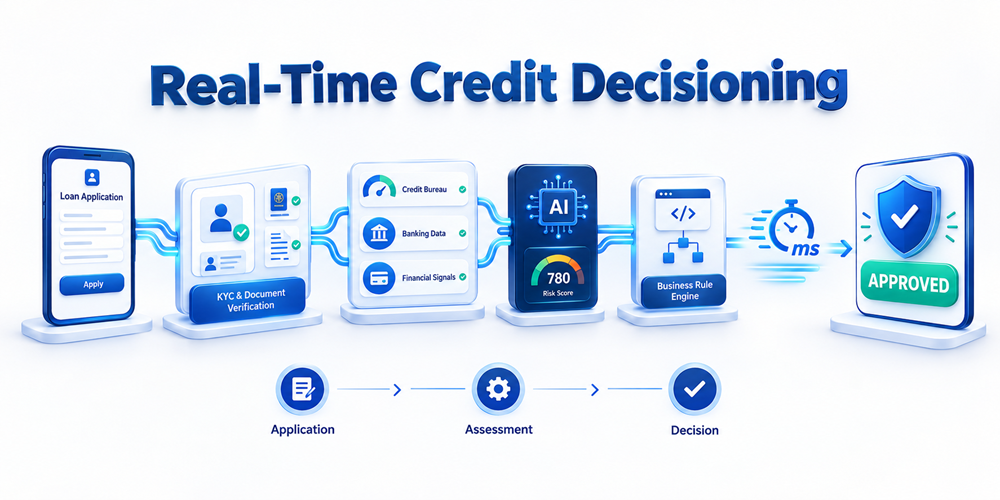
How Real-Time Credit Decisioning Works: The End-to-End Flow
A modern real-time decisioning flow, as implemented in a well-designed LMS, generally follows these stages:
Step 1: Application Intake
The borrower submits an application through a web portal, mobile app, partner integration, or API (in the case of embedded lending). Basic applicant details, loan amount, tenure, and purpose are captured digitally from the start — no paper forms.
Step 2: Digital KYC and Identity Verification
The system verifies the applicant’s identity using digital KYC methods such as Aadhaar-based e-KYC, PAN verification, video KYC, or document OCR (optical character recognition) that extracts and validates data from uploaded ID documents in seconds.
Step 3: Data Aggregation via APIs
This is the engine room of real-time decisioning. The platform simultaneously calls multiple external and internal data sources:
- Credit bureau APIs (for credit score and repayment history)
- Bank statement analysis (often via Account Aggregator frameworks or statement-parsing APIs)
- Income verification services (payroll data, GST returns, ITR data for self-employed applicants)
- Internal core banking or CRM data (for existing customers)
- Alternative data where permitted (utility payments, telecom data, digital transaction history)
Because these calls happen in parallel rather than sequentially, the entire data-gathering step — which used to take days of manual chasing — can complete in seconds.
Step 4: Fraud and Risk Screening
Automated fraud checks run concurrently, cross-referencing applicant data against internal blacklists, duplicate application detection, device fingerprinting, and consortium fraud databases to flag suspicious applications before they proceed further.
Step 5: Credit Scoring and Risk Modeling
The aggregated data feeds into a scoring engine. This can be:
- A traditional statistical scorecard built on bureau attributes and internal performance data
- A machine learning model trained on historical loan performance to predict probability of default
- A hybrid approach combining bureau score, internal score, and alternative data signals
The output is typically a risk score or probability of default, alongside key reason codes explaining the score.
Step 6: Policy Rule Engine
The risk score is passed through a configurable rule engine that applies the lender’s credit policy: minimum score thresholds, debt-to-income ratio caps, loan-to-value limits, sector or geography restrictions, exposure limits, and regulatory caps. This is where business logic — not just statistics — determines the final eligibility and loan terms (amount, tenure, interest rate, collateral requirements).
Step 7: Decision Output
Based on the combined score and rules, the system returns one of three outcomes:
- Auto-approve: The application meets all criteria and is approved instantly, often with pre-filled loan terms.
- Auto-decline: The application fails hard policy rules (e.g., blacklist match, score below minimum threshold) and is declined instantly with a compliant adverse-action explanation.
- Refer for manual review: Borderline cases, high-value loans, or applications with conflicting signals are routed to a human underwriter, but with all the data pre-aggregated and pre-scored, so the manual review itself is much faster.
Step 8: Straight-Through Processing to Disbursal
For approved loans, the decision flows directly into e-agreement generation, e-signing (via e-sign/Aadhaar e-sign frameworks), and disbursal instructions — often enabling funds to reach the borrower’s account within minutes of approval for smaller-ticket loans.
The Core Technology Components Behind Real-Time Decisioning
Building (or buying) a real-time credit decisioning capability requires several interlocking technology components:
- API Orchestration Layer
A middleware layer that manages simultaneous calls to bureau, banking, KYC, and fraud data sources, handles retries and timeouts gracefully, and normalizes responses into a consistent format for downstream scoring.
- Rules and Policy Engine
A configurable, often no-code or low-code engine that lets credit and risk teams update lending policies — score cutoffs, eligibility rules, pricing tiers — without needing a software development cycle every time policy changes.
- Scoring and Analytics Engine
Houses the statistical or ML models used to generate risk scores. Modern platforms support champion-challenger testing, where a new model is run alongside the existing one to compare performance before full rollout.
- Document and Data Verification Tools
OCR, e-KYC integrations, and bank statement analyzers that convert unstructured documents into structured, usable data automatically.
- Case Management and Workflow Engine
Routes referred applications to the right underwriter queue, tracks SLAs, and maintains a full audit trail of every automated and manual decision step.
- Core Lending / LMS Integration
Ensures that once a decision is made, the loan account is created, disbursed, and begins its lifecycle (repayments, collections, reporting) without manual re-entry.
- Monitoring, Explainability, and Audit Layer
Tracks model performance, decision consistency, and provides the reason codes and audit logs regulators and internal risk committees require — especially important as more institutions adopt AI-based scoring.
Key Benefits of Real-Time Credit Decisioning
For Lenders (Banks and NBFCs):
- Higher application throughput. Automation removes the underwriter-bandwidth bottleneck, letting the same team process far more applications.
- Lower cost per loan. Reduced manual effort translates directly into lower operating costs, which matters most for small-ticket, high-volume lending.
- Improved consistency and reduced bias. A codified rules and scoring engine applies the same criteria to every applicant, reducing the variability that comes from individual underwriter judgment.
- Better risk visibility. Real-time data means lenders are assessing the applicant’s current financial position, not a snapshot from weeks earlier when the paperwork was first collected.
- Competitive differentiation. In markets where borrowers compare offers across multiple lenders, speed of approval is increasingly a deciding factor.
- Scalability during demand spikes. Automated decisioning can absorb sudden increases in application volume (festive season loans, marketing campaigns) without proportional headcount increases.
For Borrowers:
- Near-instant clarity on loan eligibility, reducing anxiety and uncertainty
- Fewer document resubmissions, since data is pulled digitally and validated upfront
- Faster access to funds, which matters especially for emergency or working-capital needs
- More personalized loan terms, since real-time data allows for finer risk-based pricing rather than blanket rates
Real-Time Decisioning vs. Traditional Underwriting: A Comparison
Traditional underwriting is document-heavy, sequential, and dependent on individual underwriter availability, typically taking anywhere from two days to several weeks depending on loan type and lender. Real-time decisioning is data-API-driven, parallelized, and largely automated, typically resolving in seconds to a few minutes for straightforward cases, with only complex or borderline files routed to human review.
The difference isn’t just speed. Traditional underwriting tends to rely heavily on the specific documents a borrower happens to submit and the judgment of whichever officer reviews the file, which can introduce inconsistency. Real-time decisioning, by contrast, draws on a standardized set of data sources and applies the same scoring logic and policy rules to every applicant, which — when designed carefully — produces more consistent and defensible outcomes, along with a complete digital audit trail of exactly why each decision was made.
The Role of a Modern LMS in Enabling Real-Time Decisioning
None of this works as a bolt-on to a legacy, paper-based loan management system. Real-time credit decisioning requires a loan management system that is API-first from the ground up — one where origination, credit decisioning, disbursal, servicing, and collections all sit on a connected data model rather than isolated modules.
This is precisely the gap platforms like Roopya are designed to close for banks and NBFCs. A purpose-built LMS for real-time decisioning typically provides:
- Pre-built integrations with major credit bureaus, KYC providers, Account Aggregator frameworks, and payment/disbursal rails, so lenders don’t have to build and maintain each connection themselves.
- A configurable rule and policy engine that risk teams can adjust directly, without waiting on engineering sprints for every policy tweak.
- Embedded scoring capability, whether lenders want to plug in their own proprietary models or use built-in scorecards as a starting point.
- End-to-end workflow continuity, so an automated decision flows straight into agreement generation, e-sign, and disbursal without manual handoffs between systems.
- Multi-product flexibility, supporting different decisioning logic for personal loans, business loans, gold loans, or supply-chain finance from a single platform.
- Compliance and audit tooling built in, so every automated decision is logged, explainable, and ready for regulatory review.
For NBFCs and banks that have historically relied on spreadsheets, disconnected point solutions, or aging core systems, migrating to a real-time-capable LMS is often the single highest-leverage step toward materially faster loan approvals.
Implementation Challenges to Plan For
Real-time decisioning delivers significant upside, but institutions that implement it well tend to plan carefully for these challenges:
- Data quality and coverage gaps. Automated decisions are only as good as the data feeding them. Thin-file applicants (limited credit history) or regions with weaker data infrastructure may need alternative data sources or a blended manual-automated approach.
- Model governance. As institutions move from simple rule-based systems to machine learning models, they need robust processes for model validation, bias testing, and ongoing performance monitoring to avoid drift or unintended discriminatory outcomes.
- Regulatory alignment. Digital lending is an area of active regulatory attention. Lenders need to ensure decisioning logic, data usage, and disclosure practices align with applicable digital lending guidelines, data privacy requirements, and fair-lending expectations in their jurisdiction.
- Exception handling design. Not every application should be fully automated. Designing sensible thresholds for when a case is escalated to a human underwriter is critical to managing risk on edge cases and high-value loans.
- Change management. Credit and risk teams accustomed to manual review processes need training and confidence-building to trust and effectively oversee an automated system, including understanding how to interpret and override decisions when necessary.
- System resilience. Because decisioning depends on multiple external APIs (bureaus, KYC providers, banking data), the platform needs robust fallback logic for when a data source is slow or unavailable, so a single vendor outage doesn’t halt the entire lending pipeline.
Best Practices for Rolling Out Real-Time Decisioning
- Start with a well-defined product segment. Many lenders begin with a simpler, lower-risk product (such as small-ticket personal loans or pre-approved offers to existing customers) before extending real-time decisioning to more complex products like secured business loans.
- Run champion-challenger testing. Introduce new scoring models or policy changes alongside existing logic on a sample of traffic before full rollout, to validate performance safely.
- Keep humans in the loop for edge cases. Define clear referral thresholds so borderline, high-value, or unusual applications still get expert review, while the bulk of straightforward cases are automated.
- Invest in explainability. Ensure the system can articulate why a decision was made in plain terms — both for regulatory compliance and for customer-facing adverse action notices.
- Monitor continuously. Track approval rates, default rates by score band, and processing times on an ongoing basis to catch model drift or policy issues early.
- Choose an LMS partner with proven integrations. Building bureau, KYC, and Account Aggregator connections from scratch is time-consuming; a platform with these already built in significantly shortens time-to-market.
Metrics That Matter: How to Measure Success
Rolling out real-time credit decisioning is not a one-time project — it’s an ongoing operational capability that needs to be measured and tuned continuously. Lenders that get the most value from their decisioning platform typically track a consistent set of metrics across three dimensions:
Speed and efficiency metrics:
- Time to decision: The elapsed time between application submission and a final decision (approve, decline, or refer). This is the headline metric borrowers feel most directly.
- Straight-through processing rate: The percentage of applications that move from submission to decision without any manual intervention. A rising STP rate is usually the clearest sign that automation is working as intended.
- Underwriter capacity utilization: How much underwriter time is now available for genuinely complex cases versus routine file review, since that capacity can be redirected toward portfolio growth or higher-touch relationship lending.
Risk and portfolio quality metrics:
- Approval rate by score band: Tracking whether approval rates at each risk band remain stable over time, or whether they’re drifting in ways that suggest a model or policy issue.
- Default rate by decisioning channel: Comparing the eventual default performance of automated decisions against manually underwritten ones helps confirm that speed isn’t coming at the cost of risk quality.
- False decline rate: Estimating how many creditworthy applicants are being automatically declined, often assessed through periodic sampling or “reject inference” analysis, since these are lost revenue opportunities as much as they are risk-management questions.
Customer experience metrics:
- Application abandonment rate: How many applicants drop off before completing the process, which often points to friction earlier in the funnel (document upload, e-KYC steps) rather than the decisioning step itself.
- Customer satisfaction and Net Promoter Score (NPS): Direct borrower feedback on the approval experience, which is increasingly influenced by speed and transparency as much as by the final interest rate offered.
- Disbursal turnaround time: The time from approval to funds actually reaching the borrower’s account, which captures the full value of straight-through processing rather than the decisioning step in isolation.
Reviewing these metrics on a regular cadence — weekly for operational metrics, monthly or quarterly for risk and portfolio metrics — allows credit and risk teams to catch problems early, whether that’s a data source that’s started returning incomplete information or a policy rule that’s inadvertently become too conservative or too loose.
The Future of Credit Decisioning
Several trends are shaping where real-time credit decisioning goes next:
- Deeper use of alternative and cash-flow data, especially through Account Aggregator ecosystems, enabling more accurate assessment of thin-file and new-to-credit borrowers.
- Greater adoption of explainable AI models, balancing the predictive power of machine learning with the transparency regulators and lenders require.
- Embedded lending and API-first distribution, where credit decisions are delivered inside e-commerce checkouts, payroll platforms, or B2B marketplaces rather than only through a lender’s own app.
- Real-time portfolio-level risk monitoring, extending the “real-time” principle beyond origination into ongoing account management and early-warning systems for existing borrowers.
- Increasing regulatory frameworks specifically addressing algorithmic lending decisions, data consent, and digital lending conduct, which will shape how decisioning systems must be designed and documented going forward.
Institutions that build flexible, well-governed real-time decisioning capability now will be far better positioned to adapt as these trends mature, rather than needing a costly platform overhaul later. The lenders who treat their decisioning engine as a static, one-time build tend to fall behind; the ones who treat it as a living system — continuously fed with new data sources, refined models, and updated policy — are the ones who compound their advantage year over year.
Why Choosing the Right Technology Partner Matters
Because real-time credit decisioning touches so many parts of the lending stack — origination, KYC, credit bureau integration, scoring, policy management, disbursal, and servicing — the choice of technology partner has an outsized impact on how quickly and reliably a lender can go live.
A few questions are worth asking of any LMS or decisioning vendor before committing:
- How many bureau, KYC, and Account Aggregator integrations are already live and production-tested, versus how many would need to be built from scratch for your institution?
- How configurable is the rules and policy engine — can credit and risk teams make changes directly, or does every policy update require a development request?
- Does the platform support your specific loan products — personal, business, gold, supply-chain, or secured lending — with the flexibility to add new products without a platform rebuild?
- What audit, explainability, and reporting capabilities are built in, and do they align with the regulatory expectations in your market?
- How does the platform handle partial data or vendor outages, and what fallback logic exists to avoid a single point of failure?
- What does the implementation timeline actually look like for an institution of your size and complexity, based on past deployments?
These questions matter because the gap between a decisioning system that merely works in a demo and one that reliably performs in production, at scale, under real regulatory scrutiny, is significant. Getting this choice right early avoids costly re-platforming later.
Conclusion
Real-time credit decisioning has moved from a competitive edge to a baseline expectation in modern lending. By combining instant data access, automated risk scoring, configurable policy rules, and straight-through processing, banks and NBFCs can cut loan approval times from days to seconds — without sacrificing the risk discipline that responsible lending requires.
Getting there, however, depends heavily on the underlying loan management system. A fragmented stack of manual processes and disconnected tools cannot deliver real-time outcomes, no matter how good the credit policy on paper. What’s needed is an API-first, configurable, audit-ready LMS built specifically to support this kind of automated, high-speed decisioning — which is exactly the capability Roopya is built to provide for banks and NBFCs looking to modernize their lending operations.
Frequently Asked Questions (FAQ)
Q1: What is real-time credit decisioning in simple terms?
Real-time credit decisioning is an automated process where a lending system reviews an applicant’s data and returns a loan approval, decline, or referral decision within seconds to a few minutes, instead of the days or weeks a manual review typically takes.
Q2: How is real-time credit decisioning different from instant loan approval apps?
Instant loan approval apps are usually the customer-facing product; real-time credit decisioning is the underlying engine that makes that instant experience possible. The decisioning engine handles data aggregation, scoring, and policy checks behind the scenes.
Q3: Is real-time credit decisioning safe and accurate for lenders?
Yes, when implemented with proper data sources, validated scoring models, a well-configured rule engine, and clear thresholds for routing complex cases to human underwriters. Continuous monitoring and model governance are essential to maintaining accuracy over time.
Q4: What data sources are typically used in real-time credit decisioning?
Common sources include credit bureau reports, bank statement analysis, KYC and identity verification data, income documents (payroll, GST, ITR), internal customer history, and, where permitted, alternative data such as utility or telecom payment records.
Q5: Can real-time credit decisioning work for both secured and unsecured loans?
Yes, though the complexity differs. Unsecured, small-ticket loans are the easiest to fully automate. Secured loans (such as those involving property or gold as collateral) often still include a manual verification or valuation step, even when the credit scoring itself is automated.
Q6: Do NBFCs need a special LMS to implement real-time credit decisioning?
Most NBFCs and banks need a loan management system that is API-first and supports integrated data pulls, a configurable rules engine, and straight-through processing to disbursal. Legacy, paper-based, or heavily siloed systems typically cannot support true real-time decisioning without significant re-architecture.
Q7: How does real-time credit decisioning handle regulatory compliance?
A well-designed decisioning platform maintains a full audit trail of data used, rules applied, and reasons for each decision, supports compliant adverse-action disclosures, and is built to align with applicable digital lending and data privacy regulations.
Q8: What is the typical implementation timeline for a real-time decisioning system?
This varies by institution size and existing infrastructure, but lenders adopting a purpose-built LMS platform with pre-built bureau, KYC, and payment integrations can typically go live significantly faster than building custom integrations from scratch in-house.