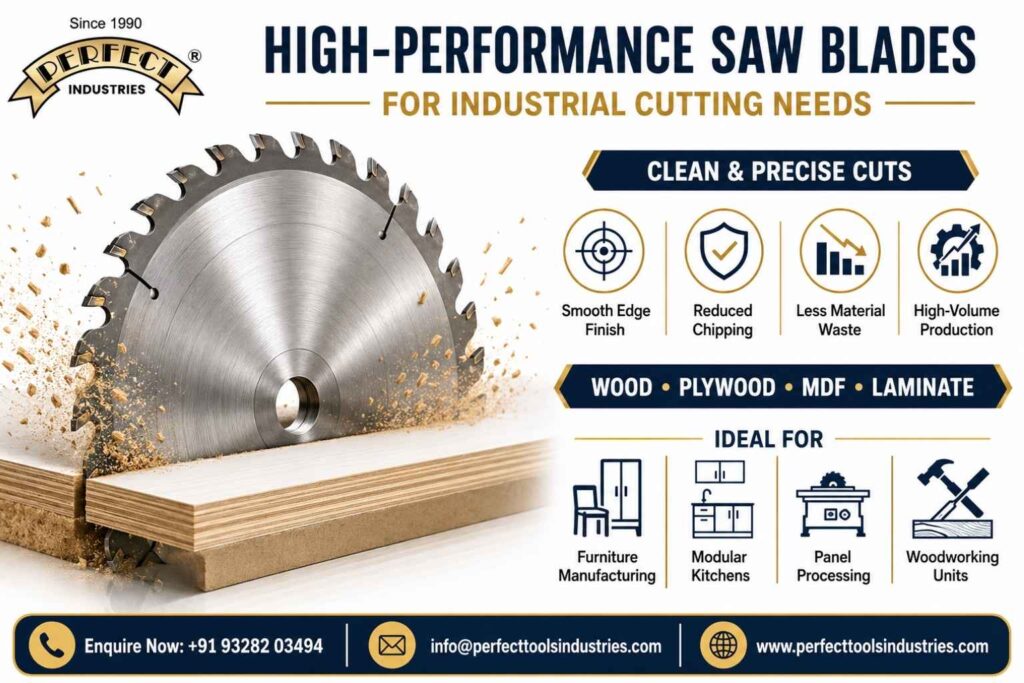
High-Performance Saw Blades for Industrial Cutting Needs Perfect Tools Industries
Saw Blades for Wood Cutting
Industrial cutting demands more than just a powerful machine. It requires the right tooling to achieve clean edges, accurate dimensions, and a dependable finish on every job. At Perfect Tools Industries, we offer high-performance Saw Blade solutions designed for furniture manufacturers, woodworking units, panel-processing facilities, interior workshops, and other demanding industrial applications.
Whether you cut solid wood, plywood, MDF, particle board, laminate, veneer, or engineered panels, the right blade directly affects your production quality. A well-selected cutting tool helps you reduce chipping, avoid burn marks, minimise material wastage, and maintain a professional finish. As a result, your team can work faster while maintaining consistency across every component.
Our Saw Blades are developed to support regular production needs with reliable cutting performance. We understand that every workshop, material, machine, and finish requirement is different. Therefore, we help businesses select a suitable cutting solution based on their actual application requirements.
Why the Right Saw Blade Matters in Industrial Cutting
A cutting blade may look like a simple machine component, but it plays a major role in the final quality of furniture, panels, doors, cabinets, and decorative products. When the blade matches the material and machine correctly, it delivers smoother cuts and supports better workflow.
In contrast, an incorrect or poorly maintained blade can lead to rough edges, excessive chipping, slow cutting, overheating, and higher machine load. These issues often create unnecessary rework and material loss. Consequently, choosing the right tool becomes an important production decision rather than a minor purchase.
01. Better Edge Quality and Surface Finish
A high-quality Saw Blade supports clean and controlled cutting. This is especially important when working with laminated boards, pre-finished panels, veneers, MDF, and particle board. These materials can chip easily if the tooth geometry, cutting speed, or blade type is not suitable.
Clean edges reduce the need for additional finishing work. Moreover, they help manufacturers maintain a premium appearance in cabinets, modular kitchens, shutters, furniture panels, and interior components. Every precise cut contributes to a more polished final product.
02. Improved Accuracy for Repeat Production
Furniture and panel manufacturing often involves repeated cutting of multiple components to the same size. A stable and suitable blade helps operators achieve better dimensional accuracy throughout the production process.
When every panel fits properly, assembly becomes easier and faster. In addition, accurate cutting reduces avoidable mistakes during edge banding, drilling, fitting, and installation. This allows businesses to improve production control and deliver more consistent work to customers.
03. Reduced Material Wastage and Rework
Material wastage directly affects production cost. Chips, uneven cuts, burn marks, and incorrect dimensions can make expensive boards unusable. However, the correct cutting tool helps minimise these problems.
A suitable blade cuts efficiently without putting unnecessary pressure on the material. Therefore, operators can achieve cleaner results with fewer rejected pieces. This improves material utilisation and helps protect profit margins in high-volume manufacturing.
04. Reliable Performance During Daily Operations
Industrial units need tools that can perform consistently during routine operations. A Saw Blade designed for the right application helps maintain cutting quality even when production schedules are demanding.
Reliable cutting performance also supports smoother workflow between different stages of manufacturing. For example, a clean-cut panel moves more easily to drilling, edging, polishing, assembly, or packaging. This reduces delays and helps teams maintain production targets.
Saw Blade for Better Cutting and Higher Productivity
The cutting tool may be one part of the overall machine setup, yet it has a major influence on quality, productivity, and finish. When businesses choose the correct blade, they create a stronger foundation for efficient manufacturing.
01. Saw Blade Selection Based on Material and Application
No single blade is ideal for every material. The material thickness, density, surface finish, machine type, blade diameter, tooth design, and operating speed all influence blade selection. That is why businesses should consider the actual cutting task before making a decision.
At Perfect Tools Industries, we provide cutting solutions for a broad range of woodworking and panel-processing applications. Our team focuses on practical requirements so that customers can choose tools that support smoother, more productive operations.
02. Saw Blades for Solid Wood Cutting
Solid wood requires a blade that can handle natural grain variations and density changes. The correct blade helps create smooth cuts while reducing the chance of splintering and burning. It is suitable for furniture parts, door frames, wooden profiles, joinery components, and custom woodwork.
Woodworkers should also ensure that the feed rate and cutting speed match the material. When the machine settings and blade selection work together, the cutting process becomes more controlled and efficient.
03. Saw Blades for Plywood, MDF, and Particle Board
Plywood, MDF, and particle board are widely used in furniture and modular kitchen manufacturing. However, these materials require careful cutting because edge damage can affect the appearance and finishing quality of the final product.
The right Saw Blade helps deliver neat cuts on panel surfaces while reducing chipping around the edges. This is important for cabinet shutters, wardrobes, shelving units, office furniture, display units, and interior panels. As a result, manufacturers can reduce rework and achieve a more refined finish.
Saw Blades for Laminates, Veneers, and Decorative Panels
Decorative materials need extra attention because visible chipping can spoil the finished look. Laminated boards, veneers, acrylic-coated panels, and other surface-finished materials demand clean, controlled cutting.
A suitable blade supports smoother edge quality and helps protect the decorative surface during processing. Therefore, it becomes a valuable choice for premium furniture, kitchen components, retail fixtures, office interiors, and customised interior projects.
Match Blade Design with Your Machine
The same material may require a different blade depending on whether you use a table saw, panel saw, beam saw, sliding table saw, CNC cutting machine, or another industrial system. Blade diameter, bore size, tooth configuration, and machine RPM must work together correctly.
Always check machine recommendations before installation. This helps maintain safe operation while supporting the best possible cutting result.
Key Features of Our Industrial Saw Blades
Perfect Tools Industries focuses on tools that help customers achieve dependable cutting performance in regular and high-volume applications. Our blade solutions are selected to support quality, efficiency, and practical workshop needs.
Key Benefits
- High-performance cutting for industrial requirements
- Clean, smooth, and precise cutting results
- Suitable for wood, plywood, MDF, laminate, and panel boards
- Helps reduce chipping, burning marks, and material wastage
- Supports better edge finish and product quality
- Suitable for regular as well as high-volume production
- Available for different machines and cutting applications
- Helps improve workflow and reduce unnecessary rework
- Reliable choice for furniture and woodworking industries
- Supports consistent results across repeated cutting operations
Applications of Saw Blades
Our cutting solutions are suitable for many industrial and woodworking requirements, including:
- Furniture and modular kitchen manufacturing
- Plywood, MDF, and particle board cutting
- Laminate, veneer, and decorative panel processing
- Solid wood cutting and joinery work
- Cabinet, wardrobe, door, and shutter manufacturing
- Interior workshops and custom furniture units
- Industrial panel saw operations
- Office furniture and retail display production
- CNC and machine-based wood panel processing
Focus on the Finish You Need
A rough-cutting application and a fine-finish application require different tool characteristics. For instance, a blade used for fast material removal may not provide the same edge quality as one intended for finished decorative panels.
Before choosing a Saw Blade, consider the final use of the component. If the edge will remain visible, choose a solution that supports a cleaner finish. If the piece will be further processed, the production requirement may be different. This simple evaluation helps you choose a more practical tool.
How to Maintain a Saw Blade for Longer Performance
Even a high-quality blade needs proper care. Regular maintenance helps preserve cutting quality, improves working life, and supports safer machine operation. In addition, it helps businesses avoid unexpected production interruptions.
01. Keep the Blade Clean
Wood resin, adhesive residue, dust, and laminate particles can build up on the blade during use. This buildup can increase friction and affect cutting performance. Therefore, clean the tool regularly using suitable blade-cleaning methods.
A clean blade cuts more efficiently and helps reduce overheating. It also allows operators to inspect the teeth and body more clearly for signs of damage or wear.
02. Install It Correctly
Correct installation is essential. Operators should check the blade direction, bore fitment, flange condition, and machine compatibility before starting work. A poorly installed blade can create vibration, inaccurate cuts, and safety concerns.
Always follow machine guidelines and use the proper tools for fitting. This supports stable operation and better cutting control.
03. Use Suitable Cutting Speed and Feed Rate
Cutting too fast or too slowly can affect the final result. Excessive feed pressure may cause rough edges, overheating, or tooth damage. On the other hand, an unsuitable speed can reduce efficiency and affect the finish.
Train operators to use suitable settings for the material and machine. When cutting parameters are controlled properly, the Saw Blade can perform more effectively for a longer period.
04. Sharpen or Replace When Required
A dull or damaged blade should not be used for continued production. It can increase machine load, create poor edges, and waste material. Timely sharpening helps restore cutting performance when the blade is suitable for reconditioning.
However, if the tool has serious damage, missing teeth, cracks, or excessive wear, replacement is the safer choice. Regular inspection helps identify these issues before they affect production quality.
Why Choose Perfect Tools Industries for Saw Blades?
Perfect Tools Industries understands the everyday requirements of woodworking, furniture production, and industrial panel processing. We aim to provide practical cutting solutions that support accurate results, cleaner finishes, and dependable workflow.
We do not believe that every application needs the same blade. Instead, we consider the material, machine, cutting requirement, production volume, and desired finish. This approach helps customers choose a tool that matches their operational needs.
When you choose our Saw Blades, you get a cutting solution built to support better productivity and quality in your workshop or manufacturing unit. From solid wood cutting to decorative panel processing, the right tool can improve the result of every cut.
For accurate, smooth, and dependable industrial cutting, connect with Perfect Tools Industries. Choose the right blade based on your material, machine, and production requirement, and bring greater consistency to your cutting operations.
For More Info:
📞 Enquire Now: +91 93282 03494
📧 Email: info@perfecttoolsindustries.com
🌐 Visit: https://www.perfecttoolsindustries.com/right-saw-blade/