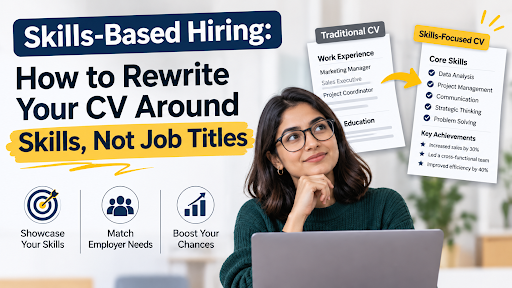
Employers across the UK and Ireland are talking more about skills-based hiring, which means judging candidates by what they can do rather than where they have worked or what their job titles were. For some roles, formal degree requirements are being relaxed, and for others, practical assessments carry more weight. Whatever the exact policy, the message for applicants is consistent: make your skills impossible to miss.
This guide shows how to rewrite your CV around skills and evidence.
What Skills-Based Hiring Means
In a traditional process, recruiters often shortlist using shortcuts: a familiar employer, a recognised job title or a particular degree. Skills-based hiring tries to replace those shortcuts with direct evidence of ability, such as work samples, assessments, structured interviews and detailed examples.
It doesn’t mean qualifications and experience no longer matter. It means they are treated as evidence of skills rather than as the goal in themselves. A CV that makes the skills explicit helps the reader make that link quickly. You can find the best CV writer here at cvireland.com.
Why Job Titles Can Mislead
Titles vary enormously between organisations. A “manager” in one firm may lead twenty people, while in another they manage a single process. A title can also fail to capture what you did. Someone called “administrator” might have run a budget, trained new staff and redesigned a system, none of which the title reveals.
By building your CV around skills, you control the story. You show the reader what you can do, with titles playing a supporting role.
Step 1: Audit Your Skills
Start by listing everything you have done in the last five to ten years, including projects, responsibilities, volunteer work and informal tasks. Under each, write the skills involved. You’ll probably find patterns, such as analysis, planning, negotiation, training or customer care.
Then sort them into three groups: skills central to your target roles, skills that are useful but secondary, and skills that are no longer relevant. Your CV should lead with the first group.
Step 2: Study Your Target Roles
Read five or six job adverts for the type of role you want and highlight repeated skills and phrases. These are the capabilities employers consistently value. Compare them with your audit and note where you have strong evidence, where your evidence is thin, and where you may need to build experience or training.
This also helps you use the right vocabulary. If you call something “client liaison” but the market says “account management”, a recruiter scanning quickly may miss the match.
Step 3: Build a Skills-Led Profile
Replace a vague opening paragraph with a tight profile that names your core strengths. For example: “Operations professional with seven years’ experience in logistics, specialising in process improvement, supplier management and team training.” Follow it with a short skills section, grouped under headings such as technical, analytical and interpersonal.
Keep the list honest and selective. Ten well-chosen skills with evidence beat thirty with none.
Step 4: Prove Each Skill
Every important skill needs an example somewhere in the CV. Use a simple pattern: what you did, how you did it and what happened as a result. “Negotiated new supplier contracts across three regions, reducing annual costs by €120,000” proves negotiation, analysis and commercial awareness in one line.
For skills that are hard to quantify, describe the scale or context: the size of the team, the number of clients, the complexity of the system or the deadline you met.
Step 5: Choose the Right Format
A skills-led CV doesn’t have to abandon chronology. Most recruiters and ATS tools still expect a reverse-chronological work history, so the best approach is usually a hybrid: skills profile and key achievements at the top, then a conventional experience section. A purely functional CV, with no clear dates or employers, can look as though it’s hiding something.
If your history has gaps or you’re changing careers, the hybrid format lets you lead with relevant strengths while remaining transparent.
Skills-Based Hiring for Career Changers
This approach helps career changers more than almost anyone. Skills such as project management, communication, problem-solving and data analysis transfer across industries, but only if you describe them in the target industry’s language.
Take a teacher moving into training and development, for instance. “Delivered lessons” becomes “designed and delivered learning programmes for groups of up to thirty, adapting content to different abilities”. The experience is the same, but the framing matches the new field.
Show Soft Skills With Evidence
Soft skills such as leadership, adaptability and communication are in high demand but easy to claim and hard to verify. Avoid listing them as bare adjectives. Instead, show them in action: leading a team through a restructure, resolving a difficult client dispute, or mentoring new colleagues to full productivity.
Add Credentials and Learning
Certifications, short courses and micro-credentials can support your skills claims, particularly when you lack formal experience. List the ones directly relevant to your target role, with the provider and year. Don’t pad the section with everything you have ever completed, since irrelevant entries dilute the strong ones.
Make Your Online Profile Skills-Led Too
Recruiters search online profiles by skill, so your headline, summary and skills section should reflect the same priorities as your CV. A linkedin profile writer in dublin or elsewhere can help you phrase them for search, while a linkedin writing agency can handle a complete rewrite if you want a consistent professional brand across platforms.
If you simply want guidance on strategy, a linkedin profile consultant can review what you have and advise on priorities. Ask for examples, and make sure whoever you choose will keep your voice rather than replacing it with generic phrases.
When to Get Professional Help
Rewriting your career around skills is harder than it sounds, because you are too familiar with your own work to see which parts matter. If you want support, look for the best team of resume writers you can find: people with recruitment experience, a consultation process and real samples.
Convenience matters to many people, so searches for resume writers near me are common, but most work is done online, so judge providers on expertise and process rather than postcode. A reputable resume writing agency will ask detailed questions about your target roles, explain its approach and be clear about pricing and revisions.
Final Thoughts
Skills-based hiring rewards candidates who can say clearly what they can do and prove it. Audit your skills, study the market’s language, lead with a focused profile, support every claim with evidence and keep your online presence aligned. Do that, and your CV will speak for you whatever your job titles say.