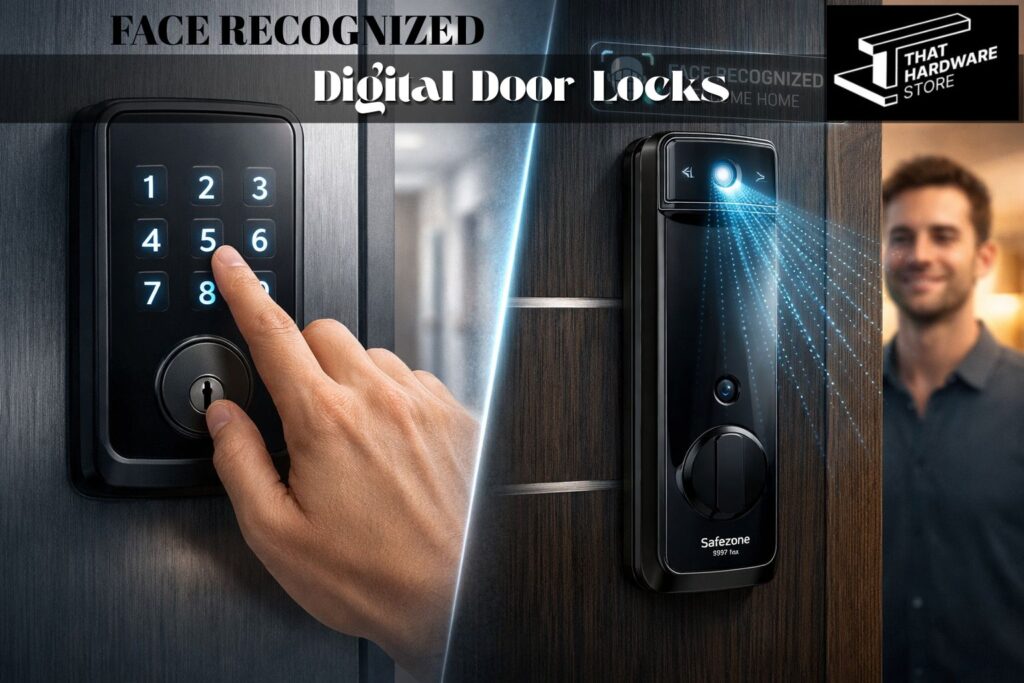
From PIN codes to advanced 3D face recognition – experience the future of smart home security with Safezone S937 Max
smart door lock with face recognition: The concept of “home” has always been synonymous with “safety.” For centuries, that safety was guaranteed by a physical piece of metal—a key. However, as we move deeper into the era of the Internet of Things (IoT) and smart infrastructure, the humble door lock has undergone a radical transformation. We have moved past the era of hiding keys under doormats. Today, the entrance to your home is no longer just a mechanical barrier; it is a sophisticated digital checkpoint.
The journey from traditional mechanical locks to the modern smart door lock with face recognition is a fascinating look at how biometric technology is reshaping our daily lives.
The First Wave: The Rise of Keyless Entry and PIN Codes
The initial shift away from physical keys began with electronic keypads. Inspired by the security systems used in high-end offices and cars, residential PIN-based locks offered a revolutionary promise: freedom from the “key ring.” These early digital locks relied on alphanumeric codes. While they solved the problem of lost keys, they introduced new challenges. “Code wear” (where frequently pressed buttons would fade, giving away the PIN) and “shoulder surfing” (where strangers could watch you type the code) meant that while they were convenient, they weren’t always more secure than a standard deadbolt.The Second Wave: Bluetooth and Mobile Connectivity
As smartphones became the remote controls for our lives, smart locks evolved to include Bluetooth and Wi-Fi connectivity. Homeowners could now lock or unlock their doors using an app. This era introduced e-keys—temporary digital permissions that could be sent to guests or delivery personnel. While mobile connectivity added a layer of remote access control, it still required an action from the user—pulling out a phone, opening an app, or waiting for a Bluetooth handshake. The industry knew that for a truly seamless experience, the lock needed to recognize the human, not just the device.The Biometric Revolution: Fingerprints and Beyond
Biometric technology changed the game by making the user’s body the key. Fingerprint scanners—specifically capacitive sensors—became the standard for premium residential security. This was a significant leap in keyless entry systems. Your unique fingerprint pattern provided a high level of security that was nearly impossible to duplicate with traditional tools. However, fingerprints have limitations. Wet hands, dirty sensors, or aging skin can sometimes cause “False Rejection Rates” (FRR). This led engineers to look toward the most sophisticated biometric marker we have: the human face.The Pinnacle of Security: Smart Door Lock Face Recognition
We are now entering the age of 3D Biometric Sensing. Unlike older 2D facial recognition (which could sometimes be fooled by a high-resolution photo), modern systems like the Safezone S937 Max use 3D Structured Light technology.How 3D Sensing Works
A smart door lock with face recognition doesn’t just “see” you; it “maps” you. It projects thousands of invisible infrared dots onto your face to measure depth, contours, and the distance between features. This creates a mathematical model that is unique to you.- Anti-Spoofing: Because it measures depth, it cannot be tricked by a 2D image or even a video playing on a screen.
- Low-Light Performance: Using infrared sensors, these locks work perfectly in pitch-black darkness, recognizing the owner the moment they step onto the porch.
- True Hands-Free Experience: This is the ultimate “walk-in” experience. Whether you are carrying groceries or holding a child, the lock identifies you and disengages the bolt before you even reach for the handle.
Why the Shift to 3D Biometrics Matters
When upgrading to a premium digital lock, it’s important to understand the technical advantages that come with 3D sensing compared to older models.- Bank-Grade Security: The algorithms used in 3D face ID locks are similar to those used in high-end smartphones and banking apps, ensuring that your home automation security is top-tier.
- Multi-Factor Authentication (MFA): Many modern locks, such as the Safezone S909 Max, allow for “Dual Verification Mode.” This requires both a fingerprint and a PIN, or a face scan and a fingerprint, providing an impenetrable layer of safety.
- Total Access Logs: Through Wi-Fi enabled smart locks, homeowners receive real-time notifications. You know exactly who entered and when, thanks to the timestamped logs synced to your smartphone.
The Aesthetic of Modern Hardware
The evolution isn’t just internal; it’s external too. The bulky, industrial-looking boxes of the early 2000s have been replaced by sleek architectural hardware. Modern smart locks feature reinforced glass panels, aerospace-grade aluminum alloys, and ergonomic handles. They are designed to complement the aesthetics of a luxury villa or a modern apartment, making the main door entrance a statement of tech-forward living.Comparing the Leaders: Safezone S909 Max vs. S937 Max
In the current market, two models stand out as benchmarks for this evolution:- Safezone S909 Max: Representing the peak of multi-access technology. It combines a biometric fingerprint sensor, emergency mechanical keys, RFID cards, and PIN access. It is the perfect all-rounder for families who want multiple fail-safes.
- Safezone S937 Max: This represents the “Face Recognition” era. With its built-in wide-angle camera and 3D sensing, it offers the fastest, most secure, and most futuristic way to interact with your home. It often includes a built-in digital doorbell and a screen on the inside, allowing you to see who is outside before opening.