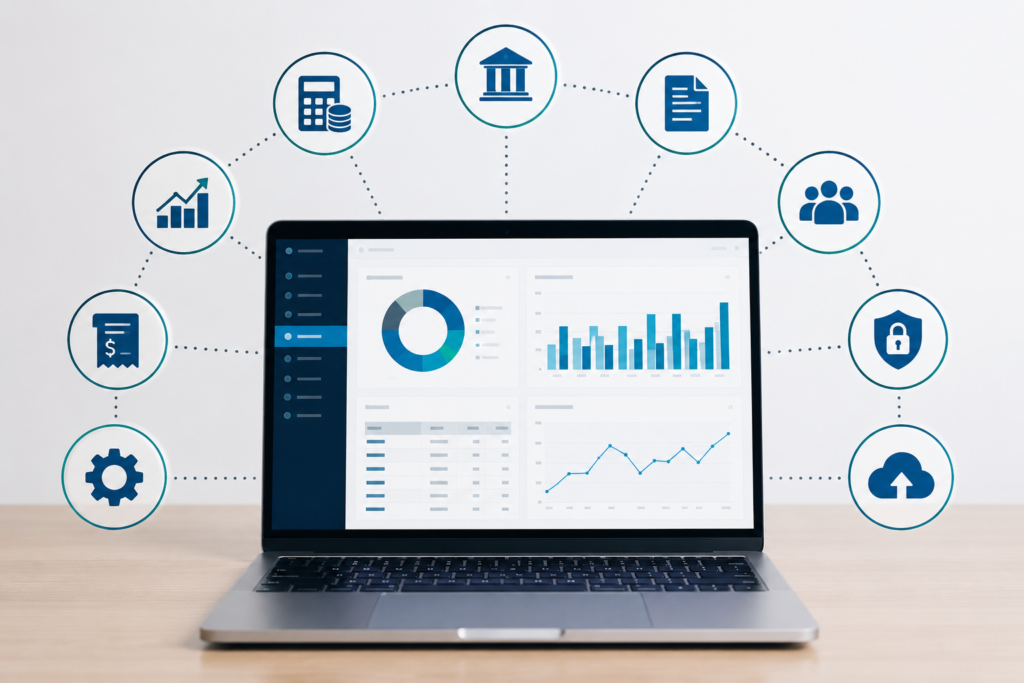
Not all accounting software is created equal — and for MSME owners, choosing the wrong one can mean wasted money, compliance headaches, and hours of manual work that automation was supposed to eliminate in the first place. With so many products on the market, it’s easy to get distracted by flashy dashboards or long feature lists that don’t actually matter for how your business runs day to day.
Understanding the essential MSME accounting software features is the first step toward making a smart, future-proof decision. This guide walks through exactly what small and medium businesses should look for — from GST compliance to inventory management — so you can choose software that genuinely saves time and supports growth, instead of adding complexity.
Why Feature Selection Matters More Than Brand Name
Many MSME owners choose accounting software based on popularity or recommendations alone, without checking whether it actually fits their business model. A retail business, a services firm, and a small manufacturer all have very different accounting needs — and the right feature set can vary significantly between them.
Choosing software based on actual requirements rather than marketing claims helps avoid:
- Paying for unused advanced features
- Missing critical compliance tools
- Needing to switch platforms later as the business grows
Must-Have Features in MSME Accounting Software
1. GST and Tax Compliance Automation
For Indian MSMEs, this is arguably the single most important feature. Software should be able to:
- Auto-calculate GST on invoices
- Generate GSTR-ready reports
- Reconcile input tax credit automatically
- Handle TDS calculations where applicable
Without this, business owners end up manually cross-checking data every filing cycle — exactly the kind of repetitive work automation is meant to eliminate.
2. Integrated Invoicing and Billing
A strong billing and accounting software solution should let you generate professional, GST-compliant invoices directly from the same system where your books are maintained — rather than using a separate billing tool that needs manual syncing later. Look for features like:
- Customizable invoice templates
- Automated payment reminders
- Online payment collection links
- Real-time tracking of outstanding receivables
3. Inventory and Stock Management
For product-based MSMEs, inventory tracking directly impacts financial accuracy. Key capabilities include:
- Real-time stock level updates
- Automatic cost of goods sold (COGS) calculation
- Multi-warehouse or multi-location tracking
- Low-stock alerts
4. Bank Reconciliation
Manually matching bank statements to recorded transactions is time-consuming and error-prone. Good software should auto-import bank feeds and suggest matches, cutting reconciliation time from hours to minutes.
5. Payroll and Statutory Compliance
If the business has employees, payroll features should include:
- Salary processing and payslip generation
- PF, ESI, and professional tax calculations
- Compliance reporting for statutory filings
6. Multi-User Access and Role-Based Permissions
As MSMEs grow, more people — staff, managers, and external accountants — need access to financial data. Look for software that allows multiple users with customizable permission levels, so sensitive data stays protected while collaboration remains smooth.
7. Real-Time Reporting and Dashboards
Instead of waiting for month-end summaries, owners should have instant access to:
- Profit & loss statements
- Cash flow reports
- Balance sheets
- Custom financial dashboards
8. Cloud Access and Data Security
Cloud-based systems allow access from anywhere while handling backups and security automatically. Features to check for include:
- Encrypted data storage
- Automatic backups
- Two-factor authentication
- Regular security audits by the provider
9. Scalability and Integrations
As MSMEs grow, their software needs evolve too. A strong integrated accounting platform combines invoicing, inventory, payroll, and compliance in one system — avoiding the operational mess of juggling multiple disconnected tools as transaction volume and team size increase.
Feature Checklist by Business Type
| Feature | Service-Based MSMEs | Retail MSMEs | Manufacturing MSMEs |
| GST invoicing | Essential | Essential | Essential |
| Inventory tracking | Rarely needed | Essential | Essential |
| Bill of materials (BOM) | Not needed | Not needed | Essential |
| Payroll | Important if hiring staff | Important | Important |
| Multi-location support | Optional | Often needed | Often needed |
| Bank reconciliation | Essential | Essential | Essential |
Legal Importance of Feature-Complete Accounting Software
Choosing software with the right compliance features isn’t just about convenience — it has real legal weight for Indian MSMEs.
Why This Matters Legally
- Avoiding penalties: Incomplete or incorrect GST filings can trigger fines and interest charges.
- Udyam Registration compliance: MSMEs registered under Udyam need accurate financial documentation to retain access to benefits like collateral-free loans and priority-sector lending.
- Audit preparedness: Software with automated audit trails makes tax assessments and due diligence considerably smoother.
Business Advantages
- Stronger loan eligibility: Financial institutions favor businesses with clean, automated records when evaluating credit applications.
- Investor readiness: Transparent, feature-complete accounting builds trust during funding conversations.
- Operational efficiency: The right features reduce time spent on manual admin, freeing owners to focus on growth.
Practical Example: Matching Features to Business Needs
Consider a small manufacturing MSME registered under Udyam that initially used basic invoicing software. As orders grew, the business struggled to track raw material costs against finished goods, leading to inaccurate pricing and profit calculations.
By switching to accounting solutions India designed for manufacturing — with BOM tracking, inventory-linked costing, and GST compliance built in — the business was able to:
- Automatically calculate production costs
- Maintain accurate stock valuation
- Generate GST-compliant invoices without manual recalculation
This kind of feature match often makes the difference between accounting software that merely records transactions and one that actively supports business decisions.
Features That Support Global Expansion
MSMEs planning to work with international clients or expand overseas should also consider features that support:
- Multi-currency invoicing and reporting
- Compliance tracking across different tax jurisdictions
- Integration with global business registration processes, such as LLC or company incorporation in other countries
- Consolidated reporting across domestic and international entities
This is particularly relevant for export-oriented MSMEs in sectors like IT services, textiles, and manufacturing, where cross-border transactions are common even at a relatively small scale.
Common Feature-Related Mistakes MSMEs Make
| Mistake | Consequence |
| Choosing software without GST automation | Manual filing errors and compliance risk |
| Ignoring inventory needs for product businesses | Inaccurate cost and profit tracking |
| Skipping multi-user access | Bottlenecks when accountants or staff need data |
| Overlooking payroll compliance features | Risk of statutory filing penalties |
| Not checking scalability | Costly migration to new software later |
Final Thoughts
The right accounting software isn’t defined by how many features it has — it’s defined by how well those features match your business’s actual operations. For most Indian MSMEs, GST compliance, invoicing, inventory tracking, and real-time reporting form the non-negotiable core, with payroll and multi-user access becoming essential as the team grows.
As MSMEs formalize through Udyam registration and increasingly look toward regional or global expansion, choosing software with the right feature set from the start isn’t just a convenience — it’s a foundation for staying compliant, credible, and ready to scale.
Frequently Asked Questions (FAQs)
1. What are the most important features to look for in MSME accounting software?
GST compliance automation, invoicing, bank reconciliation, and real-time reporting are generally considered essential, with inventory and payroll features becoming important depending on business type.
2. Do all MSMEs need inventory management features?
No. Service-based businesses often don’t need inventory tracking, while retail and manufacturing MSMEs typically require it for accurate cost and stock management.
3. Is cloud-based accounting software necessary for small businesses?
While not mandatory, cloud-based software offers advantages like remote access, automatic backups, and easier collaboration, which are increasingly valuable as businesses grow.
4. Can accounting software handle both billing and bookkeeping together?
Yes, most modern platforms combine billing and accounting software functions into a single system, eliminating the need to manually sync data between separate invoicing and bookkeeping tools.
5. Why is payroll integration important for MSME accounting software?
Payroll integration ensures salary processing and statutory deductions like PF and ESI are calculated accurately and reflected directly in the company’s financial records, reducing compliance risk.
6. Should MSMEs planning global expansion look for different accounting features?
Yes. Businesses expanding internationally should prioritize software with multi-currency support and compliance tracking across tax jurisdictions to manage cross-border transactions smoothly.