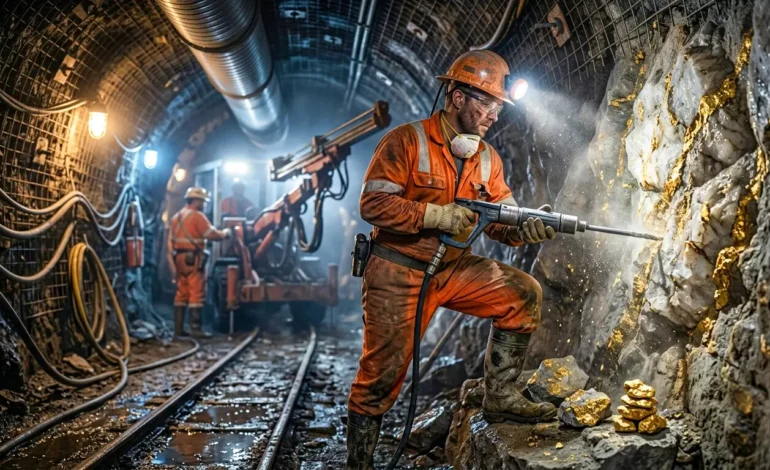
Finding gold is one problem. Reaching it is another.
A gold deposit may contain valuable ore, yet mining it can still be difficult. The deposit might sit far below the surface. It may also run through a thin zone of hard rock. In that situation, digging a huge open pit may not make financial sense.
This is where underground gold mining can become a practical option.
Instead of removing a large amount of rock from the surface, miners build a route to the deposit. They work below ground and remove ore from the area where the gold occurs.
It Starts With a Problem Beneath the Surface
Imagine a gold deposit several hundred metres below ground.
There may be millions of tonnes of rock above it. Most of that rock contains little or no gold. An open-pit mine would need to remove much of this material before reaching the deposit.
That creates a simple economic problem.
The mine would spend money moving huge amounts of waste rock before it could recover the valuable ore.
An underground operation takes a different approach. It creates a smaller path through the surrounding rock and follows the deposit below the surface.
Of course, this does not automatically make underground mining cheaper. Building shafts, tunnels, ventilation systems, and underground infrastructure can cost a lot. The value and size of the deposit must justify that investment.
The Shape of the Gold Deposit Matters
Depth is only part of the decision.
The shape of the deposit can completely change the mining plan. Some gold deposits form wide zones. Others occur as narrow veins that cut through the surrounding rock.
A narrow vein presents a different challenge from a large ore body.
If miners remove too much surrounding rock, they may collect large amounts of waste along with the gold-bearing material. This can lower the grade of the ore and increase processing costs.
For that reason, engineers often design underground workings around the actual shape of the mineralized zone.
The goal is simple: remove valuable rock without removing more waste than necessary.
How Miners Reach a Deep Deposit
There are several ways to create access below the surface.
A vertical shaft can connect the surface with deeper mining levels. A mine may also use a sloping tunnel called a decline. Declines allow trucks and other mobile equipment to travel underground.
Once the main access is ready, smaller tunnels can extend toward the ore.
These tunnels do more than provide a route to the gold. They also carry air, water, electricity, workers, equipment, and broken rock.
So, underground mine design becomes a network problem. Every route needs to connect with the next part of the operation.
Breaking the Rock Is Only the Beginning
After miners reach the deposit, they need to break the ore.
Drills create holes in the rock. Miners then load these holes with explosives and carry out controlled blasts.
The blast breaks the rock into pieces that machines can handle.
But the job does not end there.
Loaders collect the broken material. Trucks, conveyors, or other systems move it through the mine. The ore may then travel through a shaft or decline before reaching the surface.
Every extra movement costs time and money. Therefore, mine engineers spend a great deal of effort planning how ore will travel from the working area to the surface.
The Underground Environment Creates Its Own Challenges
Working below ground brings problems that do not exist in the same way at an open-pit mine.
Fresh air must reach active working areas. Heat, dust, and fumes must leave the mine. Water may also collect underground and require pumping.
Ground stability presents another major concern.
Rock can behave differently at depth than it does near the surface. Engineers therefore monitor underground openings and use support systems where needed.
Modern mines can also use sensors, remote equipment, digital mapping, and automated systems to improve control.
These technologies help, but they do not replace good mine design.
What Makes a Deposit Worth Mining?
Not every underground gold discovery becomes a mine.
The deposit needs enough valuable material to support the cost of development and production. Its grade matters. The expected recovery rate matters too.
Mining companies also consider access, energy costs, equipment, labour, infrastructure, environmental requirements, and the expected gold price.
Therefore, a discovery can be geologically interesting without being economically mineable.
This is one reason the path from gold discovery to production can take years.
From Rock to Recoverable Gold
Once miners bring the ore to the surface, another stage begins.
The rock must go through processing to separate valuable minerals from unwanted material. Crushing and grinding reduce the size of the ore. Further recovery steps then concentrate or extract the gold.
The underground section is therefore only one part of a much larger system.
If you want to understand how the full operation connects, from mine access and drilling to blasting, hauling, ventilation, and processing, this detailed guide to underground gold mining covers the complete process.
Why Underground Mining Can Make Sense
There is no simple rule that says underground mining is always better than open-pit mining.
Instead, the geology decides much of the story.
A shallow deposit spread across a large area may suit an open pit. A deep deposit with valuable ore concentrated in a smaller zone may make more sense underground.
That is the real purpose of gold mining underground: not simply to dig deeper, but to reach valuable ore without moving unnecessary amounts of rock.
When the geology, economics, engineering, and safety requirements all line up, an underground mine can turn a buried gold deposit into a workable resource.