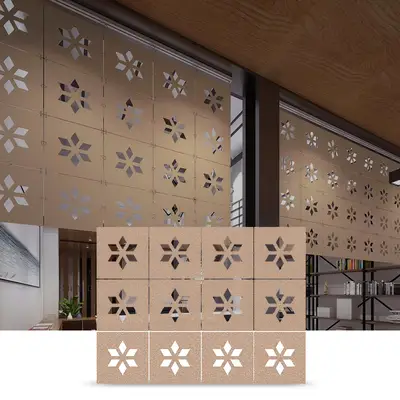
Production capacity is an important factor when choosing a manufacturing partner for an acoustic treatment project. Whether the requirement involves a small number of decorative panels or a large order for a commercial building, the manufacturer’s ability to produce the required quantity within the agreed timeframe can directly affect project planning and delivery.
For architects, contractors, interior designers, and procurement managers, evaluating production capabilities helps reduce the risk of material shortages, inconsistent batches, and construction delays. A professional Acoustic Panel Factory should be able to explain its manufacturing capabilities, production schedules, customization options, and quality-control procedures. Understanding these factors makes it easier to select a supplier that can meet both immediate and long-term project requirements.
1. What Production Capacity Means in Acoustic Panel Manufacturing
Production capacity refers to the quantity of products a factory can manufacture within a specific period under defined operating conditions. It may be measured in panels per day, square meters per week, or another unit appropriate to the product.
However, the stated production capacity does not always represent the quantity available for a new order. Existing orders, equipment maintenance, workforce availability, material supply, and product complexity can influence actual output.
Buyers should therefore distinguish between a factory’s maximum theoretical capacity and its practical available capacity. This provides a more realistic understanding of whether the manufacturer can handle a particular project.
2. Why Production Capacity Matters for Project Deadlines
Construction schedules often depend on several activities taking place in a planned sequence. Acoustic panels may need to arrive before wall finishing, ceiling installation, or final interior decoration can be completed.
If a manufacturer cannot supply the required quantity on time, contractors may face installation delays and additional coordination costs.
A factory with suitable production capacity can help project teams:
- Secure the required panel quantities within the planned schedule.
- Coordinate deliveries with different construction phases.
- Reduce the likelihood of material shortages.
- Plan installation labor more efficiently.
- Maintain progress across large commercial developments.
For projects with strict completion dates, confirming production availability before placing an order is particularly important.
3. Evaluating Equipment and Manufacturing Facilities
A factory’s equipment and production layout can provide useful information about its manufacturing capabilities. Specialized machinery may be needed for cutting, shaping, bonding, wrapping, perforating, or finishing different acoustic panel materials.
The appropriate equipment depends on the products being manufactured. For example, producing fabric-wrapped panels may involve different processes from manufacturing PET fiber panels or perforated wood acoustic products.
When evaluating a potential supplier, buyers should consider:
- Whether the factory has equipment suited to the required panel materials.
- How efficiently production moves between manufacturing stages.
- Whether specialized processes are handled in-house.
- How equipment maintenance is managed.
- Whether production can accommodate different sizes and designs.
A well-organized facility can improve workflow efficiency and support more predictable manufacturing schedules.
4. Understanding the Impact of Customization on Production
Customized acoustic panels often require additional preparation compared with standard products. Special dimensions, colors, shapes, surface patterns, and finishing requirements may involve different production settings or additional processing steps.
These requirements can affect manufacturing time and available capacity. A factory may be able to produce large quantities of standard panels quickly but require more time for complex custom orders.
Before confirming an order, buyers should provide detailed drawings, specifications, quantities, and finish requirements. They should also ask whether samples or prototypes are necessary and how approval affects the production schedule.
Clear specifications help manufacturers plan resources and reduce the risk of rework.
5. Checking Raw Material Availability
Production capacity depends not only on machinery and labor but also on the availability of raw materials. Acoustic panel manufacturing may require polyester fiber, PET materials, fabric, wood components, adhesives, backing materials, or other product-specific inputs.
If essential materials are unavailable, even a factory with substantial equipment capacity may struggle to complete an order on time.
Buyers should ask manufacturers how they manage material sourcing and whether the required materials are available for the proposed production schedule. For large or recurring orders, it may also be useful to discuss how the factory handles changes in material availability.
Reliable material planning supports continuity and helps prevent unnecessary production interruptions.
6. Assessing Workforce and Production Management
Machinery alone does not determine manufacturing output. Skilled workers, production supervisors, quality inspectors, and order-management teams all contribute to a factory’s ability to complete orders efficiently.
An experienced workforce can handle specialized production processes, identify manufacturing problems, and maintain consistent product standards.
Effective production management also involves assigning responsibilities, monitoring progress, coordinating departments, and identifying potential bottlenecks. Buyers can ask how orders are scheduled and whether the manufacturer provides progress updates during production.
These details help establish whether the factory has the organizational capability to manage the project, not just the physical equipment.
7. Balancing Production Volume with Quality Control
High production volume is valuable only when product quality remains consistent. Acoustic panels must meet the agreed specifications for dimensions, material characteristics, appearance, and relevant performance requirements.
Manufacturers should have quality checks throughout the production process rather than relying exclusively on final inspections. Depending on the product, these checks may include:
- Incoming material inspections.
- Dimensional and thickness measurements.
- Surface and finishing evaluations.
- Bonding or assembly checks.
- Packaging inspections.
- Review of relevant product test documentation.
Buyers should also clarify whether quality requirements apply to every production batch and how nonconforming products are handled.
A factory that balances output with appropriate inspection procedures is better positioned to support demanding projects.
8. Confirming Lead Times and Delivery Arrangements
Production capacity and delivery capacity are related but separate considerations. A manufacturer may complete an order on schedule, but packaging, transportation, customs procedures, or site access can still affect the final delivery date.
Before confirming an order, buyers should request a realistic production and delivery timeline. This should account for sample approval, material preparation, manufacturing, quality inspection, packaging, and transportation.
For large projects, phased deliveries may be useful. Instead of receiving the entire order at once, contractors can arrange shipments according to installation progress and available storage space.
Written confirmation of quantities, specifications, lead times, and delivery responsibilities helps prevent misunderstandings.
9. Questions to Ask Before Selecting a Factory
A structured evaluation can help buyers compare potential manufacturing partners more effectively. Useful questions include:
- What is your typical monthly production capacity for the required panel type?
- How much production capacity is currently available?
- Can you accommodate customized dimensions, colors, and finishes?
- Are the required raw materials available for the planned order?
- What is the estimated lead time for samples and bulk production?
- How do you maintain consistency across different production batches?
- Can you provide relevant product specifications and test reports?
- Do you support phased production and scheduled deliveries?
The answers should be evaluated in relation to the project’s actual requirements rather than relying on production figures alone.
Conclusion
Understanding production capacity helps buyers select an acoustic panel manufacturer that can meet project quantities, maintain quality, and deliver within realistic timeframes. Equipment, raw material availability, workforce experience, customization requirements, and production management all influence a factory’s ability to fulfill an order.
By evaluating these factors before making a purchasing decision, architects, contractors, and procurement teams can reduce supply-related risks and improve project coordination. The most suitable manufacturing partner is not necessarily the one with the largest advertised capacity, but the one with the resources, processes, and planning capabilities to meet the project’s specific requirements reliably.