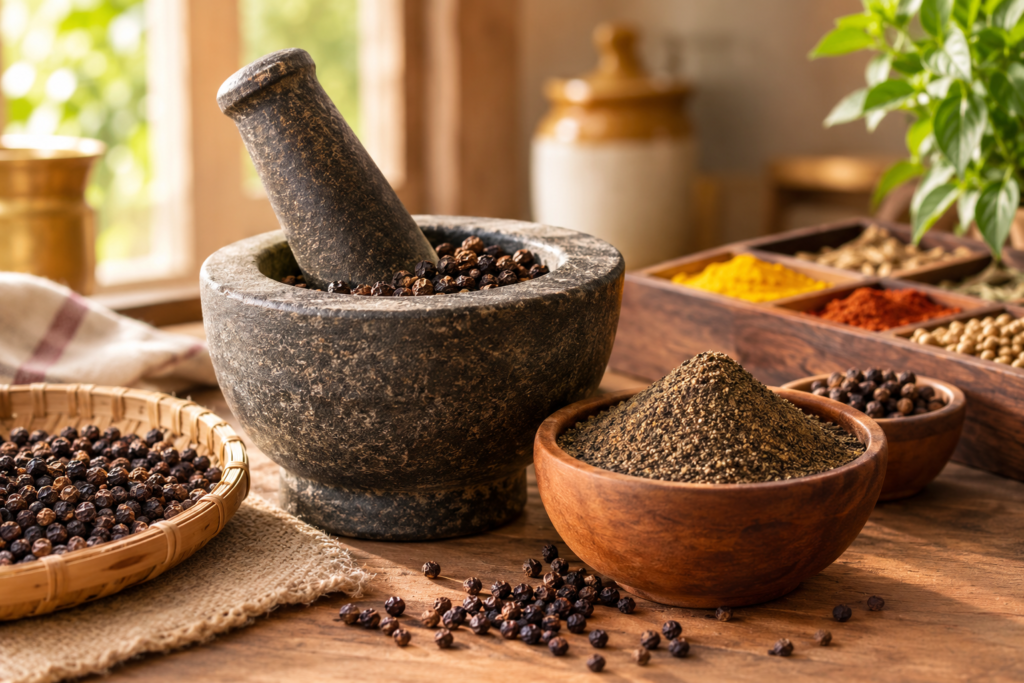
If you grew up in a big joint family, you probably remember the imam dasta. It was heavy, it made a racket, and only one person in the house was really allowed to use it. Once packet masalas came along, it quietly moved up to the loft and stayed there. Lately though, a lot of people are asking about spices made the old way, often after reading up on black pepper powder benefits and wondering if the way pepper is ground has anything to do with it. Short answer: it does, and here’s why.
What Does Pounding Mean?
Nothing fancy. You put whole spices in a heavy mortar and keep hitting them with the pestle till they turn to powder. At home that’s the brass or iron imam dasta. In villages you’ll still see the stone okhli and a long wooden musal. A few small makers have machines that copy the same up and down thump, which is very different from the fast spinning blades of a mixer.
Why bother? Because pounded spices don’t heat up much while they’re being crushed. Pepper, dhaniya and haldi carry most of their smell in natural oils, and heat drives those oils off. Pepper has one more thing going for it, piperine. That’s what gives it the bite, and it’s also what most studies on black pepper powder benefits are looking at. Grind pepper carelessly, or leave it lying around for a year, and what you get is grey dust that only sort of looks like pepper.
How the Pounding Process Works
Cleaning comes first, and it’s slow work. Stones, husk and dust are picked out by hand. Then the spices go out in the sun to dry properly, because even a little leftover moisture means lumps in the jar later, sometimes fungus too.
Not everything gets the same treatment after that. Dhaniya is sometimes roasted on a low flame. Haldi roots are boiled first and then dried for days, till they’re hard enough to knock on. Kali mirch is easy. Clean it, dry it, done.
Then comes the pounding itself, a small handful at a time, with heavy and steady strokes. Working in small batches keeps the spice cool and the powder even. Open a pack of pepper made this way and you’ll know straight off from the smell. That smell is the oil still sitting in the powder, and it’s a good sign you’re getting the black pepper powder benefits linked to piperine.
Last, everything is sieved. The coarse bits go back in the mortar for another round. Packing happens quickly after that, since air and light start eating into the aroma within days. It’s also why pounded spices are usually made in small lots and not stockpiled. Less time on a shelf means more smell, and more of the black pepper powder benefits, left by the time it reaches you.
How to Use Spice Powders at Home
There’s no special recipe here. A pinch in the food you’re already cooking is plenty, and using it a little every day is how most people end up getting black pepper powder benefits. Throw pepper or dhaniya powder into the dal or sabzi towards the end so the smell doesn’t cook off. For a quick tadka, heat ghee, drop in red chilli powder for a few seconds and pour it straight over the dal.
Haldi doodh is another one. Most mothers add a pinch of kali mirch to it without thinking twice, and they’re onto something. Piperine helps the body absorb more curcumin from haldi, which is probably the best studied of all the black pepper powder benefits. Pepper also works on raita, boiled eggs, fruit chaat and soup. One warning though. Fresh powder is a lot stronger than what you might be used to, so go easy the first few times.
What to Check When Buying and Storing
Your nose and eyes will tell you most of it. Pepper powder should be dark brown to black. If it looks grey, skip it. Haldi should be a deep yellow. The smell should hit you the moment you open the pack, and the powder should feel fine with no hard lumps. Flip the pack over and read the label too. One ingredient, that’s it.
At home, a glass jar with a tight lid is your best bet. Keep it away from the gas stove and the window, and never put a wet spoon in it. Buy small packs you’ll finish in a couple of months. Stale powder tastes flat, and you lose a good chunk of the black pepper powder benefits along with the flavour. If you’re shopping for pounded spices online, pick a brand that’s clear about how its powders are made.
About Matrika Natural Foods
Matrika Natural Foods is better known for its wood pressed oils, but they also make spice powders the traditional way, including turmeric, dhaniya, red chilli and black pepper. Their black pepper powder is freshly pounded and comes in 100 g and 200 g packs, small enough to finish while it still smells fresh. They’ve also put up a detailed post on black pepper powder benefits on their blog if you want to read more. You can order online or drop by their stores in Ambala City or Zirakpur.
Summing Up
Pounding is slow, and that’s the whole point. The spice stays cool, the oils stay in, and the powder tastes the way it should. Careful cleaning, small batches and quick packing all add up. With pepper especially, fresher means more flavour and more of the black pepper powder benefits you were after in the first place. So check the colour, smell and label before you buy, and once it’s home, keep it in a tight jar away from heat.