What Is Metal Fabrication And How Does The Process Work?
Every modern structure, heavy vehicle, and industrial machine relies on precision-engineered components built from raw stock. When sourcing custom structural components or industrial assemblies, partnering with a dependable metal fabrication shop fl ensures projects meet exact structural specifications without delays. The core process of metal fabrication transforms raw sheets, bars, and tubes into finished parts through cutting, shaping, and assembly. Understanding how these techniques operate helps manufacturers select the right methods, control production costs, and maintain quality across every build.
What Is Metal Fabrication?
Metal fabrication is the umbrella term for building machines, structures, and individual components from raw metal materials. Unlike machining alone, which typically subtracts material from a solid block, fabrication is a complete production cycle. It combines several distinct processes—including cutting, bending, forming, and joining—to construct finished sub-assemblies or turnkey units.
Raw materials used in fabrication generally arrive as stock items. These include sheet metal, structural steel (such as I-beams, angle iron, and channels), bar stock, expanded metal, and tubular stock. Fabricators take these standard shapes and transform them into specialized parts used in building construction, aerospace hardware, marine vessels, agricultural equipment, and automotive systems.
The manufacturing world categorizes metal fabrication into three main sectors:
-
Industrial Fabrication: Focuses on heavy structural components, machinery frames, pressure vessels, and large-scale plant infrastructure.
-
Commercial Fabrication: Produces visible architectural elements, retail displays, HVAC ductwork, and commercial appliances.
-
Custom Precision Fabrication: Delivers tight-tolerance components designed for high-performance applications like medical equipment, aerospace hardware, and electronics enclosures.
The Primary Metal Fabrication Process: Step-by-Step
Transforming a blueprinted concept into a finished metal product requires a sequential workflow. While specific steps vary based on design complexity, most projects follow a standardized path through the shop.
+-------------------+      +-------------------+      +-------------------+
|  1. Design & CAD  | ---> |  2. Material Prep | ---> |    3. Cutting     |
+-------------------+      +-------------------+      +-------------------+
                                                                |
                                                                v
+-------------------+      +-------------------+      +-------------------+
| 6. Finish & Coat  | <--- |   5. Joining/Weld | <--- |    4. Forming     |
+-------------------+      +-------------------+      +-------------------+
1. Design and Engineering
Before any metal is cut, engineers and designers convert project requirements into precise digital blueprints. Computer-Aided Design (CAD) software creates detailed 3D models of each component. These models then run through Computer-Aided Manufacturing (CAM) software to generate machine code (G-code) that controls automated cutting tools, CNC press brakes, and robotic welders.
Proper design for manufacturability (DFM) happens at this stage. Engineers analyze bend radiuses, hole placements, material tolerances, and structural stress points. Catching design errors digitally saves significant time and material costs before physical production begins.
2. Material Preparation and Selection
Once designs are finalized, fabricators select the appropriate metal stock based on required strength, corrosion resistance, weight limits, and conductivity. Common metals include:
-
Carbon Steel: Strong, highly weldable, and economical; ideal for structural framework and heavy equipment.
-
Stainless Steel: Alloyed with chromium to resist rust and chemical exposure; essential for food processing, marine environment, and medical devices.
-
Aluminum: Lightweight, non-magnetic, and naturally corrosion-resistant; widely used in aerospace, automotive, and transportation design.
-
Copper and Brass: Outstanding electrical and thermal conductivity combined with low friction properties; common in electrical hardware and decorative architecture.
3. Material Cutting
Cutting is the first physical manufacturing phase, reducing raw sheet or bar stock to smaller, workably sized blanks. Modern facilities utilize several high-precision cutting methods tailored to specific material types and thicknesses.
4. Forming and Bending
After blanks are cut, forming processes alter the flat metal into three-dimensional shapes without removing material. Bending forces metal past its yield point so it retains its new shape without cracking.
5. Joining and Assembly
Individual formed components are joined together to form structural sub-assemblies or complete finished assemblies. Welding is the most common joining technique, though mechanical fasteners and industrial adhesives play vital roles depending on performance requirements.
6. Surface Finishing and Inspection
The final stage improves corrosion protection, surface aesthetics, and structural performance. Techniques include grinding welds flat, sandblasting scale, applying powder coats or protective paints, and executing final quality control checks against original CAD tolerances.
Essential Metal Fabrication Methods and Techniques
Modern manufacturing relies on specialized machinery to execute cutting, forming, and joining tasks efficiently. Understanding how each method works helps designers choose the right approach for their budget and quality standards.
                      Metal Fabrication Techniques
                                   |
         +-------------------------+-------------------------+
         |                         |                         |
  Cutting Methods           Forming Methods           Joining Methods
  - Laser Cutting           - Press Brake Bending     - MIG Welding
  - Plasma Cutting          - Roll Forming            - TIG Welding
  - Waterjet Cutting        - Stamping & Punching     - Mechanical Fastening
Cutting Techniques Explained
Fabrication shops select cutting equipment based on material hardness, thickness, edge quality requirements, and thermal sensitivity.
-
Laser Cutting: Directs a high-powered focused laser beam onto the metal surface. Fiber lasers excel at rapidly cutting thin-to-medium sheet metal with extreme accuracy and clean edges.
-
Plasma Cutting: Uses an electrically conductive gas jet to blow molten metal away from the cut path. Plasma handles thick steel plates efficiently and cost-effectively, making it a staple of heavy equipment manufacturing.
-
Waterjet Cutting: Uses an ultra-high-pressure stream of water mixed with abrasive garnet particles. Because waterjet cutting produces no heat-affected zone (HAZ), it prevents material warping and heat-induced structural weakening.
-
Shearing: Uses high-capacity upper and lower blades to make straight cuts across long sheets of metal, serving as a rapid primary sizing operation.
Forming and Bends
Changing the shape of metal without melting or cutting requires controlled mechanical pressure.
-
Press Brake Bending: A hydraulic, mechanical, or electric press clamps sheet metal between a punch and die to create straight-line bends at precise angles.
-
Roll Forming: Passes continuous metal strips through a series of consecutive roller pairs to gradually shape long sections into complex profiles like roofing panels or structural channels.
-
Stamping and Punching: Uses mechanical presses equipped with custom tooling to punch holes, stamp shapes, or form shallow depressions in sheet metal at high speed.
Joining Techniques
Permanent and semi-permanent joining operations bind fabricated parts into unified structures.
-
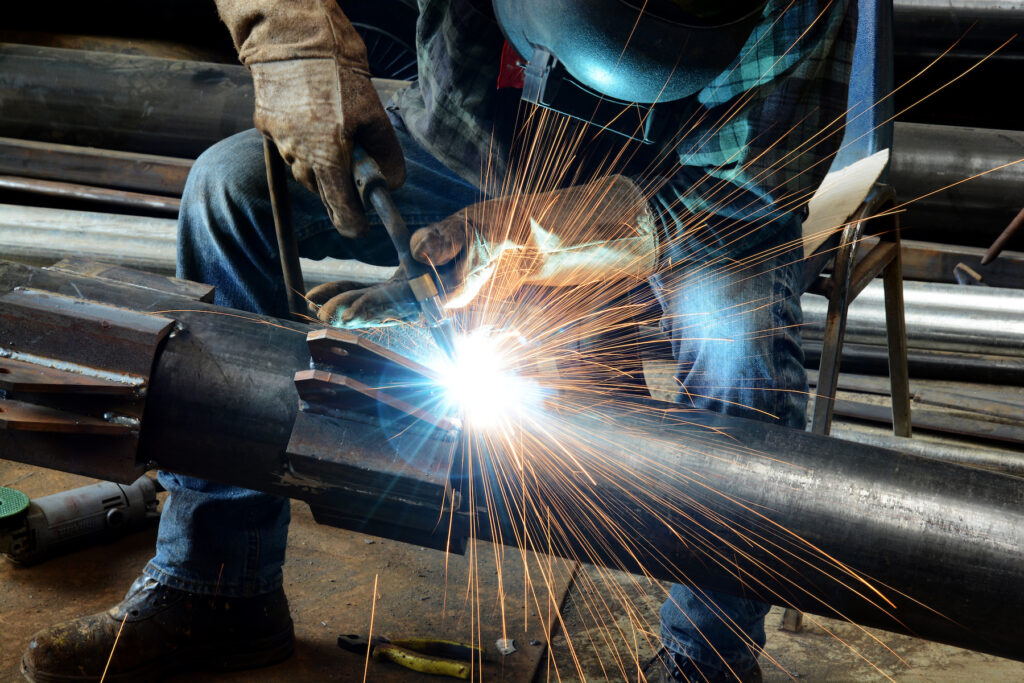
MIG Welding (GMAW): Uses a continuously fed wire electrode and shielding gas. It offers high deposition rates, making it suitable for thick structural steel work.
-
TIG Welding (GTAW): Uses a non-consumable tungsten electrode to deliver precise, clean welds on thin materials, aluminum, and stainless steel.
-
Hardware Fastening: Employs rivets, threaded inserts, bolts, and specialized industrial adhesives when components must remain removable or when heat-sensitive metals cannot be welded.
Fabrication Method Comparison Guide
Selecting the optimal processing method directly impacts part accuracy, edge finish quality, lead times, and final production costs. The table below outlines key operational characteristics of standard cutting and joining techniques used in industrial metal fabrication.
| Fabrication Method | Primary Use Case | Compatible Materials | Relative Speed | Precision / Tolerance Level |
|---|---|---|---|---|
| Laser Cutting | Intricate shapes, sheet metal parts | Steel, Stainless, Aluminum, Brass | High | Excellent (±0.002 in) |
| Plasma Cutting | Heavy plate cutting, structural frames | Carbon Steel, Stainless Steel | Very High | Moderate (±0.020 in) |
| Waterjet Cutting | Heat-sensitive alloys, thick materials | All metals, composites, stone | Moderate | High (±0.005 in) |
| Press Brake Bending | Enclosures, brackets, channels | Sheet metal, structural plate | High | High (±0.010 in) |
| MIG Welding | Heavy structural assembly | Carbon steel, low alloys | Fast | Standard weld tolerance |
| TIG Welding | Precision components, clean finishes | Stainless steel, Aluminum | Slow to Moderate | High aesthetic & structural weld |
Design and Cost Considerations for Custom Projects
Designing a metal component efficiently requires balancing functional requirements with practical shop-floor limitations. Unnecessary complexity quickly increases processing costs and lead times.
Material Selection Strategy
Choosing the right metal involves more than matching strength requirements. Material choice dictates machine speeds, tooling wear, and finishing requirements.
-
Environment: Will the part operate outdoors, in salt water, or near corrosive chemicals? Stainless steel or powder-coated aluminum offers long-term durability in harsh settings.
-
Weight vs. Strength: High-strength steel provides structural support at a lower raw material cost, whereas aluminum reduces weight for mobile applications at a higher material price per pound.
-
Weldability: High-carbon steels require preheating and specialized weld procedures, whereas low-carbon steel welds quickly without thermal risk.
Designing for Manufacturability (DFM)
Simple adjustments to part geometry significantly reduce shop hours:
-
Standardize Hole Sizes: Keep hole diameters matching standard drill bit sizes and larger than the material thickness to prevent punch breakage.
-
Maintain Uniform Bend Radii: Using consistent bend radiuses across a part minimizes machine setup changes.
-
Allow Clearance for Tooling: Ensure bends leave sufficient room for press brake punches to enter and exit without striking adjacent flanges.
-
Minimize Weld Seams: Incorporating clever bends into sheet metal panels reduces the total linear feet of manual welding required.
Industry Applications Across Modern Manufacturing
Custom metal fabrication forms the backbone of infrastructure, commercial transport, and high-tech product manufacturing across the United States.
                      Industrial Applications
                                 |
     +-------------------+-------+-------+-------------------+
     |                   |               |                   |
Construction        Transportation    Aerospace           Energy & Solar
- Heavy Beams       - Truck Chassis   - Engine Mounts     - Transformer Boxes
- Plate Girders     - Utility Bodies  - Brackets & Panels - Support Racks
Architectural and Construction Engineering
Structural fabricators turn raw plate and I-beams into load-bearing frames, bridge trusses, stair towers, and decorative exterior sunscreens. These heavy components must strictly comply with AWS (American Welding Society) standards to ensure public safety under heavy loads.
Automotive and Heavy Equipment
From commercial delivery truck chassis to agricultural harvesters, the equipment industry relies on robust sheet metal weldments and formed plate brackets. Fabrications must withstand continuous vibration, dynamic stress, and variable weather conditions.
Aerospace and Defense Hardware
Precision fabrication shops supporting aerospace manufacturing work under tight tolerances, often measured in thousandths of an inch. Aircraft brackets, ductwork, and structural frames utilize high-strength aluminum alloys and titanium, requiring specialized TIG welding and non-destructive testing (NDT).
How to Choose the Right Metal Fabrication Partner
Selecting an experienced, reliable fabrication shop ensures your project stays on schedule, within budget, and compliant with safety codes. Consider these essential evaluation criteria when choosing a manufacturing vendor:
-
In-House Technical Capabilities: Verify whether the shop houses advanced equipment, such as multi-axis CNC lasers, automated press brakes, and robotic welding cells. Facilities with comprehensive in-house tooling can handle raw material prep through final finish without relying on third-party sub-contractors.
-
Quality Certifications and Compliance: Look for recognized industry credentials such as ISO 9001:2015 certification or AWS-certified welders. These standards confirm that the shop follows documented quality control protocols for every job.
-
Prototyping and Engineering Support: A quality shop provides active Design for Manufacturability feedback. Their engineers can suggest subtle design modifications that preserve part strength while drastically reducing unit costs.
-
Material Traceability: High-stakes applications require mill test reports (MTRs) to verify chemical composition and mechanical strength. Make sure your supplier provides full material traceability from raw stock to shipment.
Conclusion
Understanding what metal fabrication is and how its processes fit together gives engineers, project managers, and product designers a distinct edge. By pairing thoughtful design principles with the right material selection and cutting-edge processing techniques, manufacturers produce durable, high-precision components for any application. Partnering with a skilled metal fabrication facility ensures that complex designs transition smoothly from CAD concepts into dependable physical products that stand up to real-world demands.
Frequently Asked Questions
What is the difference between metal fabrication and machining?
Metal fabrication encompasses the entire process of building assemblies using cutting, bending, forming, and welding sheet metal or structural stock. Machining is a specific subtractive process where cutting tools remove material from a solid block of metal to achieve precise shapes and tight tolerances. Fabrication builds complete structures, while machining often creates individual solid parts or adds fine details to fabricated items.
Which metal is easiest to fabricate?
Low-carbon (mild) steel is generally considered the easiest metal to fabricate. It cuts cleanly, bends smoothly without cracking, and welds readily using standard MIG or TIG equipment. Its forgiving structural properties make it an economical choice for structural frameworks, machinery bases, and general manufacturing.
How does laser cutting compare to waterjet cutting?
Laser cutting uses a concentrated light beam to cut sheet metal quickly and with high accuracy, making it ideal for thin to medium-thickness materials. Waterjet cutting uses a high-pressure stream of water mixed with abrasive garnet, allowing it to cut exceptionally thick plates without generating heat. Waterjet prevents heat distortion, while laser cutting offers faster speeds on thinner metal.
Why is sheet metal bending radius important in design?
Maintaining an appropriate bend radius prevents metal from cracking or tearing along the outer bend seam during forming. If an inside bend radius is set too tight for a given material thickness, the metal stretches past its tensile limit, compromising its structural integrity. Setting standard radii also allows fabricators to use existing shop tooling without requiring custom dies.
What quality certifications should I look for in a metal fabrication shop?
Key certifications include ISO 9001:2015 for standardized quality management systems and AWS (American Welding Society) certifications for welding personnel. For specialized industries, certifications like AS9100 (aerospace) or ASME (pressure vessels) demonstrate that a shop adheres to rigorous manufacturing standards and material traceability protocols.