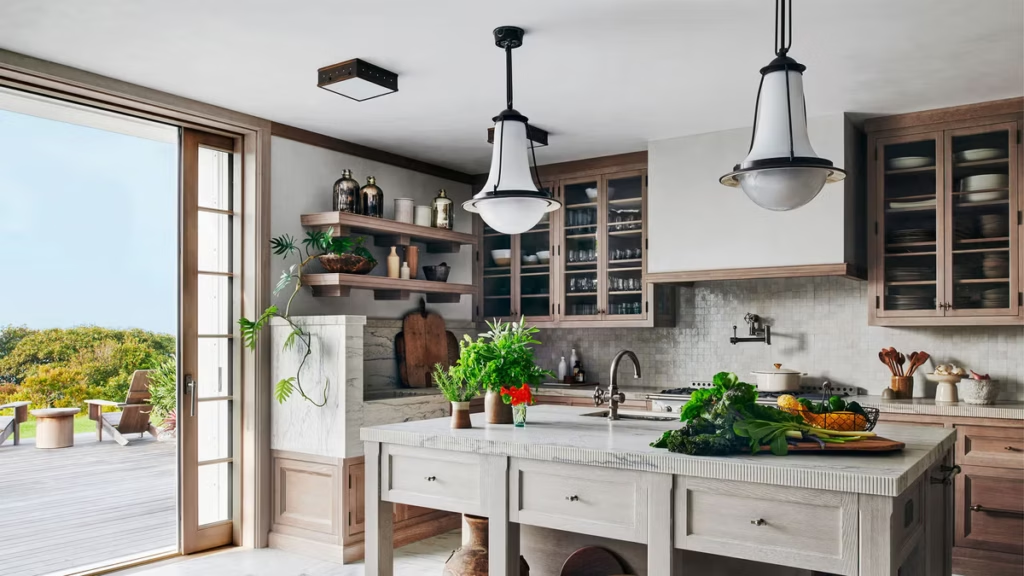
Cabinets take up the largest share of most kitchen budgets, so the choice between custom and stock deserves real thought. Whether you are updating a small galley kitchen or comparing custom kitchen islands for sale, the same question keeps coming up: is made-to-order worth the extra money? This guide explains how the two options differ in construction, sizing, materials, cost, and timeline, so you can decide with confidence.
What Stock Cabinets Are
Stock cabinets are mass-produced in factories and sold in fixed sizes. Home centers and big-box retailers usually keep common styles on hand or can ship them within days or a few weeks. Because the manufacturer builds thousands of identical units, the price per cabinet stays low.
The trade-off is limited choice. Most stock lines offer a handful of door styles, a short list of finishes, and a standard set of dimensions. You pick from what exists rather than designing what you need.
Standard Dimensions
Stock base cabinets typically follow a standard height of about 34.5 inches and a depth of about 24 inches, with widths that increase in 3-inch steps. Wall cabinets commonly come in heights such as 30, 36, and 42 inches. If your room measures neatly into those increments, stock sizing works well. If it does not, you fill the gaps with filler strips or trim.
What Custom Cabinets Are
A custom kitchen starts with your room, not a catalog. A local cabinet shop or a specialty manufacturer builds each cabinet to your exact measurements, door style, wood species, and finish. Nothing is limited to preset widths or depths.
This approach lets a designer solve problems that stock lines cannot. A cabinet can be 31 inches wide instead of 30 or 33. A pantry can reach the ceiling without a soffit. A corner can hold a purpose-built pullout rather than a generic lazy Susan.
Custom work also tends to involve more people in the process. You usually meet with a designer, approve detailed drawings, and sometimes visit the shop before installation. That collaboration is part of what you pay for.
Semi-Custom Cabinets: The Middle Option
Many homeowners treat this as a two-way choice, but there is a third category. Semi-custom cabinets come from a manufacturer’s catalog, yet they offer more variety than stock. You can often adjust widths, heights, and depths in smaller steps, choose from many more finishes, and add features such as rollout trays or decorative moldings.
Semi-custom is a practical compromise for people who want flexibility without paying for fully bespoke work. Keep it in mind as you read the comparison below, because it often lands between the two ends on price, lead time, and options.
Custom vs Stock Cabinets at a Glance
The table below summarizes the main differences. Exact numbers vary by brand, region, and materials, so treat the ranges as general patterns rather than quotes.
| Factor | Stock Cabinets | Custom Cabinets |
|---|---|---|
| Sizing | Fixed sizes, usually in 3-inch increments | Built to exact measurements |
| Design options | Limited door styles and finishes | Nearly unlimited styles, woods, and finishes |
| Construction | Often particleboard, MDF, or plywood boxes | Commonly plywood or solid wood, chosen by you |
| Typical lead time | Days to a few weeks | Often several weeks to a few months |
| Cost level | Lowest per cabinet | Highest per cabinet |
| Fit in unusual spaces | Needs filler pieces and trim | Designed around angles, slopes, and odd corners |
| Special features | Basic options | Built-in appliances panels, custom storage, unique details |
| Best suited for | Budget-focused or standard-layout kitchens | Unusual layouts, high-end finishes, specific storage needs |
Notice that cost and flexibility move in opposite directions from left to right. That relationship drives most of the decisions in the sections that follow.
How Construction and Materials Differ
Price differences between the two categories come largely from what is inside and behind the door. Looking closer at construction helps you judge whether a higher quote is justified.
Boxes and Joinery
The cabinet box is the frame that holds everything together. Many stock lines use particleboard or medium-density fiberboard (MDF) for the box, often covered with a laminate or thermofoil layer. These materials can perform well in dry conditions, but they can swell if water sits on them for long, such as near a sink with a slow leak.
Custom shops more often build boxes from plywood or solid hardwood. Plywood resists moisture damage better than particleboard and holds screws more securely over time. Joinery also varies, with better builders using dovetail or dowel joints instead of only staples and glue.
That said, higher price does not always mean better quality. Some stock and semi-custom lines use all-plywood construction, and a poorly built custom cabinet is still a poor cabinet. Ask what the boxes are made of and how the joints are assembled, whatever the category.
Doors, Finishes, and Hardware
Door options show the clearest gap. A stock line may offer a few Shaker-style and flat-panel doors in a limited color range. A custom builder can match a stain to an existing floor, mix paint colors, or recreate a profile from an older home.
Hardware matters too. Drawer slides and hinges determine how a cabinet feels after years of use. Soft-close hinges and full-extension slides are available across all categories now, but the quality of the hardware itself differs. It is worth opening and closing sample drawers before you commit.
Sizing and Layout Flexibility
Layout is where a custom kitchen often earns its price. Think of a kitchen with a window that sits two inches lower than standard, or a wall that runs 10 feet 7 inches. Stock cabinets will leave small gaps that need fillers, and those gaps can look awkward if the room has many of them.
Custom cabinets can also take on shapes stock lines do not offer. Examples include an angled run that follows a bay window, a built-in banquette with storage, or a cabinet face that matches the surrounding millwork. Islands benefit especially from this, since a built-to-fit island can include seating overhangs, a specific sink location, or appliance cutouts sized to the exact model you own.
If your kitchen is a simple rectangle with regular walls, flexibility matters less. A standard layout built from stock or semi-custom units can look polished and function well.
Cost and Timeline
Cabinets can account for a large portion of a kitchen remodel, and the category you choose has a strong effect on the total. In general, stock is the least expensive, semi-custom sits in the middle, and custom costs the most. The gap can be wide, and it widens further with premium woods, complex finishes, and added features.
Several factors beyond the category affect the final price:
- Material: solid hardwood costs more than plywood, which costs more than particleboard
- Door style: simple flat panels usually cost less than detailed raised-panel or inset styles
- Finish: multi-step paint or glaze finishes add labor
- Accessories: pullouts, spice racks, and built-in organizers add up quickly
- Installation: custom work and unusual layouts can require more time on site
Timeline is the other major difference. Stock cabinets are often available quickly, which helps when you need to finish a project fast. Custom orders require design approval, production, finishing, and delivery, so planning several weeks to a few months ahead is wise. Ask each supplier for a current lead time in writing, since it changes with demand.
Choosing the Right Option for Your Kitchen
No single answer fits every household. A better approach is to match the option to your priorities, your room, and how long you plan to stay in the home.
When Stock Cabinets Make Sense
Stock cabinets are a smart choice if your budget is tight, your layout is simple, or you need to finish quickly. They also suit rental properties, resale flips, and secondary spaces like laundry rooms. Spending the savings on better countertops, lighting, or appliances can improve the kitchen more than upgrading cabinets would.
When Custom Cabinets Are Worth It
Custom cabinets are worth considering if your room has unusual dimensions, if you want a specific look that catalogs do not offer, or if you plan to stay in the home for many years. They also help when you have particular storage needs, such as a baker’s cabinet, tall tray dividers, or panel-ready appliances that blend in. In older homes, custom work can match existing trim and proportions in a way stock cannot.
If neither extreme feels right, request a quote for semi-custom as well. Comparing three quotes side by side is the easiest way to see what each extra dollar actually buys.
Common Mistakes to Avoid
A few errors show up often during cabinet shopping, and most are easy to prevent.
First, avoid ordering before measuring carefully. Measure twice, note the location of windows, vents, plumbing, and outlets, and have the designer or installer confirm before anything goes into production. Custom cabinets are rarely returnable.
Second, do not compare quotes without matching specifications. One quote may include crown molding, soft-close hardware, and installation, while another leaves them out. Ask each supplier to itemize materials, hardware, finishes, delivery, and labor.
Third, do not ignore the warranty. Ask what it covers, how long it lasts, and whether it applies to finishes and hardware as well as the cabinet boxes.
Finally, look at physical samples. Photos and screens misrepresent color and texture, so request a door sample and view it in your own kitchen lighting.
Conclusion
The difference between custom and stock cabinets comes down to flexibility versus cost. Stock cabinets are affordable, quick to get, and perfectly sound for standard layouts. Custom cabinets cost more but let you control size, materials, style, and storage, which matters most in irregular rooms or long-term homes. Semi-custom offers a balanced middle path. Start by measuring your space, setting a realistic budget, and requesting itemized quotes for each option. Once you can compare them fairly, the right choice for your kitchen usually becomes clear.
Frequently Asked Questions
1. Are custom cabinets always better quality than stock cabinets?
Not always. Custom cabinets offer more control over materials and construction, but quality depends on the builder. Some stock and semi-custom lines use sturdy plywood boxes, while a poorly built custom cabinet can disappoint. Ask about materials, joinery, and warranty for every option.
2. How much more do custom cabinets cost than stock?
The gap varies widely based on materials, finishes, and kitchen size. Custom is generally the most expensive and stock the least. The best way to know is to request itemized quotes for the same kitchen layout from several suppliers.
3. Can I mix stock and custom cabinets in one kitchen?
Yes, many homeowners do. A common approach uses stock or semi-custom cabinets for standard runs and custom pieces for a feature wall, island, or tricky corner. Make sure door styles and finishes match so the kitchen looks cohesive.
4. How long does it take to get each type of cabinet?
Stock cabinets are often available within days to a few weeks. Semi-custom and custom orders take longer because they are made after you order. Lead times change with demand, so confirm the current schedule with your supplier before planning your project.
5. Do custom cabinets increase home value?
They can improve appeal, especially when the work is well designed and suits the home. However, resale value depends on the local market, the overall kitchen quality, and buyer preferences. Talk with a local real estate professional before spending heavily with resale in mind.