One of the most common questions first-time founders ask before incorporating is: “How much money do I need to have before I can register a company?”
It is a completely reasonable concern. Most people assume that company registration requires a significant sum sitting in a bank account before the process can even begin. The reality, especially in India, is very different — and far more startup-friendly than most people realise.
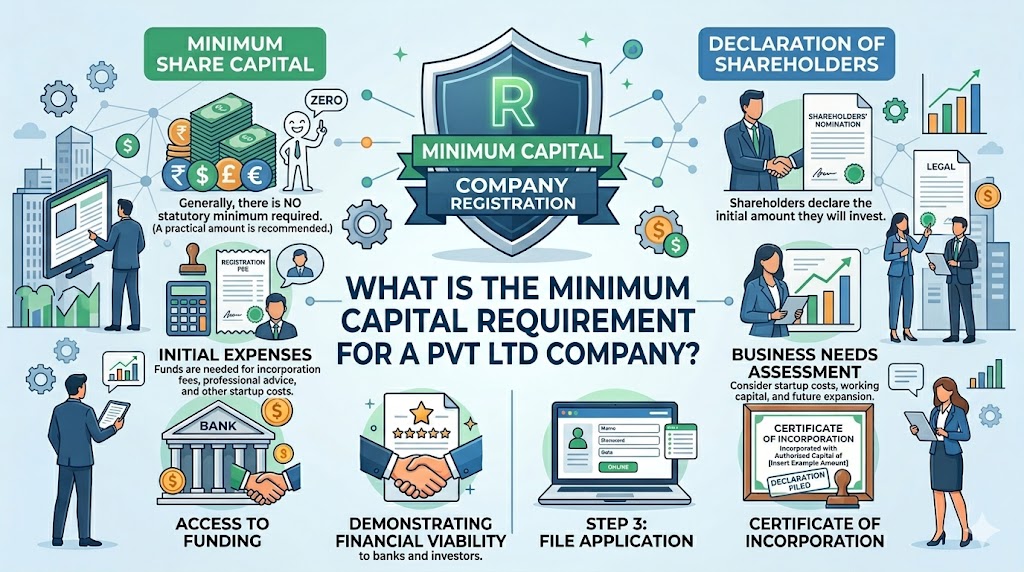
Here is the short answer: there is no minimum capital requirement to register a Private Limited Company in India. That rule was removed by the Companies (Amendment) Act, 2015. You do not need to have Rs. 1 lakh, Rs. 5 lakh, or any fixed amount in place before you incorporate.
But here is what most quick-answer articles miss: while there is no legal minimum, there is a practical minimum — and understanding the distinction between authorized capital and paid-up capital is essential before you make any decision about how to structure your company’s finances from day one.
This guide covers everything you need to know: what changed in 2015, what the terms actually mean, how much capital most founders start with, and what you should genuinely consider before you file.
The Old Rule and What Changed
Before 2015, every entrepreneur registering a Private Limited Company in India had to comply with a mandatory minimum paid-up capital of Rs. 1,00,000 (one lakh rupees). This was set out under the original provisions of the Companies Act, 2013.
The Companies (Amendment) Act, 2015 removed this requirement entirely. The amendment was part of a broader government push to improve India’s ease of doing business ranking and reduce barriers to entrepreneurship — particularly for early-stage startups and micro-enterprises that should not need to demonstrate a specific capital threshold just to get a company off the ground.
The effect was immediate and significant: from 2015 onwards, entrepreneurs could register a Private Limited Company with any amount of capital — including zero paid-up capital at inception, as long as capital was actually infused within 60 days of incorporation.
Today in 2026, this remains the law. Under Section 2(68) of the Companies Act, 2013 as amended, there is no statutory minimum capital requirement for a Private Limited Company in India.
Understanding Capital: The Terms You Need to Know
Before deciding how much capital to use for your company, you need to understand the three key types of share capital — and how they differ from one another.
Authorized Capital
Authorized capital (also called nominal capital or registered capital) is the maximum amount of share capital that your company is permitted to issue to shareholders. It is declared in the Capital Clause of your Memorandum of Association (MoA) at the time of incorporation and is registered with the Registrar of Companies (ROC).
Think of authorized capital as the ceiling. Your company cannot issue shares beyond this limit without first formally increasing it through a board resolution, shareholder approval, and ROC filing.
Key facts about authorized capital:
- Declared at the time of incorporation in the MoA
- The basis on which ROC filing fees and stamp duty are calculated
- Can be increased at any time after incorporation by following the prescribed process
- There is no legal minimum or maximum (though most startups start with Rs. 1 lakh)
Subscribed Capital
Subscribed capital is the portion of authorized capital that shareholders have agreed to subscribe to — i.e., the shares they have committed to take. It cannot exceed the authorized capital.
Paid-Up Capital
Paid-up capital is the amount actually received by the company from shareholders in exchange for shares that have been issued to them. It is the real money that has come into the company’s bank account.
Key facts about paid-up capital:
- Represents the actual equity invested by shareholders
- Shown on the company’s balance sheet as part of shareholder equity
- No statutory minimum since the 2015 amendment
- Cannot exceed the authorized capital
- A company cannot operate indefinitely with zero paid-up capital (the ROC may strike it off after one year)
The Relationship in Practice
Here is a simple example to make the distinction concrete:
Example: Priya and Rajan start a tech services company. They declare an authorized capital of Rs. 10 lakh in their MoA. At incorporation, they each subscribe to 5,000 shares of Rs. 10 face value each, paying Rs. 50,000 apiece — bringing the total paid-up capital to Rs. 1 lakh.
Authorized Capital: Rs. 10 lakh
Subscribed Capital: Rs. 1 lakh
Paid-Up Capital: Rs. 1 lakh
Later, when they raise angel funding of Rs. 25 lakh, they increase their authorized capital and issue new shares to the investor. Their paid-up capital increases accordingly.
Quick Reference: Authorized vs. Paid-Up Capital
| Parameter | Authorized Capital | Paid-Up Capital |
| What it is | Maximum share issuance ceiling | Actual money received from shareholders |
| Where it appears | Capital Clause of MoA | Balance sheet (shareholders’ equity) |
| Legal minimum | None (practically Rs. 1 lakh for fees) | None since 2015 amendment |
| Basis for fees | Yes — ROC fees and stamp duty calculated on this | No |
| Can it be changed? | Yes, by filing with ROC | Yes, by issuing or buying back shares |
| Must it be deposited? | No — it is a ceiling, not a deposit | Yes — it is actual money received |
So How Much Capital Should You Actually Start With?
The absence of a legal minimum does not mean the answer is zero. The practical considerations are different from the legal ones, and both matter.
The Practical Minimum: Rs. 1 Lakh Authorized Capital
While there is no statutory minimum, most founders in India start with an authorized capital of Rs. 1 lakh. Here is why this amount has become the de facto starting point:
ROC fees are lowest at Rs. 1 lakh. The MCA’s SPICe+ form currently charges zero government fee for authorized capital up to Rs. 15 lakh for companies being incorporated (introduced to reduce startup costs). However, stamp duty on the MoA and AoA is calculated based on authorized capital and varies by state. Starting with Rs. 1 lakh keeps your initial stamp duty as low as possible.
Banks accept it. When you open your company’s current account, banks conduct their own due diligence. An authorized capital of Rs. 1 lakh is a well-understood and widely accepted starting point that triggers no red flags.
Investors recognise it. For early-stage companies, Rs. 1 lakh is a completely normal starting point. It signals that you are capital-efficient and have not over-committed before your first funding round.
It can be increased anytime. If you need to raise capital later — through equity, ESOPs, or a funding round — you can increase your authorized capital by following a straightforward ROC process. You are not locked in.
How Much Paid-Up Capital Do You Need?
This is more nuanced and depends on your business. Here are the practical considerations:
Operational costs in the first 6 months. Your paid-up capital should cover your immediate operational expenses — salaries, software, premises, marketing, professional fees — for the period before you generate consistent revenue. A useful rule of thumb is to ensure 6 months of runway from your initial equity infusion.
Compliance obligations. Immediately after incorporation, you must file Form INC-20A (Declaration of Commencement of Business) and pay for your statutory audit, ROC filings, and GST registration if applicable. These costs run between Rs. 5,000 and Rs. 15,000 in the first year.
Credibility with counterparties. A paid-up capital that is visibly too low can create friction with enterprise clients, landlords, and financial institutions. Most professional service firms and B2B clients check a company’s MCA filings as part of their vendor qualification process.
Investor expectations. If you plan to raise a pre-seed or seed round, your investors will subscribe to new shares that increase your paid-up capital. Your initial capital needs to reflect a reasonable commitment from the founding team.
For most early-stage startups and service businesses, a paid-up capital in the range of Rs. 1 lakh to Rs. 5 lakh is a sensible and practical starting point. Capital-intensive businesses — manufacturing, infrastructure, healthcare equipment — may need substantially more.
Impact of Authorized Capital on Registration Fees
One practical reason to be deliberate about your authorized capital figure is that it directly affects what you pay at incorporation.
Government Fees (ROC Fees)
Under the current MCA fee structure, companies with authorized capital up to Rs. 15 lakh pay zero government filing fees under the SPICe+ form. This is a significant incentive to start with a modest authorized capital and increase it later.
For authorized capital above Rs. 15 lakh, the fee schedule scales as follows:
| Authorized Capital | Approximate ROC Fees |
| Up to Rs. 15 lakh | Rs. 0 (waived under SPICe+) |
| Rs. 15 lakh – Rs. 50 lakh | Rs. 2,000 – Rs. 5,000 |
| Rs. 50 lakh – Rs. 1 crore | Rs. 5,000 – Rs. 10,000 |
| Above Rs. 1 crore | Scales further |
Note: Fee structures are subject to revision. Always verify current fees on the official MCA portal.
Stamp Duty
Stamp duty is a state-level levy calculated on the authorized capital of the company. Rates vary significantly across states:
| State | Approximate Stamp Duty (Rs. 1 lakh capital) |
| Delhi | Rs. 200 – Rs. 500 |
| Maharashtra | Rs. 1,000 – Rs. 5,000 |
| Karnataka | Rs. 500 – Rs. 2,000 |
| Tamil Nadu | Rs. 500 – Rs. 2,000 |
| West Bengal | Rs. 1,000 – Rs. 5,000 |
These are approximate ranges. Actual stamp duty depends on current state schedules.
The takeaway: Declaring a higher authorized capital than you immediately need inflates your stamp duty with no corresponding benefit. Start with Rs. 1 lakh, and increase it when you actually need to raise capital.
When Should You Increase Your Authorized Capital?
Increasing authorized capital is a routine and well-defined process. You should plan for it when:
- Raising external funding: Venture capital, angel investment, or institutional funding requires you to issue new shares to investors, which requires sufficient authorized capital headroom.
- Issuing ESOPs: Employee stock option plans require a pool of unissued shares. You need adequate authorized capital to accommodate this.
- Adding new co-founders: If you are bringing a co-founder on board as a shareholder, you need to issue shares — which requires available authorized capital.
- Debt-to-equity conversion: If lenders are converting loans into equity, you need the authorized capital ceiling to accommodate the conversion.
The process requires passing a board resolution, obtaining shareholder approval through an Ordinary Resolution, filing Form SH-7 with the ROC, and paying the applicable fees and stamp duty. A practicing CA or CS can complete this in a few days.
Capital Requirements: India vs. Other Countries
For founders comparing India’s framework with other jurisdictions, here is how minimum capital requirements compare globally:
| Country | Structure | Minimum Capital |
| India | Private Limited Company | No minimum (since 2015) |
| United Kingdom | Private Limited Company | £1 (nominally) |
| Singapore | Private Limited (Pte. Ltd.) | S$1 |
| United States | LLC / Corporation | No federal minimum; varies by state |
| Germany | GmbH | €25,000 |
| France | SARL | €1 (reduced from €7,500) |
| China | Limited Liability Company | No statutory minimum (since 2014) |
India compares favourably with major startup ecosystems globally. The 2015 amendment aligned India with Singapore and the UK in making capital requirements effectively nominal, reducing one more barrier to formal entrepreneurship.
If you are looking to do online company registration in India as a foreign national or NRI, note that the same capital rules apply — there is no higher minimum capital requirement for foreign-owned private limited companies under FDI regulations (though sector-specific rules may apply in certain industries).
Common Mistakes Founders Make with Capital Planning
Understanding what not to do is as important as knowing the rules. These are the most frequent mistakes founders make at the capital planning stage.
Starting with too little paid-up capital. While legally permissible, registering with negligible paid-up capital and then running operations through director loans or informal arrangements creates accounting complications, tax questions, and friction with banks and investors later. The effort of cleaning this up during a due diligence process is significant.
Setting authorized capital too high upfront. Some founders declare Rs. 1 crore in authorized capital on day one “to be safe.” This results in higher stamp duty and ROC fees at incorporation with no benefit, since you can increase authorized capital whenever you need to.
Confusing authorized capital with operational budget. Authorized capital is a legal construct in your MoA. It does not mean you have that money in the bank. Planning your actual operational expenses is a separate exercise from deciding your authorized capital figure.
Waiting to infuse paid-up capital. A company incorporated with zero paid-up capital must receive capital within 60 days of incorporation. Failure to do so creates compliance risk, and companies with zero paid-up capital for an extended period can face ROC strike-off action.
Not planning for funding-round dilution. If you intend to raise equity funding, you need authorized capital that comfortably accommodates post-round shareholding. Founders sometimes increase authorized capital at the last minute before closing a round, adding cost and delay. Build in headroom from the start.
Getting Your Company Registration Right From Day One
Capital planning is one piece of the incorporation puzzle. Choosing the right business structure is another. For most founders — startups, professional services firms, e-commerce businesses, and MSMEs planning to grow — private limited company registration remains the preferred path because it offers:
- Limited liability protection for founders and shareholders
- Separate legal identity distinct from its owners
- Investor-friendly shareholding and share transfer mechanisms
- Credibility with enterprise clients, banks, and government agencies
- Eligibility for startup schemes, government tenders, and MSME benefits
The right capital structure — modest authorized capital, sensible initial paid-up capital, and a plan to increase both as the business grows — sets you up for clean financial records, easy fundraising conversations, and no compliance surprises in year two.
Frequently Asked Questions
Q1. What is the minimum capital required to register a Private Limited Company in India?
As of 2026, there is no statutory minimum capital required to register a Private Limited Company in India. The Companies (Amendment) Act, 2015 removed the earlier requirement of Rs. 1,00,000 minimum paid-up capital. You can technically incorporate with any amount of capital, though most founders start with an authorized capital of Rs. 1 lakh and a paid-up capital of Rs. 1 lakh as a practical and bank-friendly baseline.
Q2. What is the difference between authorized capital and paid-up capital?
Authorized capital is the maximum amount of share capital your company is permitted to issue to shareholders — it is the ceiling declared in your Memorandum of Association. Paid-up capital is the actual money received by the company from shareholders against shares issued to them. Authorized capital determines your ROC fees and stamp duty at incorporation; paid-up capital reflects the real equity your shareholders have invested.
Q3. Can I register a Pvt Ltd company with Rs. 1,000 or even Rs. 100 as paid-up capital?
Legally, yes — there is no minimum. In practice, however, extremely low paid-up capital creates credibility problems with banks, investors, and enterprise clients. Most founders opt for at least Rs. 1 lakh in paid-up capital to ensure smooth account opening, a professional MCA profile, and a solid starting foundation for future fundraising.
Q4. Does higher authorized capital mean higher registration fees?
Yes, authorized capital directly affects the stamp duty payable at incorporation, which is calculated as a percentage of the authorized capital under each state’s stamp act. Rates vary significantly by state. Government ROC fees are waived under SPICe+ for companies with up to Rs. 15 lakh in authorized capital. Declaring more capital than you immediately need inflates your initial registration cost without any near-term benefit.
Q5. Can I increase my company’s authorized capital after registration?
Yes. Increasing authorized capital is a standard, well-defined process. It requires a board resolution, shareholder approval via Ordinary Resolution, filing Form SH-7 with the ROC, and paying the applicable incremental fees and stamp duty. It is typically completed within a few working days with the help of a practicing CA or CS. Most founders increase their authorized capital when planning a funding round, ESOP issuance, or co-founder onboarding.
Q6. Is there a maximum limit on authorized capital for a Private Limited Company?
No. The Companies Act, 2013 does not prescribe a maximum limit for authorized capital. Companies are free to declare as high an authorized capital as their business requires, subject to paying the applicable fees and stamp duty at each stage.
Q7. What happens if a company is incorporated with zero paid-up capital?
While there is no legal minimum, a company cannot operate with zero paid-up capital indefinitely. The ROC can initiate strike-off proceedings against companies that have not received any paid-up capital or conducted any business for an extended period. Additionally, you cannot open a company bank account, sign meaningful contracts, or file Form INC-20A (declaration of commencement of business) without at least some initial capital infusion from shareholders.
Conclusion
The minimum capital requirement for a Private Limited Company in India is, legally speaking, zero — a deliberate policy decision made in 2015 to lower the barriers to formal entrepreneurship and bring more businesses into the regulated economy.
But the more useful answer for any founder is this: zero is not a capital strategy. The right starting point is a paid-up capital that reflects your actual operational needs for the first 6 to 12 months, paired with an authorized capital figure that keeps your incorporation costs low while giving you room to issue shares as your business grows.
For the vast majority of startups and small businesses in India, that means starting with Rs. 1 lakh in authorized capital and Rs. 1 lakh in paid-up capital — a clean, low-cost, bank-friendly structure that is immediately ready for real operations.
Capital planning at incorporation is not just about satisfying a legal requirement. It is about setting your company up with a financial structure that works for your first investor conversation, your first bank account, your first enterprise client, and your first year of compliance. Get that right, and everything that follows becomes easier.
At Elixir Filings, we help founders choose the right capital structure from day one — ensuring your company is incorporated cleanly, compliant, and ready for growth.