Precious metals have long attracted investors seeking tangible assets, portfolio diversification, and opportunities to benefit from changing market conditions. While gold and silver often receive the most attention, platinum has its own distinctive appeal. Its limited supply, industrial importance, and role in precious metals markets make it an interesting option for investors exploring alternatives to traditional investments.
For buyers researching Platinum coins dallas, understanding what determines platinum’s value is an important first step. The price of these coins depends on more than the current market rate of platinum. Purity, weight, mint reputation, dealer premiums, market demand, and resale potential can all influence the total value of an investment.
Whether you are a first-time bullion buyer or an experienced precious metals enthusiast, learning these fundamentals can help you make more informed purchasing decisions.
Platinum’s Rarity Creates Distinct Investment Appeal
One of the main reasons platinum coins attract investors is the metal’s relative scarcity. Platinum is rarer than gold in terms of annual mine production, and its extraction and processing can be challenging. Much of the world’s platinum supply comes from South Africa, with Russia and other producing countries also contributing to the market.
This concentrated supply creates potential vulnerabilities. Mining disruptions, labor disputes, electricity shortages, transportation problems, or geopolitical developments can affect the availability of platinum and influence prices.
However, rarity alone does not guarantee higher returns. Platinum’s market value also depends on industrial consumption, investment demand, recycling, and broader economic conditions.
Limited Supply Can Influence Prices
When demand rises while available supply remains constrained, prices may experience upward pressure. Conversely, weaker industrial demand or increased recycling can reduce that pressure.
Investors should therefore evaluate platinum as a commodity with its own supply-and-demand dynamics rather than assuming it will always follow gold’s price movements.
For example, a buyer who purchases platinum coins during a period of relatively low prices may benefit if demand strengthens later. Nevertheless, prices can also decline, and no future increase is guaranteed.
Industrial Demand Gives Platinum Additional Value
Platinum is not valued solely for its role as a precious metal. It is also an important industrial material used in applications that require durability, chemical stability, and catalytic properties.
This practical usefulness distinguishes platinum from assets whose value depends primarily on investor sentiment.
Automotive and Manufacturing Applications
One of platinum’s established uses is in catalytic converters, which help reduce harmful emissions from certain vehicles. Platinum also has applications in chemical processing, petroleum refining, glass manufacturing, and specialized industrial equipment.
Demand from these sectors can influence the broader platinum market. Changes in vehicle production, emissions standards, manufacturing activity, and substitution between platinum and other metals may affect consumption.
Clean Energy and Emerging Technologies
Platinum is also used in certain hydrogen-related technologies, including proton-exchange membrane fuel cells and electrolyzers. Growth in these industries could create additional sources of demand over time.
However, the pace of adoption depends on infrastructure investment, production costs, government policies, technological developments, and competition from alternative technologies.
For bullion investors, the key takeaway is that platinum’s industrial applications can create opportunities as well as risks. Industrial demand may support prices during favorable periods, but an economic slowdown can weaken consumption and put downward pressure on the market.
Physical Platinum Coins Offer Tangible Ownership
Another reason investors consider platinum coins is the ability to own physical metal directly. Unlike shares in a mining company or a financial product linked to platinum prices, a bullion coin represents an identifiable quantity of precious metal.
The United States Mint explains that bullion coins are investment-grade coins valued primarily according to their metal content and fineness. Their prices generally reflect the underlying metal’s market price plus a premium covering production and distribution costs.
You can learn more through the U.S. Mint’s official bullion coin information.
Direct Ownership Without Mining Company Exposure
Buying physical platinum coins does not expose an investor directly to an individual mining company’s management decisions, operating expenses, or corporate debt. Instead, the investment’s metal value is tied primarily to the platinum market.
Physical ownership does come with responsibilities. Buyers must consider secure storage, insurance where appropriate, authenticity, transaction costs, and the difference between purchase and resale prices.
Platinum coins should therefore be viewed as one possible component of a diversified financial strategy, not a substitute for every other type of investment.
Coin Purity, Weight, and Mint Reputation Matter
Not all platinum coins have identical specifications. Understanding what you are purchasing helps you compare products accurately and avoid paying an unnecessarily high premium.
Purity and Precious Metal Content
Purity indicates how much of a coin consists of platinum. For example, a coin containing one troy ounce of .9995-fine platinum contains approximately 0.9995 troy ounces of pure platinum.
A one-ounce coin with a different purity may contain a different quantity of fine metal. Buyers should check the stated weight and fineness rather than relying on appearance or face value.
Government-issued bullion coins, such as American Platinum Eagles, provide published specifications that make it easier to verify their metal content.
Recognized Mints and Popular Coin Designs
Coins from established government mints often benefit from recognizable designs, documented specifications, and familiarity among bullion dealers.
Examples include:
- American Platinum Eagle: A platinum bullion coin issued by the United States Mint.
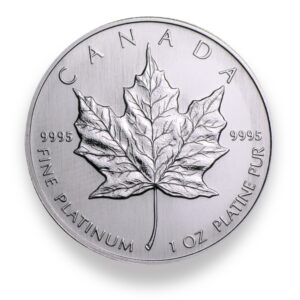
- Canadian Platinum Maple Leaf: A platinum bullion coin associated with the Royal Canadian Mint.
- Other recognized platinum bullion issues: Products from established mints may appeal to buyers depending on availability, purity, and pricing.
Recognition can help with resale, although it does not eliminate market risk or guarantee that every dealer will offer the same price.
Investors should also distinguish standard bullion coins from proof or collectible issues. A proof coin may carry a higher premium because of its finish, limited mintage, or collector appeal. That premium may not be fully recovered when selling.
Market Prices and Dealer Premiums Affect Investment Value
The spot price is the market benchmark for platinum, generally quoted per troy ounce. It changes in response to trading activity, industrial demand, supply conditions, currency movements, and investor expectations.
However, investors buying physical platinum coins typically pay more than the spot value of the metal.
Understanding the Premium
A dealer premium accounts for factors such as minting, distribution, inventory, operating expenses, and market demand. Premiums can differ between products, dealers, and market conditions.
The following table illustrates how these factors influence a buyer’s decision.
| Factor | Why It Matters |
|---|---|
| Spot price | Establishes the underlying market value of platinum. |
| Coin weight and purity | Determine the amount of fine platinum contained in the coin. |
| Dealer premium | Increases the amount paid above the metal’s spot value. |
| Brand and recognition | May influence buyer confidence and resale demand. |
| Collector appeal | Can add value beyond the underlying metal content. |
| Buyback offer | Helps determine the amount an investor could recover when selling. |
| Storage and insurance | May add to the total cost of ownership. |
A Practical Pricing Example
Suppose the spot price of platinum is $1,000 per troy ounce and a one-ounce coin carries a hypothetical 8% premium.
The coin’s purchase price would be $1,080 before any applicable taxes, shipping, or other charges.
If the investor later sells the coin when the spot price remains at $1,000, a dealer’s offer might be below spot or might include a smaller premium than the original purchase price. The investor could therefore incur a loss even though the platinum market price has not changed.
These figures are illustrative, not current market quotations. The example demonstrates why comparing purchase prices alone is insufficient.
Before buying, compare the total price, the dealer’s current resale or buyback terms, and the premium against comparable products.
Portfolio Diversification Can Make Platinum Coins Attractive
Diversification involves spreading investments across assets that may respond differently to economic conditions. Platinum can provide exposure to precious metals while introducing market characteristics that differ from those of gold and silver.
Gold is often associated with investment demand and its perceived role as a store of value. Silver has substantial industrial applications alongside investment demand. Platinum combines precious metal investment interest with significant industrial consumption.
These differences can create diversification opportunities, but they do not mean the metals will always move independently.
Platinum Is Not a Guaranteed Hedge
Precious metals can sometimes help investors navigate periods of inflation, currency uncertainty, or financial instability. Nevertheless, their performance varies across market cycles.
Platinum’s substantial industrial exposure can make it sensitive to manufacturing activity and automotive demand. Consequently, it may fall during periods when investors are concerned about economic growth, even if other precious metals perform differently.
A balanced investment strategy should account for risk tolerance, liquidity requirements, time horizon, and existing holdings. Investors should avoid concentrating their savings in platinum solely because its market price appears inexpensive relative to another metal.
Liquidity and Resale Potential Matter to Long-Term Buyers
An investment’s value is meaningful only when an investor can reasonably convert it into cash at an acceptable price. Platinum bullion coins are traded through precious metals dealers and other market participants, but their resale conditions can vary.
What Influences Resale Value?
Several factors may affect the amount a seller receives:
- Current platinum spot price.
- Coin weight, purity, and condition.
- Market demand for the particular product.
- Dealer inventory and willingness to purchase.
- Recognition of the mint and coin series.
- The difference between dealer buying and selling prices.
Popular bullion coins may be easier for buyers and dealers to identify than unfamiliar products. Even so, resale offers can vary, and a coin’s original retail premium is not necessarily recoverable.
Before making a substantial purchase, ask the dealer how buyback prices are determined and whether the business currently purchases the same type of coin it sells.
Keeping invoices, original packaging where applicable, and product documentation can also help with recordkeeping and future transactions.
How to Buy Platinum Coins in Dallas With Confidence
For local investors, choosing a reputable bullion dealer is an important part of the purchasing process. A knowledgeable dealer should be able to explain product specifications, pricing, premiums, and relevant transaction terms without relying on exaggerated promises about future returns.
Those researching Platinum coins can use the following checklist before committing to a purchase.
Compare Total Costs
Request a clear price for the specific coin, including applicable shipping, insurance, and taxes. Compare similar coins with equivalent weight, purity, and condition rather than comparing unrelated products.
A lower advertised price is not necessarily the best value if the product has a higher premium elsewhere in the transaction or less favorable resale terms.
Verify Authenticity and Specifications
Purchase products with clearly stated metal content and recognizable specifications. Research the mint, check the coin’s published dimensions and weight, and ask how the seller verifies authenticity.
The U.S. Mint’s Bullion Consumer Awareness guidance recommends researching market prices, understanding premiums, and checking a dealer’s reputation before purchasing.
Be particularly cautious of offers priced substantially below the prevailing metal value. An unusually low price deserves additional scrutiny rather than an immediate purchase.
Evaluate Dealer Transparency
A reliable transaction should include clear information about the product, the total amount due, delivery or collection arrangements, and applicable return or cancellation terms.
Ask questions before placing an order, especially if you are new to physical platinum. A dealer’s willingness to explain these details can help you assess whether the purchase meets your needs.
Plan for Secure Storage
Physical coins should be protected against theft, loss, and damage. Depending on the size of the investment, options may include a suitable home safe or an appropriate professional storage arrangement.
Consider the cost, access requirements, and insurance implications of each option before deciding where to keep your holdings.
Why Consider ArkoEx When Exploring Platinum Bullion?
Investors looking for platinum coins in the Dallas market can begin by reviewing the products and information available from established local precious metals dealers.
ArkoEx is a precious metals dealer based in Dallas, Texas, with an online catalog featuring gold, silver, and platinum bullion products. Its website lists platinum coins and bars, including one-ounce Platinum Eagle coins and platinum bars.
This product range gives buyers a starting point for comparing physical platinum options based on weight, product type, and pricing. Availability and prices can change with market conditions, so investors should confirm the current details before ordering.
When evaluating any bullion purchase, consider how the quoted price compares with the spot market, what premium applies, and what resale options may be available. Buyers can visit the ArkoEx website to explore its platinum bullion offerings and contact the business with product or purchasing questions.
The objective is not simply to find a coin for sale. It is to understand what you are buying, what it costs, and how the purchase fits into your broader financial plans.
Conclusion:
Platinum coins attract investors for several reasons, including the metal’s relative scarcity, industrial importance, tangible ownership benefits, and potential contribution to portfolio diversification. Recognized coin designs, verified purity, and transparent dealer pricing can also influence their appeal.
However, platinum is not a risk-free investment. Prices can fluctuate significantly, industrial demand can weaken, and dealer premiums may not be fully recovered when selling. Careful research is therefore essential before committing capital.
For buyers exploring Platinum coins dallas, the most practical approach is to compare reputable dealers, verify product specifications, understand the total purchase cost, and consider resale options before making a decision.
ArkoEx offers a place to begin researching platinum bullion products in Dallas. Explore its platinum bullion selection to review available coins and bars, compare your options, and make a purchase decision based on informed research rather than market speculation alone.