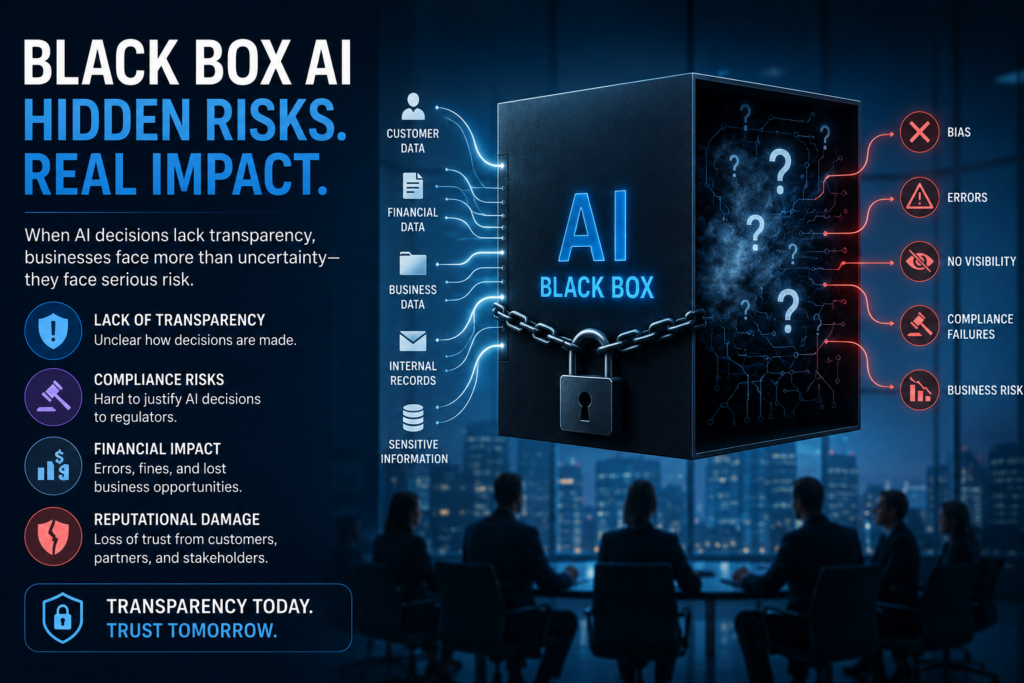
Why Black Box AI Is a Business Risk for Enterprises
Artificial intelligence has become an essential technology for organizations looking to improve efficiency, automate workflows, and make faster business decisions. From customer support and document processing to financial forecasting and operational planning, AI is helping companies accomplish more with fewer resources. While these advancements offer tremendous opportunities, they also introduce a growing concern that many business leaders can no longer ignore—black box AI.
As organizations increasingly rely on AI-driven decisions, executives are asking an important question: Can we trust an AI system if we don’t understand how it reaches its conclusions?
This question is becoming more important as AI influences hiring decisions, financial approvals, fraud detection, customer interactions, healthcare recommendations, and legal processes. When AI operates without transparency, organizations face risks that extend beyond technology. They face operational, regulatory, financial, and reputational challenges.
Understanding the risks associated with black box AI is becoming a critical part of responsible enterprise AI adoption.
What Is Black Box AI?
Black box AI refers to artificial intelligence systems whose decision-making process is difficult or impossible for humans to understand. While these systems may produce accurate results, they often cannot clearly explain how those results were generated.
For businesses, this lack of transparency creates uncertainty. Leaders may know what decision was made but remain unable to determine why the AI reached that conclusion.
As organizations depend more heavily on AI, explain ability is becoming just as valuable as accuracy.
Companies want AI systems that not only deliver results but also provide confidence in how those results are produced.
Why Transparency Matters
Businesses make important decisions every day. Whether approving loans, identifying fraud, reviewing legal contracts, or evaluating customer behaviour, organizations need confidence in the technology supporting those decisions.
Transparent AI allows employees and decision-makers to understand how recommendations are created. This improves accountability and makes it easier to identify potential errors before they affect business operations.
Without transparency, organizations may struggle to justify AI-driven decisions to customers, regulators, partners, or internal stakeholders.
Trust begins with understanding.
Business Risks of Black Box AI
When AI systems operate without visibility, organizations face several challenges.
One of the biggest concerns is decision-making without accountability. If an AI system produces an unexpected outcome, businesses may find it difficult to identify the source of the problem or explain the reasoning behind it.
Black box AI can also create operational risks when employees become overly dependent on recommendations they cannot verify.
In regulated industries, this lack of explain ability may increase compliance concerns and complicate audits.
For executive leadership, these uncertainties make AI governance increasingly important.
AI Governance Reduces Uncertainty
AI governance provides the framework organizations need to manage artificial intelligence responsibly.
It establishes policies for selecting, monitoring, and evaluating AI systems while ensuring they align with business objectives and security requirements.
Governance also encourages organizations to document AI processes, monitor performance, and review high-impact decisions before implementation.
Rather than slowing innovation, AI governance creates confidence that technology is operating responsibly.
Businesses with strong governance frameworks are better prepared to scale AI safely.
Why Boards Are Paying Attention
Artificial intelligence is no longer only an IT initiative.
Today, AI influences business strategy, operational performance, financial planning, customer experience, and regulatory compliance.
Because AI decisions can directly affect business outcomes, executive leadership and board members are becoming more involved in AI oversight.
Boards increasingly expect visibility into AI-related risks, data protection strategies, governance policies, and compliance efforts.
AI has become a business issue rather than simply a technology project.
Organizations that communicate AI risks effectively build stronger executive confidence.
Data Privacy and Explainable AI
AI systems frequently process customer records, employee information, financial documents, contracts, and operational data.
When organizations cannot explain how AI uses this information, concerns around privacy naturally increase.
Explainable Questa AI helps businesses understand how sensitive data contributes to AI-generated recommendations.
Greater transparency supports stronger privacy controls while helping organizations build trust with customers and regulators.
Businesses that prioritize explain ability often find it easier to demonstrate responsible AI practices.
Building Responsible AI Systems
Responsible AI extends beyond accuracy and performance.
Organizations should develop AI systems that are transparent, secure, fair, and aligned with business objectives.
This includes monitoring AI performance, reviewing important decisions, protecting sensitive information, and maintaining clear oversight throughout the AI lifecycle.
Responsible AI encourages continuous improvement rather than blind trust in automation.
Companies that adopt these principles are better prepared for future technological and regulatory changes.
Balancing Innovation With Accountability
Businesses should never feel forced to choose between innovation and accountability.
Modern AI strategies should support both.
Organizations can continue adopting advanced AI capabilities while maintaining visibility into decision-making processes.
Transparency strengthens confidence in AI rather than reducing its value.
Employees become more comfortable using intelligent systems when they understand how recommendations are generated.
Customers are also more likely to trust organizations that demonstrate responsible AI practices.
Preparing for the Future of Enterprise AI
Artificial intelligence will continue becoming more capable and deeply integrated into business operations.
As organizations automate increasingly important processes, explain ability and governance will become competitive advantages.
Future-ready businesses will focus on AI transparency, security, accountability, and continuous oversight alongside technological innovation.
Organizations that prepare today will be able to adopt advanced AI solutions with greater confidence and lower risk.
Responsible AI is becoming a defining characteristic of successful digital transformation.
Conclusion
Black box AI offers powerful capabilities, but it also introduces important business challenges when organizations cannot understand how decisions are made.
Transparency, explain ability, and strong AI governance help businesses reduce uncertainty while improving trust, accountability, and regulatory readiness.
Organizations that invest in responsible AI practices today will be better equipped to manage future risks while unlocking the full value of enterprise artificial intelligence.
The future of successful AI adoption belongs to businesses that combine innovation with transparency, ensuring every intelligent decision supports long-term growth, customer trust, and operational excellence.