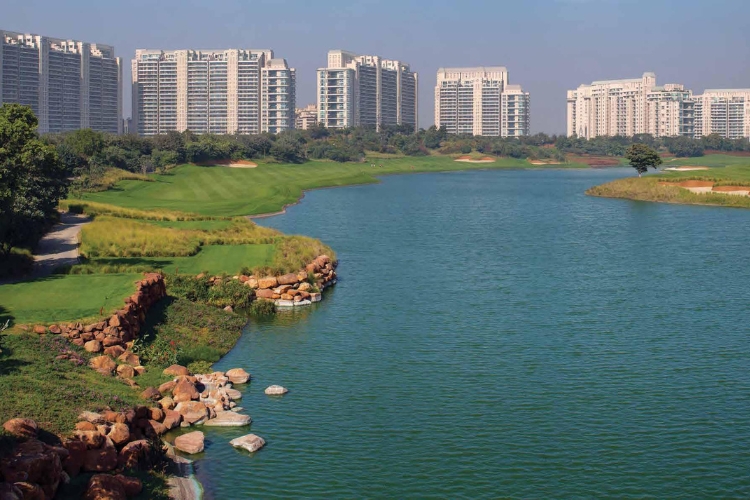
In real estate finance, certain properties transcend standard market metrics to establish entirely new asset classes. In New York, Manhattan’s 432 Park Avenue redefined the economics of super-prime residential towers; in London, One Hyde Park created a global benchmark for price per square foot. In India, that paradigm shift belongs unequivocally to DLF The Camellias.
Located in Sector 42 along Gurgaon’s prime Golf Course Road corridor, The Camellias has evolved from a high-end residential launch into one of the most lucrative trophy assets in Asian real estate history. Beyond the lifestyle appeal, examining The Camellias through an investment lens reveals a compelling case study in structural supply constraints, capital preservation, and capital appreciation.
1. Unprecedented Capital Appreciation Rates
When DLF originally launched preliminary bookings for The Camellias Gurgaon around 2013, initial prices hovered between ₹18,000 and ₹22,500 per square foot. Over the subsequent decade, while broader Indian residential real estate navigated regulatory overhauls (such as RERA and GST implementation) and macro-economic fluctuations, The Camellias experienced an unprecedented trajectory.
By 2024–2026, secondary market transactions for completed units surged past ₹80,000 to ₹1,00,000+ per square foot, with penthouse and prime golf-facing units commanding even higher premiums. Residences originally priced between ₹15 crore and ₹25 crore now routinely trade upward of ₹70 crore to ₹100+ crore.
This represents an annualized capital appreciation rate that outpaced nearly every traditional asset class in India over the same period, including benchmark equity indices and gold.
2. Structural Scarcity: The Land-Constraint Premium
The fundamental driver of value at The Camellias is absolute, irreversible scarcity. Ultra-luxury real estate value is heavily dictated by location and density.
The Golf Course Road micro-market represents the most valuable commercial and residential stretch in the National Capital Region (NCR). However, contiguous land along this strip is entirely exhausted. Within this corridor, DLF holds a near-monopoly on prime land directly fronting the 18-hole DLF Golf & Country Club.
Across its 17.5 acres, The Camellias houses only 429 residences. Because local zoning and physical space prevent any future expansion of golf-course-fronting land in Phase 5, supply is permanently capped. In financial terms, when demand from an expanding pool of high-net-worth individuals meets a strictly fixed supply curve, price inelasticity takes over.
3. The Buyer Profile: Wealth Migration into Physical Assets
The buyer demographic at The Camellias has undergone a notable shift over the past five years, reflecting larger structural changes in India’s wealth generation ecosystem:
- Promoters & Industrial Dynasties: Multi-generational business families relocating from traditional prime south/central Delhi colonies (such as Golf Links, Jor Bagh, or Vasant Vihar) into integrated vertical compounds offering superior security and infrastructure.
- Tech Founders & New-Economy Unicorn Builders: First-generation entrepreneurs seeking to park liquidity from IPOs or secondary stake sales into secure, blue-chip tangible assets.
- Global Indian HNWIs & NRIs: Non-Resident Indians based in London, Dubai, Singapore, and New York using the development as a primary Indian foothold that matches the service standards of international ultra-luxury developments.
This high-conviction buyer base rarely purchases with high-leverage debt. As a result, the secondary market at The Camellias is insulated from distress sales or interest-rate volatility, creating an exceptionally stable price floor.
4. Superior Rental Yields and Institutional Holding
In typical Indian residential markets, gross rental yields traditionally hover between 2.0% and 3.5%. However, super-prime properties with turnkey corporate appeal operate under different dynamics.
Due to the concentration of Fortune 500 headquarters, multinational technology hubs, and diplomatic missions across Gurgaon, demand for top-tier executive housing is constant. Fully furnished, professionally designed residences at The Camellias command monthly rentals ranging from ₹15 lakh to ₹25+ lakh, yielding attractive holding returns for institutional family offices and high-net-worth landlords who view these units as wealth-preservation vehicles.
5. Inflation Hedge and Generational Asset Status
Unlike standard residential properties that depreciate in value as building infrastructure ages, ultra-prime developments managed under institutional-grade sinking funds maintain their baseline appeal over decades.
The USGBC LEED Platinum certification, state-of-the-art building management systems, and high maintenance standards funded by resident associations ensure that physical degradation is minimized. Consequently, investors view a residence at The Camellias not as a short-term trade, but as a multi-generational store of value—a hedge against currency inflation and broader economic shifts.
The Verdict
DLF The Camellias has successfully decoupled itself from standard residential market cycles. Driven by extreme land scarcity along Golf Course Road, an influx of newly created domestic capital, and an institutionalized property management structure, it stands as a case study in how ultra-luxury real estate can transition from simple residential housing into a premier financial asset class.
Read our blog on Sobha Crescent