dallas county truck accident lawyer
A collision involving a commercial truck is rarely a simple traffic accident. Unlike crashes involving two passenger vehicles, truck accidents often involve multiple parties, extensive regulations, complex evidence, and severe injuries. While a police report provides an important starting point, it is only one piece of the puzzle. Victims who rely solely on the police report may overlook critical evidence that could significantly impact their claim.
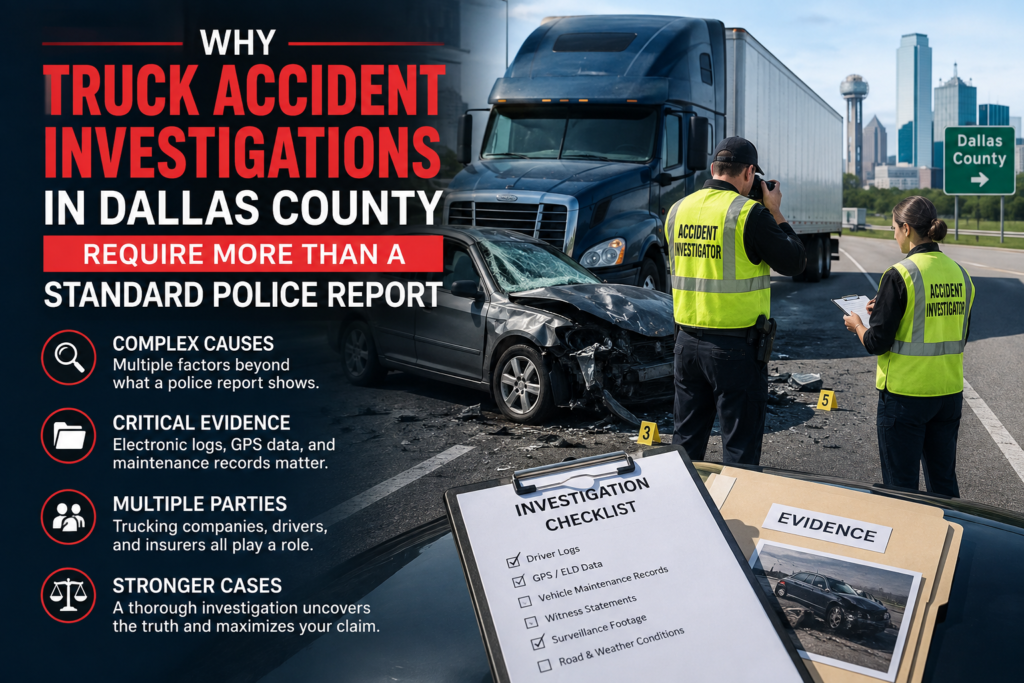
A skilled Dallas County Truck Accident Lawyer understands that a successful claim depends on conducting a comprehensive truck accident investigation that goes far beyond what responding officers can document at the scene. From reviewing electronic logging devices to examining maintenance records and identifying violations of FMCSA regulations, every detail matters when determining liability and pursuing fair compensation.
This guide explains why truck accident investigations require a much deeper analysis than a standard police report and how victims can protect their legal rights after a serious commercial truck collision.
Why a Police Report Is Only the Beginning
Police officers perform an essential role after an accident. They document basic facts, interview witnesses, note weather and road conditions, issue citations when appropriate, and prepare an official accident report.
However, police officers are not responsible for conducting a complete civil liability investigation.
Their report may not include:
- Driver qualification records
- Truck maintenance history
- Electronic logging device (ELD) data
- Black box information
- Company safety policies
- Cargo loading records
- Federal compliance documentation
- Internal trucking company communications
Because of these limitations, victims should never assume that the police report tells the entire story.
Truck Accident Cases Are Far More Complex
Commercial trucking companies operate under numerous federal and state regulations that passenger vehicle drivers do not.
Every trucking company must comply with:
- Driver qualification requirements
- Hours-of-service limitations
- Drug and alcohol testing
- Vehicle inspection standards
- Maintenance schedules
- Cargo securement rules
- Driver training requirements
When any of these rules are violated, they may establish negligence and strengthen an injury claim.
A knowledgeable Dallas County Truck Accident Lawyer investigates every possible violation that may have contributed to the collision.
Understanding FMCSA Regulations
The Federal Motor Carrier Safety Administration (FMCSA) establishes safety standards for commercial trucking companies operating throughout the United States.
These FMCSA regulations are designed to reduce preventable accidents by requiring carriers to maintain safe operations.
Some common FMCSA violations include:
- Driver fatigue
- Exceeding hours-of-service limits
- Inadequate driver training
- Failure to inspect vehicles
- Poor maintenance practices
- Improper cargo securement
- Lack of required medical certifications
Violations may serve as powerful evidence during a truck accident claim.
Important Evidence That Police Reports Often Miss
One of the biggest reasons truck accident investigations are different is the volume of evidence available.
Electronic Logging Device (ELD) Records
Federal law requires many commercial trucks to use electronic logging devices.
These devices record:
- Driving hours
- Rest periods
- Vehicle movement
- Engine operation
- Driver status changes
These records may reveal whether the driver exceeded legal driving limits before the accident.
Black Box Data
Many commercial trucks contain Event Data Recorders (EDRs), often called “black boxes.”
These systems may record:
- Vehicle speed
- Brake application
- Throttle position
- Engine performance
- Steering activity
- Sudden deceleration
Black box data can help reconstruct the events leading up to a collision.
Driver Qualification Files
Federal regulations require trucking companies to maintain detailed records on every commercial driver.
These files may include:
- Driving history
- Previous accidents
- License status
- Medical certifications
- Drug testing history
- Employment background
- Safety training
An experienced attorney reviews these records to determine whether the trucking company hired or retained an unsafe driver.
Maintenance Records
Mechanical failure contributes to many truck crashes.
Investigators examine:
- Brake inspections
- Tire replacement history
- Steering repairs
- Suspension maintenance
- Lighting inspections
- Safety recalls
Poor maintenance may establish commercial trucking liability against the trucking company or maintenance contractor.
Cargo Documentation
Improperly loaded cargo can cause:
- Rollovers
- Jackknife accidents
- Cargo spills
- Weight imbalance
- Tire blowouts
Investigators review shipping records, weight tickets, and loading procedures to determine whether cargo contributed to the crash.
Why Truck Crash Evidence Disappears Quickly
One major challenge in every truck accident investigation is preserving evidence.
Critical evidence can disappear within days.
Examples include:
- Electronic data being overwritten
- Surveillance footage deleted
- Driver log updates
- Truck repairs
- Damaged vehicle disposal
- Witness memories fading
Prompt legal action often allows attorneys to send preservation letters requiring companies to retain important evidence.
Identifying Every Responsible Party
Unlike ordinary car accidents, truck accident claims often involve several potentially liable parties.
These may include:
Truck Driver
The driver may have been:
- Distracted
- Fatigued
- Speeding
- Driving under the influence
- Improperly trained
Trucking Company
The employer may be responsible for:
- Negligent hiring
- Poor supervision
- Safety violations
- Inadequate training
- Failure to maintain vehicles
Cargo Loading Company
Improper loading can directly contribute to serious crashes.
Cargo companies may share liability when unsafe loading practices cause accidents.
Maintenance Contractors
Outside repair companies responsible for defective inspections or repairs may also bear responsibility.
Truck Manufacturers
Sometimes defective brakes, tires, steering systems, or other components contribute to collisions.
Product liability claims may become part of the investigation.
Accident Reconstruction Experts
Complex truck collisions often require professional accident reconstruction.
These experts analyze:
- Impact angles
- Vehicle damage
- Road markings
- Tire impressions
- Black box data
- Vehicle speed
- Driver reaction times
Their findings can strengthen an injury claim by explaining exactly how the collision occurred.
Catastrophic Truck Injuries Often Require Extensive Investigation
Commercial trucks can weigh up to 80,000 pounds when fully loaded.
Because of this massive size difference, victims often suffer catastrophic truck injuries such as:
- Traumatic brain injuries
- Spinal cord injuries
- Paralysis
- Internal organ damage
- Severe fractures
- Amputations
- Burns
- Permanent disabilities
These life-changing injuries often involve substantial medical costs and long-term care needs, making a thorough investigation essential to accurately assess damages.
Insurance Companies Conduct Their Own Investigations
Shortly after a serious truck accident, trucking companies and insurers often begin investigating immediately.
Their teams may include:
- Claims adjusters
- Attorneys
- Accident reconstruction specialists
- Safety experts
- Private investigators
Their primary objective is often to minimize the company’s financial exposure.
Victims benefit from having independent investigators working to uncover all available truck crash evidence and present a complete picture of what happened.
Damages That May Be Recoverable
Depending on the facts of the case, victims may seek compensation for:
- Emergency medical treatment
- Hospital expenses
- Future medical care
- Rehabilitation
- Lost wages
- Reduced earning capacity
- Pain and suffering
- Emotional distress
- Permanent disability
- Property damage
- Home modifications
- Loss of quality of life
In fatal accidents, surviving family members may also pursue wrongful death damages under applicable law.
Steps to Take After a Truck Accident
If you are involved in a commercial truck collision, consider these important steps:
- Seek immediate medical attention.
- Report the accident to law enforcement.
- Photograph vehicles, injuries, and the accident scene if it is safe to do so.
- Obtain witness contact information.
- Preserve medical records and accident-related documents.
- Avoid discussing fault at the scene.
- Refrain from providing recorded statements to insurers without understanding your rights.
- Consult a Dallas County Truck Accident Lawyer as soon as possible to help preserve evidence and evaluate your legal options.
Why Early Legal Representation Matters
Truck accident investigations become more difficult as time passes.
Early legal involvement may help:
- Preserve electronic evidence
- Secure maintenance records
- Obtain black box data
- Identify federal safety violations
- Locate witnesses
- Coordinate expert analysis
- Build a stronger compensation claim
Because trucking companies often respond quickly after serious crashes, timely action can make a significant difference in preserving critical evidence.
Conclusion
A police report is an important document, but it is rarely enough to fully explain why a commercial truck crash occurred. A thorough truck accident investigation requires reviewing electronic records, maintenance logs, federal compliance documents, witness testimony, accident reconstruction evidence, and other materials that police officers typically do not collect.
If you or a loved one has suffered catastrophic truck injuries, working with an experienced Dallas County Truck Accident Lawyer can help ensure that every aspect of the investigation is carefully examined. By uncovering violations of FMCSA regulations, identifying all responsible parties, and preserving critical truck crash evidence, victims are better positioned to pursue the compensation they may be entitled to under the law.
Frequently Asked Questions (FAQs)
1. Why isn’t a police report enough after a truck accident?
A police report summarizes the scene but usually does not include black box data, maintenance records, driver logs, or other evidence needed to establish commercial trucking liability.
2. What evidence is most important in a truck accident investigation?
Electronic logging device data, black box recordings, maintenance records, driver qualification files, cargo documentation, witness statements, and accident reconstruction findings are often critical.
3. How do FMCSA regulations affect a truck accident case?
Violations of FMCSA regulations—such as exceeding hours-of-service limits or failing to maintain vehicles—may help demonstrate negligence and support a personal injury claim.
4. Who can be held liable for a commercial truck accident?
Depending on the circumstances, liability may extend to the truck driver, trucking company, cargo loader, maintenance provider, or manufacturer of defective truck components.
5. When should I contact a Dallas County Truck Accident Lawyer?
It is generally advisable to seek legal guidance as soon as possible after the accident so that important evidence can be preserved and your legal options can be evaluated before critical information is lost.