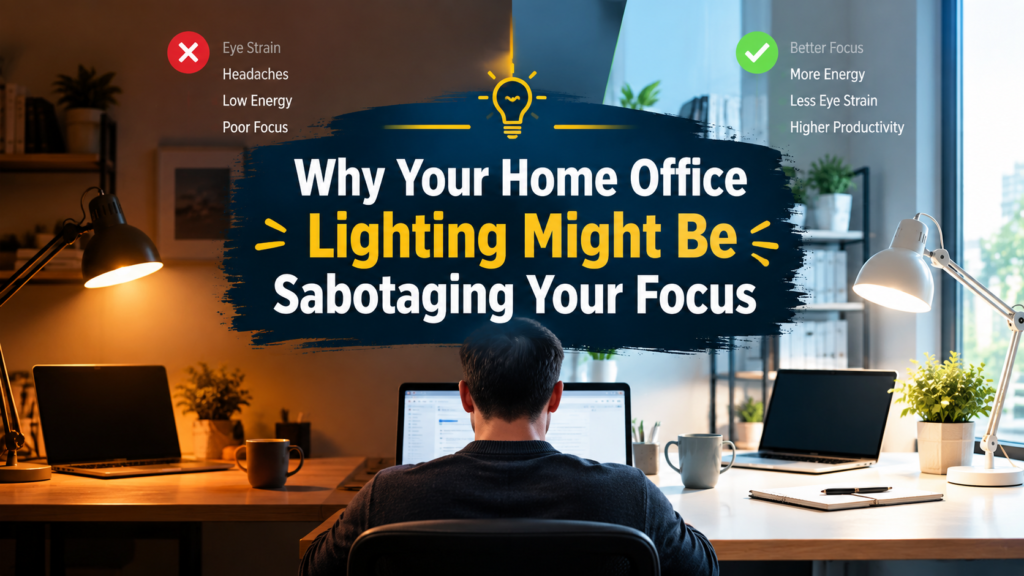
You’ve optimized your chair, upgraded your monitor, and maybe even invested in a mechanical keyboard that clicks just right. But if you’re still rubbing your eyes by mid-afternoon or feeling unexplainably drained after a few hours at your desk, the culprit might be something you’ve completely overlooked: the light sitting right in front of you.
Lighting is one of the most underrated factors in a productive workspace, and it’s also one of the easiest to fix.
How Poor Lighting Quietly Wrecks Your Workday
Most people don’t think about lighting until something feels wrong, a headache creeping in, eyes that won’t focus, a general sense of fatigue that coffee doesn’t fix. By then, the damage to your afternoon is already done.
Overhead Light Alone Isn’t Enough
Relying solely on a ceiling fixture or ambient room light creates uneven illumination across your desk. Shadows fall across your keyboard, your screen reflects glare from the wrong angle, and your eyes are constantly micro-adjusting to compensate. That constant adjustment is exhausting, even if you don’t consciously notice it happening.
The Wrong Color Temperature Throws Off Your Body Clock
Light isn’t just about brightness; its color temperature matters just as much. Cool, blue-toned light late in the day can interfere with your natural energy rhythm, while overly warm, dim light in the morning can leave you feeling sluggish when you need to be sharp. Most desks default to whatever bulb came in the fixture, which is rarely optimized for either.
Glare Is a Silent Productivity Killer
A lamp positioned incorrectly, or one with an exposed bulb, can throw glare directly onto your screen or into your line of sight. Over a full workday, that glare forces your eyes to work harder than they should, and eye strain has a way of quietly draining your focus long before you consciously feel tired.
What Good Desk Lighting Actually Looks Like
Fixing your workspace lighting isn’t about buying the most expensive lamp on the market. It’s about understanding a few basic principles and choosing a fixture that fits how you actually work.
Task Lighting Should Be Adjustable
A fixed-position lamp forces you to work around its light, instead of the other way around. A good desk lamp lets you angle the head, extend the arm, and direct light exactly where your hands and eyes need it most whether that’s a keyboard, a notebook, or a drawing tablet.
Brightness Should Be Flexible, Not Fixed
Your lighting needs to change throughout the day. Bright, focused light works well for detailed morning tasks, while a softer setting in the evening reduces strain as natural light fades outside. Dimmable lamps let you adjust on the fly instead of forcing one brightness level onto every hour of your workday.
Warm and Cool Settings Serve Different Purposes
Lamps with adjustable color temperature give you flexibility that a single-tone bulb simply can’t. Cooler light in the morning supports alertness, while warmer tones later in the day feel easier on tired eyes without pulling you out of focus mode entirely.
Design Matters More Than People Assume
A cluttered, oversized lamp on a small desk creates its own kind of friction, one more thing competing for space and attention. A well-designed lamp should complement your workspace, not dominate it. This is where a curated desk lamps collection makes a real difference, since options built with both function and form in mind tend to fit seamlessly into a workspace instead of looking like an afterthought bolted onto the corner of a desk.
Matching a Lamp to How You Actually Work
Not every desk lamp suits every kind of work, and it’s worth thinking through your own habits before choosing one.
For Detail-Heavy Work
If your day involves close reading, writing, or fine detail work, prioritize a lamp with strong, direct brightness and minimal shadow-casting. An adjustable arm that lets you bring light closer to your work surface matters more here than aesthetic flourishes.
For Long Screen Sessions
If most of your day is spent looking at a monitor rather than paper, glare control becomes the priority. Look for a shaded or diffused design that softens the light rather than casting a hard beam directly at your screen.
For Shared or Multi-Purpose Spaces
A home office that doubles as a guest room or reading nook benefits from a lamp that looks intentional even when it’s not in “work mode.” A more decorative design with a dimmer function gives you flexibility to shift from bright task lighting to soft ambient light in seconds.
Small Change, Noticeable Difference
It’s easy to underestimate how much a single lighting fixture affects your day. But ask anyone who’s replaced a harsh, glaring desk lamp with a properly adjustable one, and they’ll tell you the difference is immediate fewer end-of-day headaches, less squinting at the screen, and a workspace that actually feels comfortable to sit in for hours at a time.
Final Thoughts
Your desk setup is only as good as its weakest link, and for a lot of home offices, that weak link is lighting. Before you invest in another gadget or accessory, take a hard look at what’s actually illuminating your workspace. A well-chosen, adjustable lamp with the right brightness and color temperature options can do more for your daily focus than most productivity apps ever will and it’s one of the simplest upgrades you can make to a desk you already own.