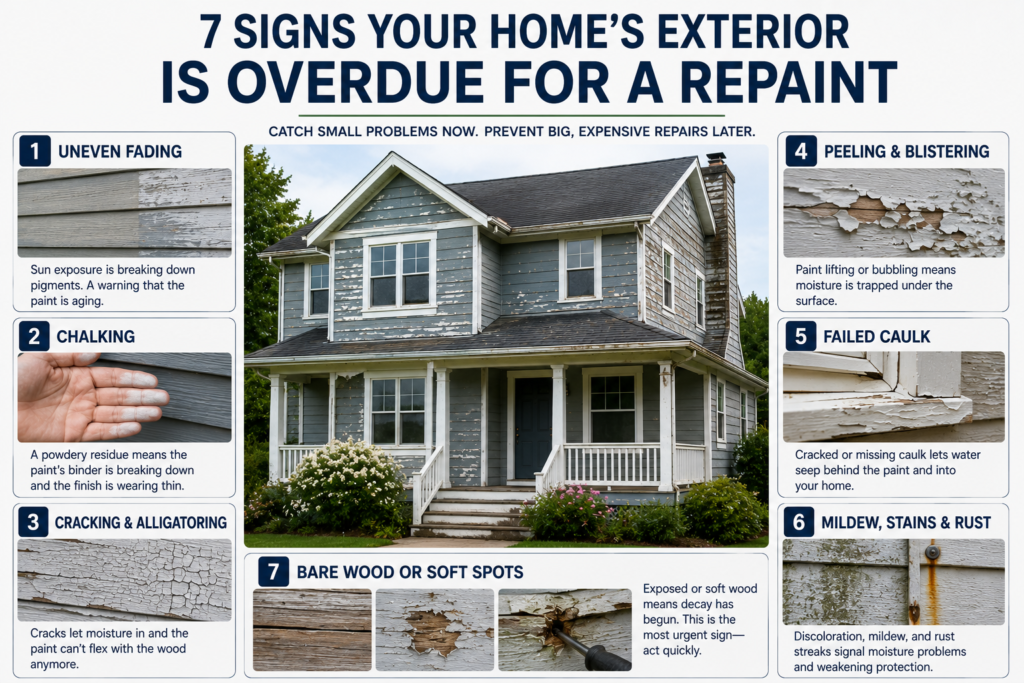
Exterior paint almost never fails overnight. It telegraphs its decline for a year or two first, in a sequence of symptoms that professionals read the way a mechanic reads engine noises, and the financial stakes of reading them correctly are larger than most homeowners realize. Caught early, a declining paint job is exactly that: a paint job, priced in coating and labour. Caught late, after water has spent a couple of winters behind the failed film, the same house needs rot repair, trim replacement, and sometimes new siding sections before any exterior repainting can even begin, and the invoice multiplies accordingly. The difference between those two outcomes is rarely money or diligence; it is simply knowing what to look for and walking the house once a year with that knowledge.
Here are the seven signs professionals check on every assessment, arranged in rough order from early warning to genuine emergency, with what each one means mechanically and what it should prompt you to do.
1. Fading That Is No Longer Even
All exterior paint fades, and gentle uniform fading is just the film aging gracefully. What matters diagnostically is uneven or dramatic fading: a south wall noticeably lighter than the sheltered strip beneath its eave, or a colour that has drifted visibly from the protected patch behind a downspout. Strong fading means ultraviolet light has degraded the pigments, and pigment breakdown is always the opening act of binder breakdown, because the same radiation attacks both. A faded film still protects, but its clock is audibly running, and fading on the sunny faces is your earliest, cheapest opportunity to start planning and budgeting on your own schedule rather than the weather’s.
2. Chalking You Can Wipe Off With Your Hand
The test costs nothing: rub a palm firmly across the siding on a dry day. If it comes away dusted with a powdery residue the colour of your paint, the resin binder holding the film together is decomposing and releasing pigment, a condition called chalking. Light chalking is a two year warning. Heavy chalking, where every touch leaves a visible mark on your hand, means the film is actively thinning season by season and its protective life is nearly spent. Chalking carries a second, practical implication for whoever paints next: chalk is a bond breaker, and new paint applied over an unwashed chalky surface will peel early no matter its quality, which is why a thorough wash is non negotiable on any older repaint.
3. Hairline Cracking and Alligatoring
Look closely at the sunniest walls and the oldest paint. Fine cracks in the surface, and especially the scaly, reptilian pattern painters call alligatoring, reveal that the film has embrittled and can no longer flex with the wood’s daily and seasonal movement. Every crack, however hairline, is a water entry point, and once water is cycling through the film instead of shedding off it, decline accelerates sharply with each wet season. Isolated cracking on one exposure can sometimes be addressed locally, but widespread cracking means the coating has reached the end of its flexible life everywhere, and the countdown is now measured in seasons rather than years.
4. Peeling and Blistering
This is the symptom everyone recognizes, and by the time it appears, the underlying problem is already established, because peeling is not a surface event. It means adhesion has failed, almost always because moisture reached the back of the film, through cracks, through failed caulk, or by vapor pressure from inside a damp wall, and physically pushed the coating off. Small, isolated peeling can be scraped, sanded, primed, and spot repaired if the surrounding film is sound. Peeling appearing in multiple areas at once means the bond line is failing generally and the whole surface needs professional attention now, not next season. One caution belongs here: on homes built before 1978, deteriorating paint layers may contain lead, and disturbing them by scraping or sanding requires proper precautions; the United States Environmental Protection Agency publishes clear homeowner guidance on identifying and safely handling it (epa.gov/lead).
5. Failed or Missing Caulk
Walk the trim, windows, corner boards, and joints, and look at the caulk lines the way an inspector would. Caulk that has cracked, hardened, pulled away from one side of its joint, or gone missing entirely leaves open seams that channel water directly behind your paint and into the wall assembly, bypassing the coating’s protection completely. Failed caulk almost never gets its own line in a homeowner’s mental budget, and it is one of the most common root causes of the expensive hidden damage discovered during repaints. The economics are absurdly lopsided: a tube of quality caulk and an hour of attention this year genuinely prevents rot repairs costing hundreds of times as much a few years from now, which makes the annual caulk inspection the highest return twenty minutes in home maintenance.
6. Mildew, Staining, and Rust Streaks
Grey green speckling spreading across shaded and north facing walls, brown tannin or water stains bleeding below sills, and rust streaks descending from nail heads and fixtures are three different symptoms with one shared meaning: the paint system is no longer managing water. Mildew is a living colonization of chronically damp film, and it holds moisture against the surface while feeding on it. Rust streaks mean fasteners are corroding inside the wall, a symptom especially common near salt water. Stains of every kind share an important property for repaint planning: they bleed through fresh coats applied over them, so they must be killed, washed, and sealed with appropriate stain blocking primer, not merely covered. Their appearance is the signal that the house has moved from cosmetic aging into active moisture trouble.
7. Bare Wood or Soft Spots
If you can see grey, weathered wood anywhere on the house, or if a screwdriver pressed into trim or a sill sinks in with soft resistance, protection has already failed at that location and decay has begun. This is the emergency stage, and the meter is now running in the most expensive currency, because every additional month of exposure converts more of the eventual invoice from painting into carpentry. Bare and soft spots warrant a professional assessment promptly, in any season, since the correct response may involve repairs and priming that stabilize the damage before the full repaint happens in the next proper weather window.
What To Do With What You Found
Score your walkaround honestly. One or two symptoms from the early list mean you should plan and budget deliberately: gather quotes this season for work in the next painting window, on your terms. Several symptoms from the middle of the list mean the house is due now, and delay is buying damage. Anything from the final two categories means calling a professional promptly, because a thorough assessment and properly prepared repaint at that stage can still stop the deterioration where it stands, while another winter of exposure may take that option off the table. The annual twenty minute walk is the entire discipline; the house will always tell you where it is in the cycle, provided you know its vocabulary.
Frequently Asked Questions
How often should I inspect my home’s exterior paint?
Once a year at minimum, and spring is the ideal moment because winter inflicts most of the annual damage and the findings can feed directly into planning for the summer painting season. A slow circuit of the house checking walls, trim, caulk lines, and sills takes about twenty minutes and reliably catches problems while they are still cheap.
Can I just touch up peeling spots instead of repainting everything?
Sometimes, if the peeling is genuinely isolated and the surrounding film passes the chalk and flexibility tests. The failing area must be scraped to sound edges, sanded, primed, and recoated, not just painted over. Once peeling appears in several separate places, spot repairs become a losing game and a full repaint is the more economical path.
Is chalking paint dangerous or just cosmetic?
On modern paints, chalking itself is a normal end of life symptom rather than a hazard, and its significance is diagnostic: the film is thinning and approaching replacement. The exception is older homes, where pre 1978 layers may contain lead; deteriorating paint on those houses should be handled with proper precautions rather than dry scraped casually.
What happens if I ignore these signs for a few more years?
Water gets behind the failed film and into the wood, and the project grows from repainting into rot repair, trim replacement, and in serious cases siding replacement, typically multiplying the total cost well beyond a timely repaint. The paint symptoms are the affordable stage of a sequence that becomes structural if it is left to run.