Learn how to launch a payday loan business from licensing and capital to compliance and tech. A complete step-by-step guide for new lenders in 2026.
The payday loan industry continues to serve a real and persistent need: millions of borrowers each year require small, short-term cash advances to bridge the gap between paychecks or handle sudden expenses. For entrepreneurs and financial institutions, this creates a genuine business opportunity — but one that comes wrapped in heavy regulation, reputational sensitivity, and operational complexity.
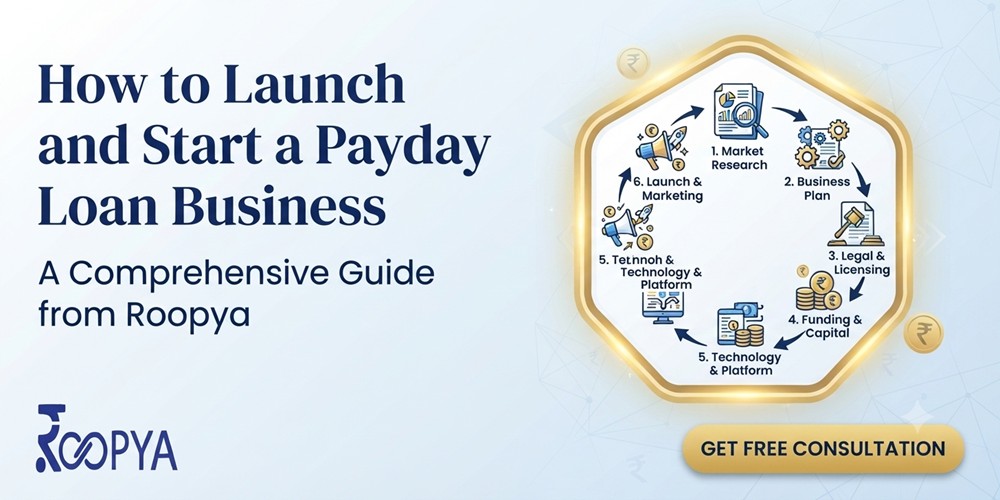
Starting a payday loan business isn’t as simple as opening a storefront and handing out cash. It requires the right legal structure, adequate capital, state-by-state licensing, a compliant loan process, and — increasingly — a modern digital lending platform that can automate origination, underwriting, disbursement, and collections. This guide walks through every stage of launching a payday loan business in 2026, from initial planning to scaling with technology.
If you’re evaluating the operational side of this business, a platform like Roopya — a no-code loan origination and loan management system built for NBFCs and lenders — is worth understanding early, since your technology stack will shape almost every decision you make from here on.
What Is a Payday Loan Business?
A payday loan business provides short-term, small-dollar loans that borrowers typically repay from their next paycheck. Loan amounts are usually modest, terms run from a couple of weeks to a couple of months, and approval is based on proof of income and an active bank account rather than a traditional credit check. Because underwriting is fast and collateral-free, payday lenders charge a flat fee or a higher annualized rate compared to conventional loans, which compensates for the elevated default risk and the speed of disbursal.
This model appeals to a segment of borrowers who are underserved by banks — gig workers, hourly employees, and people with thin or damaged credit files. That underserved demand is exactly why the segment remains commercially viable, provided it is run compliantly and responsibly.
Step 1: Research the Market and Define Your Niche
Before any paperwork, spend real time understanding the market you intend to serve.
- Study local demand. Look at income levels, unemployment trends, and the presence (or absence) of existing payday lenders in your target geography.
- Decide on a channel. Will you operate a physical storefront, an online-only lending platform, or a hybrid model? Online payday lending has grown significantly because it reduces overhead and widens your addressable market, but it also means you may need licenses in every state or region where your borrowers reside, not just where your office sits.
- Identify your niche. Some lenders focus purely on salary advances for salaried employees, others on gig-economy workers, and others on small emergency loans for a broader population. A defined niche makes your underwriting rules, marketing, and product design far simpler to build.
- Study competitors. Understand their loan amounts, fee structures, repayment terms, and technology experience. A cumbersome application process is one of the easiest gaps to exploit with a smoother digital journey.
A clear market thesis at this stage will influence your licensing strategy, your capital plan, and the loan management technology you eventually choose.
Step 2: Choose Your Legal and Business Structure
Once you know who you’re serving and how, formalize the business itself.
- Select a legal entity. Most payday lenders register as an LLC or a corporation to separate personal and business liability. Some larger operators structure as a Non-Banking Financial Company (NBFC) or equivalent regulated lending entity, depending on jurisdiction, which opens the door to larger capital pools and institutional funding.
- Register your business name with the relevant company registrar or Secretary of State, and secure a tax identification number.
- Draft a business plan that covers your target market, loan products, projected volumes, funding sources, staffing, technology stack, and a realistic default-rate assumption. Lenders, investors, and regulators will all want to see this document at some point.
- Open a dedicated business bank account. Regulators typically require proof of a segregated account used exclusively for lending operations, and many require a letter from your bank confirming a minimum unencumbered cash balance.
Getting the entity structure right early avoids costly restructuring later, especially once licensing applications are underway, since most regulators tie the license to a specific legal entity.
Step 3: Understand Licensing and Regulatory Requirements
This is the single most important — and most commonly underestimated — step in starting a payday loan business. Payday lending is one of the most tightly regulated consumer finance categories in almost every country, and the specific rules vary enormously by state, province, or national regulator.
Key regulatory elements to research and prepare for:
- Lending license. Nearly every jurisdiction that permits payday lending requires a specific consumer lending or small-dollar/payday lending license, separate from your general business registration. Some jurisdictions prohibit the product entirely or cap interest rates so low that the traditional payday model isn’t viable — know this before you invest further.
- Minimum net worth or cash-on-hand requirement. Regulators commonly require proof of unencumbered capital, which can range from a modest sum in smaller markets to well over a hundred thousand dollars in stricter jurisdictions.
- Surety bond. Many regulators require a surety bond tied to your loan portfolio size, protecting borrowers if the lender fails to meet its obligations.
- Interest rate and fee caps. Almost all regions cap the fees or APR a payday lender can charge, along with rules on rollover loans, cooling-off periods between loans, and maximum loan-to-income ratios.
- Disclosure requirements. Loan agreements must disclose the total cost of credit, repayment schedule, and borrower rights in plain language, often in a legally prescribed format.
- Data protection and credit bureau reporting. You may be required to report loan performance to credit bureaus and to comply with data privacy law when collecting and storing borrower information.
- Registration with financial regulators. Depending on your jurisdiction, this could mean a state Department of Financial Institutions, a national central bank, or a consumer protection authority. In markets with a national digital lending framework, additional registration as a regulated lending entity or a partnership with a regulated lender may be mandatory before you can operate any lending app or website.
Licensing timelines can run from a few weeks to several months per jurisdiction, and applications typically require background checks on owners and officers, audited financials, and a description of your lending technology and data-security practices. If you intend to lend across multiple states or regions, budget significant time and legal cost for multi-jurisdiction licensing — this is frequently the single biggest bottleneck between “idea” and “first loan disbursed.”
Because rules shift often, work with a lending compliance attorney or licensing consultancy that specializes in small-dollar and payday lending, rather than relying solely on generic business-formation advice.
Step 4: Plan Your Startup Capital
Payday lending is capital-intensive because you are, in effect, warehousing risk on your own balance sheet (or a partner lender’s) until loans repay.
Budget for the following categories:
- Regulatory capital. The minimum net worth or cash reserve mandated by your licensing jurisdiction.
- Licensing and legal fees. Application fees, attorney fees, and compliance consulting, which can add up quickly across multiple states.
- Loan capital / lending float. The actual cash you’ll disburse to borrowers. This is your largest and most variable cost, scaling directly with loan volume.
- Default reserve. Because payday loans carry higher default risk than secured lending, set aside a meaningful reserve — often in the range of a mid-single-digit to low-double-digit percentage of projected loan volume — to absorb non-repayment.
- Technology costs. Loan origination, underwriting, disbursement, collections, and reporting software. Building this in-house is expensive and slow; most new entrants now license a ready-made loan management platform instead.
- Marketing and customer acquisition. Digital ads, SEO, referral programs, and — for storefronts — signage and location costs.
- Staffing. Loan officers, collections agents, compliance staff, and customer support, even if your core process is automated.
Funding sources vary from founder capital and angel or private investors to credit lines from banks or non-bank funders, and increasingly, capital partnerships with NBFCs or other regulated lenders who provide the balance sheet while you provide the technology and origination.
Step 5: Build a Compliant Loan Process
Your loan process is the operational core of the business, and it needs to be both borrower-friendly and airtight from a compliance standpoint.
A typical payday loan journey includes:
- Application intake — name, employment details, income proof, and bank account information, usually collected online or in-app.
- Identity and eligibility verification — KYC checks, employment verification, and confirmation of an active bank account, often through automated document and bank-statement analysis.
- Underwriting and credit decisioning — a rules-based or scorecard-based decision engine assessing income stability, existing debt, and repayment capacity, even where formal credit bureau data is thin.
- Disclosure and agreement — a clear, compliant loan agreement showing principal, fees, total repayment amount, and due date, with the borrower’s explicit consent.
- Disbursement — funds sent to the borrower’s bank account, typically within minutes to a few hours for digital lenders.
- Repayment and collections — automated reminders, scheduled debits, and a structured collections workflow for missed payments, including any legally mandated grace periods or repayment plans.
- Reporting — internal portfolio reporting plus any mandatory regulatory or credit-bureau reporting.
Every one of these steps has compliance implications, and manual handling introduces both operational risk and human error. This is precisely why most modern payday lenders — including NBFCs and fintech lenders — run this entire flow through a dedicated loan origination system (LOS) and loan management system (LMS) rather than spreadsheets and manual approvals.
Step 6: Choose the Right Lending Technology
Technology is what separates a payday loan business that can scale profitably from one that drowns in manual work and compliance risk. At a minimum, your platform should handle:
- Digital application and onboarding with document upload and e-KYC.
- Automated credit scoring and decisioning, including configurable business rules for approval thresholds, loan amounts, and pricing.
- Fraud detection, since payday lending’s speed makes it a common target for identity fraud and loan stacking.
- Disbursement integration with banking and payment rails for near-instant payouts.
- Collections automation, including reminders, auto-debits, and structured workflows for delinquent accounts.
- Regulatory and MIS reporting, so you can produce the reports regulators and investors will ask for without manual reconciliation.
- Analytics, to track portfolio health, default rates, customer acquisition cost, and loan-level profitability in real time.
Building this stack from scratch typically takes months of engineering time and ongoing maintenance. That’s why many new and existing lenders turn to purpose-built infrastructure such as Roopya’s Loan Origination and Loan Management System, which is designed specifically for salary-advance and payday-style lending. A no-code platform lets you configure loan products, credit policies, and approval workflows without a development team, connect to pre-integrated credit bureaus, KYC, and payment APIs, and go live in a matter of days rather than months — while staying aligned with evolving regulatory requirements. For a new payday lender, this can compress a 6–12 month build timeline down to a matter of weeks, letting you focus your limited capital on licensing, compliance, and customer acquisition instead of software engineering.
Step 7: Design Responsible Lending Practices
Payday lending’s reputation problem is real, and regulators worldwide are tightening rules in direct response to predatory practices seen in the past. Building responsible lending into your model from day one isn’t just ethical — it’s a genuine competitive and regulatory advantage.
- Cap the number of consecutive rollovers or renewals a borrower can take.
- Assess repayment capacity rather than approving loans that are almost certain to default or trap the borrower in a debt cycle.
- Offer clear, jargon-free disclosures of total cost and repayment terms before the borrower commits.
- Provide hardship or extended repayment options for borrowers facing genuine difficulty, rather than escalating aggressively straight to collections.
- Train collections staff on fair-practice standards, and avoid contact methods or frequency that could be classified as harassment under consumer protection law.
Lenders that build a reputation for fairness see lower regulatory friction, better repeat-customer rates, and stronger word-of-mouth — all of which matter enormously in a segment where trust is scarce.
Step 8: Market Your Payday Loan Business
Once you’re licensed, capitalized, and operationally ready, customer acquisition determines how quickly you reach profitability.
- SEO and content marketing targeting borrowers actively searching for short-term loan solutions in your service area.
- Paid search and social ads, carefully worded to meet advertising rules for consumer credit products, which are often stricter than general advertising law.
- Partnerships with employers, gig platforms, or retailers whose customers frequently need short-term cash access.
- Referral programs rewarding existing borrowers for referring others who repay responsibly.
- Local presence (for storefronts) through signage, community engagement, and local search optimization.
Track your cost per funded loan carefully — in payday lending, acquisition cost has to be weighed against a single loan’s fee revenue, so efficient, targeted marketing matters more here than in almost any other lending category.
Step 9: Monitor, Optimize, and Scale
Once loans are flowing, your job shifts to active portfolio management.
- Track key metrics: approval rate, default rate, average loan size, repeat-borrower rate, cost per acquisition, and portfolio yield.
- Refine your underwriting model continuously using real repayment data — your scorecard should get sharper with every cohort of loans.
- Expand thoughtfully. Once a jurisdiction is profitable and stable, use the same licensing and technology playbook to expand into new states or regions rather than rebuilding the process from scratch each time.
- Diversify products carefully, such as adding installment loans or salary-advance products alongside payday loans, once your core operation is stable — a step platforms with pre-configured loan products make considerably easier.
- Stay current on regulation. Payday lending rules change frequently; build a habit of regulatory monitoring or retain compliance counsel on an ongoing basis rather than treating licensing as a one-time task.
Common Mistakes to Avoid
- Underestimating licensing timelines and costs, especially when planning multi-state operations.
- Undercapitalizing the default reserve, which can cause a cash crunch even when the underlying business is fundamentally sound.
- Building technology in-house too early, burning capital and time that could go toward licensing and customer acquisition.
- Ignoring responsible lending design, which invites regulatory scrutiny and reputational damage that can be difficult to reverse.
- Weak fraud controls, given that payday lending’s speed makes it an attractive target for fraud rings and identity theft.
Launching a payday loan business in 2026 is entirely achievable, but it rewards careful preparation far more than speed. Success depends on getting four things right: proper licensing in every jurisdiction you serve, sufficient capital including a realistic default reserve, a compliant and borrower-friendly loan process, and — critically — the right lending technology to run it all efficiently from day one.
Rather than spending months building origination, underwriting, disbursement, and collections systems in-house, most successful new entrants now launch on established, no-code lending infrastructure. Platforms like Roopya let you configure a fully compliant payday or salary-advance lending operation — from application to collections — and go live in days, with 300+ pre-integrated APIs, AI-powered fraud detection, and built-in regulatory reporting, so your team can focus on licensing, capital, and growth instead of engineering.
Frequently Asked Questions (FAQs)
1. How much capital do I need to start a payday loan business? Startup capital varies widely by jurisdiction, but you should plan for regulatory minimum net worth requirements (from a few thousand dollars to over a hundred thousand, depending on the region), licensing and legal fees, a lending float to fund actual loans, and a default reserve of roughly 5–15% of projected loan volume.
2. Do I need a special license to run a payday loan business? Yes. Almost every jurisdiction that permits payday lending requires a specific consumer lending or small-dollar/payday lending license, separate from standard business registration. Requirements typically include a minimum net worth, a surety bond, and background checks on owners.
3. Can I run a payday loan business entirely online? Yes, online-only payday lending is common and often more cost-efficient than a storefront model. However, you generally still need licenses in every state or region where your borrowers are located, not just where your company is registered.
4. How long does it take to get a payday loan license? Timelines vary by regulator and can range from a few weeks to several months per jurisdiction, particularly if you’re applying in multiple states or regions simultaneously.
5. What technology do I need to launch a payday loan business? At minimum, you need a system for digital applications and KYC, automated credit decisioning, disbursement integration, collections automation, fraud detection, and regulatory reporting. Most new lenders use a ready-made loan origination and management platform, such as Roopya, instead of building this in-house.
6. Is the payday loan business still profitable in 2026? It can be, particularly for lenders who combine efficient digital origination with disciplined underwriting and a well-managed default reserve. Margins have tightened in many markets due to rate caps and rising compliance costs, making operational efficiency and low customer acquisition cost increasingly important to profitability.
7. What’s the difference between a payday loan and a salary advance product? A payday loan is typically an independent short-term loan repaid on a borrower’s next payday, while a salary advance is usually tied more directly to an employer relationship or verified income stream, often with lower fees and more structured repayment. Many lenders now offer both under a single lending platform.
8. What are the biggest risks in starting a payday loan business? The main risks are regulatory non-compliance, undercapitalized default reserves, fraud, and reputational damage from poor lending practices. Careful licensing, adequate capital planning, strong fraud controls, and responsible lending design mitigate most of these risks.