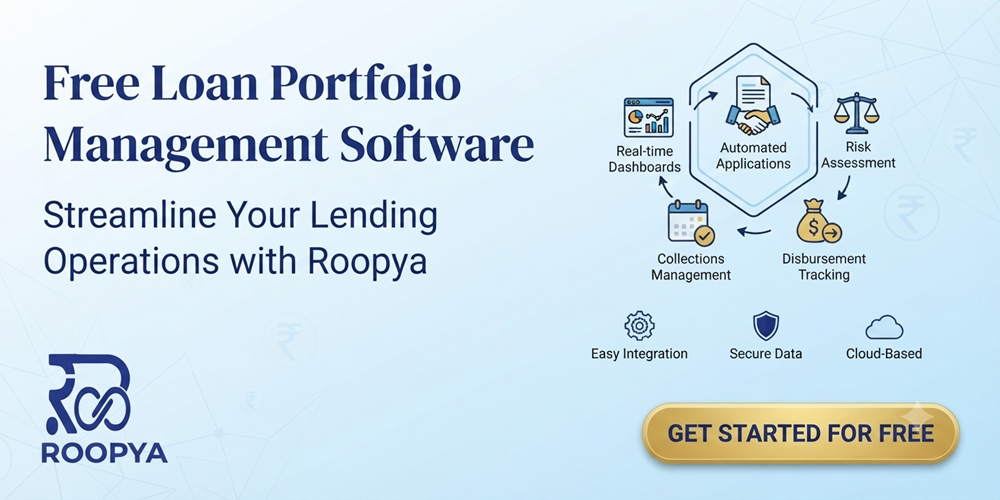
Explore free loan portfolio management software options, their limits, and how Roopya's zero-upfront, pay-per-loan platform helps NBFCs and lenders scale without heavy CAPEX.
Every lending business — whether it’s a two-person microfinance startup, a growing NBFC, or a digital lending platform — eventually runs into the same wall: spreadsheets stop working. Loan counts climb into the hundreds, repayment schedules multiply, collections calls pile up, and one missed EMI reminder starts costing real money. That’s the moment most founders and finance teams start typing “free loan portfolio management software” into Google.
It’s a completely reasonable search. Nobody wants to commit six or seven figures to enterprise software before they’ve even proven their lending model works. But “free” in the lending-technology world is a loaded word, and it means very different things depending on who’s selling it to you. This guide breaks down what loan portfolio management software actually does, what you genuinely get for free versus what free tools quietly cost you later, and how platforms like Roopya are changing the economics of getting started — with a pay-as-you-use model that removes the traditional upfront licensing burden lenders used to be stuck with.
By the end of this article, you’ll know exactly what to look for, what to avoid, and how to evaluate whether a “free” tool is really free or just free until it isn’t.
What Is Loan Portfolio Management Software?
Loan portfolio management software (often abbreviated LPMS or bundled into a broader Loan Management System, LMS) is the system of record a lender uses to track every loan from disbursement to closure. Instead of managing borrower records, EMI schedules, interest accruals, penalties, and collections across scattered spreadsheets and WhatsApp reminders, a portfolio management platform centralizes all of it into one place.
At a functional level, this software typically handles:
- Loan account creation and disbursement tracking — recording principal, tenure, interest rate, and product type for every borrower
- Amortization and repayment scheduling — auto-generating EMI schedules, due dates, and interest-principal splits
- Payment processing and reconciliation — capturing repayments via UPI, NACH, cheque, or cash and matching them against dues
- Delinquency and collections management — flagging overdue accounts and triggering reminders or recovery workflows
- Portfolio-level reporting — giving management a real-time view of disbursed amount, outstanding principal, NPA ratios, and yield
- Regulatory and compliance reporting — formatting data for RBI returns, credit bureau reporting, and audit trails
In short, it’s the operating backbone of any lending business. Get it wrong, and you either drown in manual reconciliation or lose visibility into which loans are quietly turning bad.
Why Lenders Search for “Free” Loan Portfolio Management Software
The appeal of free software is obvious, but the underlying motivations tend to fall into a few buckets:
1. Early-stage lenders testing the model. A new NBFC or a fintech piloting a lending product with a few hundred loans doesn’t want to sign a multi-year enterprise contract before knowing if the unit economics work.
2. Microfinance institutions and NGOs with thin margins. Many MFIs operate on wafer-thin spreads and simply cannot absorb large software licensing fees, especially in the first two to three years.
3. Finance teams tired of spreadsheets but not ready for a “system.” Excel and Google Sheets get borrowers tracked for a while, but the moment two people need to edit the same file, or a formula breaks silently, portfolio accuracy suffers.
4. Budget-conscious founders comparing vendors. Even well-funded lenders want to know what free or low-cost tooling exists before they commit budget to a paid platform.
All of these are valid starting points. The trouble is what happens next.
The Real Cost of “Free” Loan Software
Free tools generally fall into three categories, and each comes with trade-offs that aren’t obvious on day one.
1. Spreadsheets and Manual Trackers
Google Sheets or Excel is technically free, and for the first fifty loans it might genuinely work. But spreadsheets have no audit trail, no access control, no automated interest calculation logic that scales, and absolutely no protection against a single wrong formula silently corrupting your entire portfolio view. There is no borrower-facing portal, no automated reminders, and reconciling payments becomes a full-time manual job as volume grows.
2. Open-Source Loan Management Systems
There are a handful of open-source lending platforms available for self-hosting. These can be a reasonable option for technically strong teams, but “free” here really means “free of license fees” — you still absorb the cost of:
- Hosting infrastructure and server maintenance
- A development team to configure, customize, and patch the system
- Building your own integrations to credit bureaus, payment gateways, KYC/eKYC providers, and SMS/WhatsApp gateways
- Ongoing security patching and regulatory-compliance updates
- No dedicated support when something breaks in production
For a lender with an in-house engineering team, this can work. For most NBFCs and MFIs, whose core competency is credit — not software engineering — this quietly becomes an expensive, slow-moving project.
3. “Freemium” SaaS Tools with Hard Caps
Some commercial platforms offer a genuinely free tier, but it’s almost always capped — a limited number of loan accounts, no API access, no collections automation, and no compliance reporting. These tools are fine for testing a UI, but they are rarely built to survive contact with real regulatory obligations like RBI reporting formats, credit bureau submissions, or NPA classification rules.
The common thread across all three: free software shifts cost from a subscription line-item to hidden costs in engineering time, compliance risk, and operational inefficiency. That’s not a criticism of free tools — it’s simply the trade-off to go in with eyes open.
What a Growing Lender Actually Needs
Once a lending business crosses a few hundred active loans, the requirements shift from “track my loans” to “run my lending operation.” At that point, the features that matter most include:
- Automated amortization and interest accrual that handles reducing balance, flat rate, or bullet repayment structures without manual recalculation
- A business rule engine to configure credit policies, approval thresholds, and collection escalation logic without needing a developer for every change
- Integrated credit bureau pulls (CIBIL, Experian, CRIF, Equifax) baked into the underwriting flow
- Automated collections workflows — reminders via SMS/WhatsApp/email, escalation to field agents, and payment-plan restructuring
- Early warning and risk analytics to flag accounts showing stress before they slip into default
- Regulatory-ready reporting formatted for RBI, credit bureaus, and internal audit
- A borrower-facing portal so customers can self-serve their repayment schedule and make payments without calling support
- Role-based access control and audit trails, which matter enormously the moment you have more than one person touching the system
This is where the “free vs paid” conversation really gets tested. Free tools rarely offer all of this out of the box, and building it yourself takes months a growing lender usually doesn’t have.
How Roopya Approaches This Differently
Roopya is a no-code lending infrastructure platform built for NBFCs, banks, MFIs, and loan service providers that need loan origination, loan management, collections, and analytics — without the traditional cost and time burden of building or licensing enterprise lending software.
Instead of a large upfront software license, Roopya is built around a pay-as-you-use model: lenders aren’t required to make a heavy capital investment before they’ve processed a single loan. That structure is specifically designed for the same audience that searches for “free loan portfolio management software” — lenders who want to get started without a large upfront commitment and only scale their spend as their loan book grows.
Core Modules Inside Roopya’s Loan Portfolio Management System
Loan Origination System (LOS) Digital application forms, automated credit scoring, document verification, and real-time decisioning so new applications move from submission to approval without manual bottlenecks.
Loan Management System (LMS) This is the portfolio management core — covering the full lifecycle of an active loan, including amortization schedules, payment processing, and a customer-facing portal so borrowers can track and pay their own dues.
Collections System Automated reminders, configurable collection workflows, structured payment plans, and agent management tools to keep recovery rates healthy without a bloated manual collections team.
Early Warning System Predictive, behavior-based analytics that flag accounts likely to default before they actually do — giving risk teams a chance to intervene early rather than reactively.
Lending Analytics & Advanced Reporting Real-time portfolio analytics, performance metrics, and regulatory-ready reports, with custom dashboards and scheduled report exports so management always has an accurate picture of the book.
Why the Model Matters for Cost-Conscious Lenders
Roopya’s platform is positioned around a few principles that directly address why lenders go looking for free software in the first place:
- No large upfront licensing cost before go-live — spend scales with usage rather than being front-loaded
- Go live in as little as one day, thanks to pre-built onboarding flows and 20+ pre-configured loan products, instead of a multi-month implementation project
- 300+ pre-integrated APIs across credit bureaus, verification services, and payment gateways, so lenders don’t have to build and maintain their own integrations — one of the biggest hidden costs of free, self-hosted tools
- A no-code business rule engine, so credit policies and workflows can be configured by business teams, not engineering teams
- Built-in compliance monitoring, kept current with regulatory changes, rather than lenders having to track and implement RBI updates themselves
- AI-powered modules for document analysis, fraud detection, and credit decisioning available for lenders that want to move beyond a purely rules-based system as they scale
In effect, Roopya replaces the “build it yourself for free” path with a platform where the heavy lifting — integrations, compliance, infrastructure, and ongoing maintenance — is already done, and cost is tied to actual loan volume rather than a fixed license.
Free vs. Pay-As-You-Use: A Practical Comparison
| Factor | Free / Spreadsheet Tools | Open-Source Self-Hosted | Roopya (Pay-As-You-Use) |
|---|---|---|---|
| Upfront licensing cost | ₹0 | ₹0 (license) but engineering cost | No large upfront capital required to start |
| Time to go live | Immediate, but not scalable | Weeks to months of dev work | As fast as 1 day |
| Credit bureau & payment integrations | Manual/None | Built in-house | 300+ pre-integrated |
| Collections automation | Manual | Custom-built | Built-in, configurable |
| Compliance updates | Manual tracking | Team responsibility | Continuously maintained |
| Scalability past a few hundred loans | Breaks down | Depends on engineering capacity | Built for scale |
| Ongoing maintenance | You | You | Handled by platform |
The takeaway isn’t that free tools are bad — for a handful of loans, they’re a fine starting point. The takeaway is that “free” and “low-cost, scalable” are not the same thing, and the moment a lending business is serious about growth, the hidden costs of free tooling tend to outweigh the visible cost of a usage-based platform.
How to Evaluate Any Loan Portfolio Management Software (Free or Paid)
Whether you land on a free tool, an open-source system, or a platform like Roopya, run it through the same checklist:
- Does it handle your actual loan products? Personal loans, gold loans, business loans, and payday loans all have different repayment logic — make sure the software supports your specific product structure.
- Can it scale past your current volume without a re-platforming project? What works for 50 loans should not require a full rebuild at 5,000.
- Is compliance and audit-readiness built in, or bolted on? RBI reporting, credit bureau formats, and audit trails should be native features, not manual exports.
- How are payments reconciled? Automated matching against UPI/NACH/bank feeds saves enormous manual effort compared to manual entry.
- What does collections automation actually look like? Reminder cadences, escalation logic, and payment-plan flexibility directly affect recovery rates.
- Is there a real support structure behind it? Free and self-hosted tools often mean you’re your own support team when something breaks in production.
- What’s the real total cost of ownership? Add up engineering time, integration costs, and maintenance — not just the sticker price — before comparing options.
“Free loan portfolio management software” is a search born out of a real and valid concern: nobody wants to overspend on infrastructure before their lending business has proven itself. Spreadsheets and open-source tools can absolutely get an early-stage lender off the ground, but they come with hidden costs in engineering time, missing integrations, and mounting compliance risk once volume grows.
Platforms like Roopya address this gap directly — offering a full loan origination, portfolio management, collections, and analytics stack, built on a no-code foundation, with a pay-as-you-use pricing model that removes the traditional upfront barrier to entry. For lenders who’ve outgrown spreadsheets but aren’t ready for a heavy enterprise commitment, that combination — fast go-live, pre-built integrations, and usage-based cost — is often the more sustainable middle ground.
Explore Roopya’s Loan Management System →
Frequently Asked Questions
Is there truly free loan portfolio management software available? Yes, in the sense of free-to-use spreadsheets, some open-source lending systems, and capped freemium SaaS tiers. However, “free” usually means no license fee — not zero cost. Hidden costs show up as engineering time, missing integrations, and manual compliance work as your loan book grows.
What’s the difference between a Loan Origination System (LOS) and a Loan Management System (LMS)? An LOS handles everything before disbursement — applications, credit scoring, document verification, and approval decisioning. An LMS (which includes portfolio management) takes over after disbursement, managing repayment schedules, collections, and the ongoing servicing of the loan until closure.
Can small NBFCs or MFIs use Roopya instead of building their own system? Yes. Roopya is built specifically for NBFCs, banks, MFIs, and loan service providers that want a full lending infrastructure without building and maintaining it in-house. Its pay-as-you-use pricing means lenders aren’t forced into a large upfront investment before they’ve proven volume.
How fast can a lender go live on Roopya? Roopya’s pre-built onboarding process and 20+ pre-configured loan products are designed to get lenders live in as little as one day, compared to the weeks or months typically required to build or fully configure a lending system from scratch.
Does Roopya support regulatory compliance for Indian lenders? Yes. The platform is designed to stay current with regulatory requirements, including RBI-aligned compliance monitoring, so lenders don’t have to manually track and implement every regulatory change themselves.
What loan products can be managed on a portfolio management platform like Roopya? Roopya supports a broad range of loan products out of the box, including personal loans, payday/salary advance loans, gold loans, business and SME loans, home loans, and auto loans, each with product-specific workflows.
Is spreadsheet-based loan tracking a viable long-term option? It can work for very small, early-stage portfolios, but spreadsheets lack audit trails, automated interest accrual logic, access controls, and reconciliation — all of which become critical risk points as loan volume grows.
What integrations come pre-built with Roopya? Roopya offers 300+ pre-integrated APIs spanning credit bureaus, identity verification services, and payment gateways, removing the need for lenders to build and maintain these integrations themselves.
Does Roopya require coding knowledge to configure? No. Roopya is a no-code platform — credit policies, approval workflows, and loan product configurations can be set up through a visual interface by business users, without engineering involvement.
How is Roopya priced if it isn’t free? Roopya uses a pay-as-you-use model rather than a large upfront license fee, so cost scales with actual loan volume processed on the platform instead of being charged as a fixed cost before go-live. Exact pricing details are available on Roopya’s pricing page.