Explore the key features, benefits and 2026 trends in home loan management software — from AI underwriting to Account Aggregator verification.
A home loan is usually the largest, longest-tenure financial commitment a borrower will make, and for lenders it is one of the most document-heavy, compliance-sensitive products in the credit portfolio. Property valuation, title verification, long amortisation schedules, mortgage registration and years of servicing all have to work together without error — for decades at a time, in some cases.
As housing finance in India grows and diversifies across banks, housing finance companies (HFCs), NBFCs and fintech lenders, manual processes and disconnected spreadsheets are no longer good enough. Purpose-built home loan management software has become the backbone of modern mortgage lending — and 2026 is bringing some genuinely useful changes to how that software works. This guide covers what home loan management software actually does, why it matters, and the trends reshaping it this year.
What Is Home Loan Management Software?
Home loan management software is a digital platform built specifically to handle the home and mortgage loan lifecycle — from the first application through underwriting, sanction, disbursement, EMI servicing and eventual closure. Unlike generic loan software, it is designed around the specific mechanics of secured, long-tenure property lending: property valuation, Loan-to-Value (LTV) calculations, mortgage/charge creation, long-term amortisation, and compliance with housing-finance-specific regulation.
At its core, the software typically combines a Loan Origination System (LOS) for everything that happens before disbursement, and a Loan Management System (LMS) for everything that happens after — servicing, collections, foreclosure and reporting. Together, these reduce manual effort, speed up approvals, and give lenders a single, auditable record of each loan from application to closure.
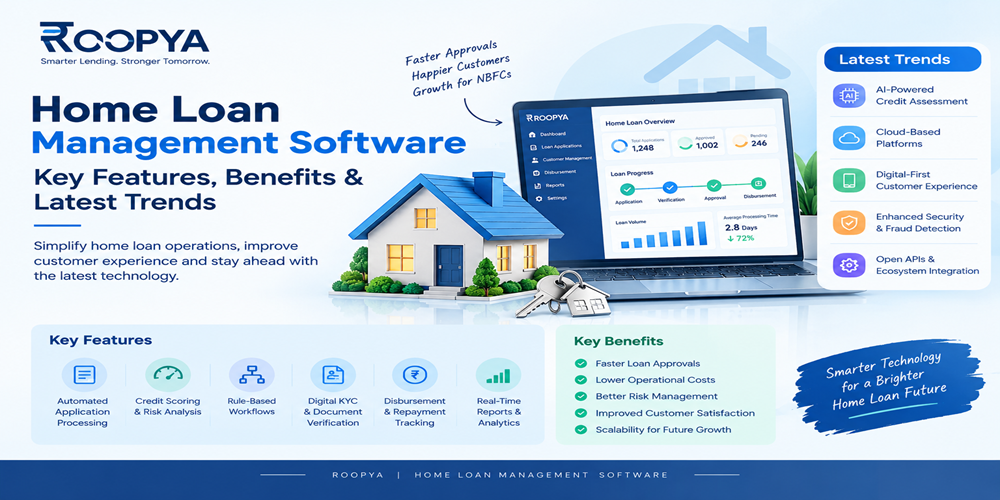
Key Features of Home Loan Management Software
A capable home loan platform typically brings together the following modules:
| Module | What It Does |
| Loan Origination System (LOS) | Digitises the application, underwriting, approval and closing workflow with configurable rules for different home loan variants. |
| Risk Assessment & Underwriting | Evaluates credit score, debt-to-income ratio and Loan-to-Value (LTV) ratio to support consistent, policy-driven lending decisions. |
| Mortgage & EMI Calculation Engine | Models interest rate scenarios, EMI schedules and long-tenure amortisation, including fixed and floating-rate options. |
| Document Management & e-Sign | Securely stores and retrieves KYC, income and property documents, with e-signature support for faster closing. |
| Compliance & Regulatory Tools | Tracks adherence to RBI, National Housing Bank (NHB) and RERA requirements, with automated audit trails. |
| CRM & Borrower Communication | Keeps borrowers informed at every stage through email, SMS and self-service portals. |
| Loan Servicing & Collections | Manages disbursement, EMI collection, prepayment, foreclosure and charge/mortgage-related workflows after sanction. |
| Analytics & Reporting | Gives real-time visibility into portfolio performance, approval turnaround time and delinquency trends. |
Loan Origination and Underwriting
The origination module digitises the application, underwriting, approval and closing process, with configurable workflows for different home loan variants — purchase loans, construction loans, loans against property, balance transfer and top-up loans. Underwriting engines evaluate credit score, debt-to-income ratio and LTV ratio against the lender’s credit policy, so decisions are consistent and explainable.
Property Valuation and LTV Analytics
Because the loan is secured against real estate, accurate property valuation is central to the process. Good platforms use historical and current market data to assess property value against factors like location, size, condition and local trends, then calculate the LTV ratio that drives approval decisions, pricing and mortgage insurance requirements.
Mortgage Calculation and Amortisation
Financial analysis tools model different mortgage scenarios — fixed versus floating interest rates, tenure options, and the resulting EMI and amortisation schedule — so both the lender and the borrower can see exactly how the loan will play out over its (often 15-30 year) term.
Document Management and e-Sign
Home loans involve a large volume of KYC, income, property and legal documents. Document management modules offer secure storage, retrieval and e-signature capabilities, which speeds up closing and reduces the risk of lost or mismatched paperwork.
Compliance and Regulatory Tools
Home loan software needs to support adherence to RBI directives, National Housing Bank (NHB) guidelines, and, where applicable, state-level RERA requirements for under-construction properties — typically through automated compliance checks and audit trails that make regulatory reporting and internal audits far less painful.
CRM, Servicing and Collections
Borrower-facing CRM tools maintain communication through email, SMS and self-service portals across what can be a decades-long relationship. After disbursement, the loan management layer handles EMI collection, prepayment and foreclosure requests, and charge/mortgage-related servicing workflows.
Analytics, Reporting and Fraud Detection
Real-time dashboards track approval turnaround time, portfolio performance, delinquency trends and operational bottlenecks. Increasingly, analytics layers also flag anomalies that could indicate fraud — such as inflated appraisals or inconsistent application data — for manual review before disbursement.
Benefits of Home Loan Management Software
Moving from manual or semi-digital processes to a dedicated home loan platform typically delivers:
- Faster loan approvals: automated verification, credit scoring and underwriting can take approval timelines from days down to hours for straightforward applications.
- Fewer manual errors: structured workflows and system-enforced checks reduce data-entry mistakes and missed compliance steps.
- Better risk assessment: consistent, rule-based underwriting combined with bureau and alternative-data integration improves credit decisioning.
- Improved borrower experience: self-service application tracking, faster turnaround and clear communication build trust in a high-value, high-stakes product.
- Stronger regulatory posture: automated audit trails and compliance checks make it easier to respond to RBI, NHB and RERA requirements.
- Operational scalability: cloud-based platforms can handle growing application volumes and multi-branch or multi-partner operations without a proportional rise in headcount.
- Portfolio visibility: real-time analytics help management teams spot delinquency trends, concentration risk and process bottlenecks early.
Latest Trends in Home Loan Management Software (2026)
Home loan technology in India is evolving quickly, shaped by regulatory infrastructure and the broader digital lending ecosystem. The trends worth watching in 2026 include:
1. Account Aggregator-Based Income Verification
The RBI-backed Account Aggregator (AA) framework lets borrowers consent to share verified bank-statement data directly from their bank to the lender, instead of uploading PDFs that can be altered. According to industry body Sahamati, AA-enabled home loans and loans against property reached roughly 1.09 lakh loans worth about ₹20,777 crore in FY26 — a 624% year-on-year increase — and the broader AA ecosystem facilitated an estimated ₹3.82 lakh crore in loans across all segments in the same period. This is a clear signal that AA-based verification is moving from pilot to mainstream in secured lending, including home loans.
2. AI-Powered Underwriting and Document Processing
AI and machine learning are increasingly used to extract and verify data from income documents, bank statements and property papers, flag anomalies that may indicate fraud, and support more consistent, explainable underwriting decisions — reducing manual review time for straightforward applications.
3. Deeper Co-Lending Integration
As co-lending partnerships between banks and NBFCs expand, lenders increasingly need their origination and servicing systems to stay in sync on outstanding balances, EMI schedules and prepayment status in real time, rather than relying on manual reconciliation between partner institutions.
4. Digital Property and Title Verification
Integration with digital land record systems is beginning to let lenders verify property titles electronically in select states, reducing one of the more time-consuming parts of the mortgage process — though physical and legal verification still plays an important role in most transactions today.
5. No-Code, Configurable Platforms
Lenders are increasingly favouring no-code or low-code platforms that let business and credit teams configure loan products, eligibility rules and workflows themselves, rather than waiting on lengthy IT development cycles — shortening the time from product idea to market launch.
6. Embedded and Partner-Channel Distribution
Home loan origination is increasingly being embedded into partner channels — real estate platforms, builder tie-ups and loan service providers (LSPs) — requiring home loan software with open APIs that can plug into multiple distribution points cleanly.
How to Choose the Right Home Loan Software
- Match the platform to your scale: a no-code SaaS platform suits lenders wanting to launch or expand quickly; a large bank with complex, high-volume requirements may need deeper enterprise customisation.
- Confirm compliance mapping: ask specifically how the platform supports RBI, NHB and relevant RERA requirements, and how it handles mortgage/charge creation workflows.
- Check integration breadth: verify support for credit bureaus, Account Aggregator connectivity, payment gateways, e-sign and KYC APIs.
- Evaluate total cost of ownership: compare subscription or per-loan pricing against implementation, integration and support costs.
- Ask about implementation timelines and request a live demo against your own home loan workflows before committing.
Roopya’s Approach to Home Loan Software
Roopya (roopya.money) offers home loan software as part of its broader no-code lending infrastructure, which also covers personal, gold, business/SME, auto and payday loans on one platform. For home loans specifically, Roopya supports property valuation integrations, LTV-based underwriting, MODT (Memorandum of Deposit of Title Deeds) workflow support, and long-tenure amortisation schedules, alongside its wider set of 300+ pre-integrated APIs, a no-code business rule engine, and AI-assisted document analysis and fraud checks.
Because the platform is designed for same-day go-live and pay-as-you-use pricing, it can be a practical option for lenders who want to launch or modernise a home loan product without a multi-month build — though, as with any vendor, it’s worth validating the specific compliance mappings and integrations you need through a live demo.
Home loan management software has moved from a back-office convenience to a strategic necessity — not just for speed, but for the accuracy, compliance and borrower trust that a multi-decade, high-value loan product demands. In 2026, the technology is being reshaped by Account Aggregator-based verification, AI-assisted underwriting, deeper co-lending integration, and more configurable, no-code platforms.
Whichever platform you evaluate, prioritise compliance readiness, integration depth and a genuine, hands-on demo against your own workflows. If you’d like to see how Roopya’s home loan module works in practice, you can request a free demo here.
Frequently Asked Questions (FAQ)
What is home loan management software?
Home loan management software is a digital platform that helps banks, housing finance companies (HFCs), NBFCs and mortgage brokers manage the full home loan lifecycle — from application and underwriting through disbursement, EMI collection and closure.
How is a Loan Origination System (LOS) different from a Loan Management System (LMS) in home lending?
An LOS covers everything before disbursement — the application, document collection, credit checks, underwriting and sanction — while an LMS takes over after disbursement, handling EMI schedules, collections, prepayments, foreclosure and servicing. Many modern platforms, including Roopya, combine both in one system.
What are the key features to look for in home loan software?
Look for a configurable Loan Origination System, automated credit bureau and KYC integration, LTV and risk-assessment tools, an amortisation/EMI calculator, document management with e-sign, compliance tracking for RBI/NHB/RERA requirements, and real-time analytics and reporting.
Is home loan software compliant with RBI and NHB guidelines?
Reputable platforms are designed to support compliance with RBI directives, National Housing Bank (NHB) guidelines and, where relevant, state RERA requirements, through automated checks and audit trails. Always confirm the specific compliance mappings with your chosen vendor before go-live.
How does Account Aggregator (AA) integration help home loan underwriting?
The RBI-backed Account Aggregator framework lets a borrower consent to share verified bank-statement data directly from their bank to the lender’s system, replacing manually uploaded and potentially altered PDF statements. Per industry data, AA-enabled home loans and loans against property reached about 1.09 lakh loans worth roughly ₹20,777 crore in FY26 — a 624% year-on-year increase — showing fast-growing adoption in secured lending.
How much does home loan software cost in India?
Pricing varies by deployment model. Cloud-based, SaaS or no-code platforms are often available from roughly ₹50,000 per month depending on volume and features, while fully customised enterprise implementations can range from about ₹20 lakh to over ₹1 crore per year depending on scale and integrations.
How long does it take to implement home loan software?
SaaS-based or no-code platforms can typically be configured and launched in one to three weeks, while heavily customised enterprise systems may take two to three months, depending on the number of integrations and branches involved.
Can home loan software integrate with credit bureaus?
Yes. Most modern home loan platforms integrate with major credit bureaus such as CIBIL, Experian, Equifax and CRIF to fetch real-time credit reports and scores as part of the underwriting process.
What role does AI play in modern home loan software?
AI is increasingly used for document analysis and verification, fraud detection, automated income and bank-statement analysis, and rule optimisation within the business rule engine — reducing manual review time and improving consistency in credit decisions.
Who should use home loan management software?
Banks, housing finance companies, NBFCs, fintech lenders and mortgage brokers that originate or service home loans and loans against property can all benefit from dedicated home loan management software.