Discover how autonomous lending works — AI credit scoring, instant KYC, automated disbursement & collections. See how Roopya powers it end-to-end.
Lending has always been a business built on trust, risk assessment, and speed. For decades, that meant paperwork, manual underwriting, branch visits, and loan officers poring over financial statements for days before a borrower heard back. Today, that model is being replaced. Banks, NBFCs (Non-Banking Financial Companies), and microfinance institutions (MFIs) across India and globally are moving toward a new operating model called autonomous lending, where technology, not manpower, drives most of the loan lifecycle.
If you have searched for “how does autonomous lending work,” you are probably trying to understand what is actually happening under the hood: how a loan can be approved in minutes instead of weeks, how a system decides who is creditworthy without a human reading every application, and whether this approach is safe, compliant, and scalable for your lending business.
This guide breaks down autonomous lending in plain language: what it is, how each stage of the loan lifecycle becomes automated, the technology stack that makes it possible, and what lenders should evaluate before adopting it. We will also look at how a unified lending infrastructure platform like Roopya brings autonomous lending capabilities to banks, NBFCs, and loan service providers without requiring them to build any of this technology from scratch.
What Is Autonomous Lending?
Autonomous lending refers to a lending model where artificial intelligence (AI), machine learning (ML), business rule engines, and pre-integrated data sources work together to originate, underwrite, disburse, service, and collect loans with minimal manual intervention. Instead of a loan officer manually checking documents, calculating eligibility, and approving or rejecting an application, an autonomous lending system performs these steps automatically, in real time, using pre-configured rules and predictive models.
It is important to note that “autonomous” does not mean “unsupervised” or “unregulated.” A well-designed autonomous lending system still operates within a human-defined credit policy, complies with regulatory guidelines, and includes escalation paths for edge cases that genuinely need human judgment. The goal is not to remove humans from lending entirely, but to remove humans from repetitive, rules-based, data-heavy tasks so that human attention is reserved for policy design, exceptions, and relationship management.
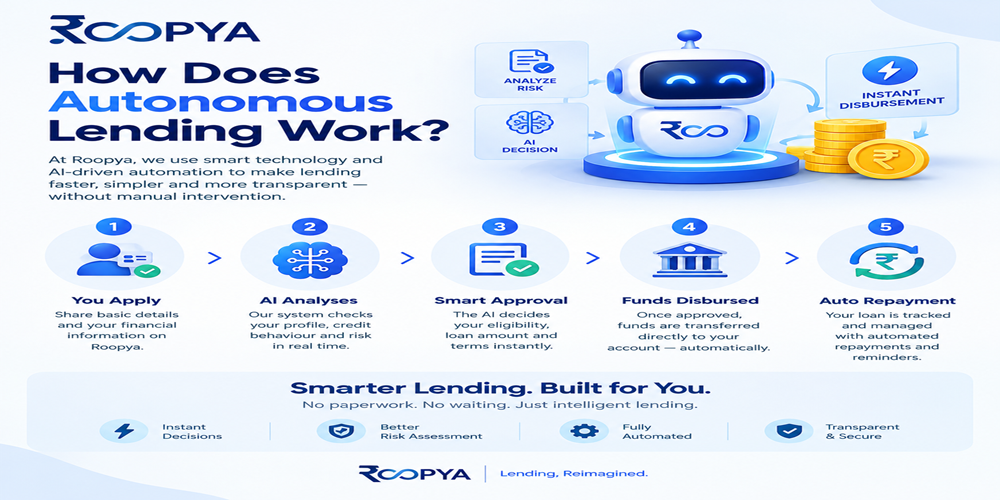
In simple terms: a borrower applies, the system verifies their identity and documents, pulls their credit data, scores their risk, checks it against lending policy, approves or declines the loan, disburses the funds, sets up the repayment schedule, monitors the loan for early warning signs, and manages collections if needed — largely without a human touching each individual application.
Traditional Lending vs. Autonomous Lending
To understand why autonomous lending matters, it helps to compare it against the traditional process it is replacing.
In a traditional lending workflow, a borrower typically fills out a paper or basic digital form, submits physical or scanned documents, and waits for a credit officer to manually verify identity, income, and existing liabilities. The credit officer then references bureau reports, applies underwriting judgment, and escalates the file for approval. This process can take anywhere from a few days to several weeks, depending on the loan type and lender. It is also expensive: every file that a human touches adds operational cost, and inconsistent judgment between officers can create unfair or unpredictable outcomes for similar borrowers.
Autonomous lending compresses this timeline dramatically. Document verification that once took a day can be completed in seconds using optical character recognition (OCR) and AI-based document analysis. Credit decisions that once required a committee can be generated in milliseconds using a scoring engine that has already been calibrated against thousands of data points. Because the same rules are applied identically to every applicant, autonomous lending also tends to produce more consistent, auditable, and fair outcomes than manual underwriting, provided the underlying models and rules are designed and monitored responsibly.
The Core Components of an Autonomous Lending System
Autonomous lending is not a single piece of software. It is an orchestration of several interconnected components, each automating a specific part of the loan lifecycle. Understanding these components makes it much easier to understand how the whole system works together.
1. Digital Onboarding and Application Capture
The journey begins with a digital application form, usually accessible via web, mobile app, or an embedded widget on a partner’s website (a model known as embedded finance). Instead of static PDF forms, autonomous lending platforms use dynamic, intelligent forms that adapt based on the loan product, the applicant’s profile, and data already available about them. Fields can be pre-filled using Aadhaar-based e-KYC, PAN verification, or other digital identity checks, reducing drop-offs and manual data entry errors.
2. AI-Powered Document Verification
Once the borrower uploads documents — identity proof, address proof, income documents, bank statements — an AI-powered document analysis engine takes over. Using OCR combined with natural language processing (NLP), the system extracts relevant data fields, cross-checks them against submitted information, and flags inconsistencies or signs of tampering. Modern systems can process documents with well above 95% accuracy and complete verification in seconds rather than hours, while also running fraud checks such as detecting doctored images, mismatched fonts, or metadata anomalies.
3. Automated Credit Scoring and Alternative Data
This is the heart of autonomous lending. Instead of relying solely on a traditional credit bureau score, autonomous systems pull data from multiple sources: credit bureaus, bank statement analysis, GST filings (for business loans), utility payment history, telecom data, and in some cases behavioral or transactional data from partner platforms. Machine learning models analyze this combined dataset to generate a risk score that is often more predictive than a bureau score alone, particularly for thin-file or new-to-credit borrowers who may not have an extensive credit history.
4. The No-Code Business Rule Engine (BRE)
Even the most sophisticated ML model needs to operate within a lender’s specific credit policy — minimum income thresholds, maximum loan-to-income ratios, exclusion lists, geographic restrictions, product-specific eligibility criteria, and regulatory requirements. A business rule engine lets risk and credit teams configure these policies visually, without writing code, and update them instantly as market conditions or regulations change. The BRE takes the output of the credit scoring model and applies the lender’s specific rules to arrive at a final approve, decline, or refer-for-review decision.
5. Real-Time Decisioning
Once the credit score and rule engine outputs are combined, the system renders a real-time lending decision. For a large share of applications — often the majority in a well-tuned system — this decision requires zero human involvement. Only applications that fall into a defined “grey zone,” or that trigger a specific fraud or policy flag, are routed to a human underwriter for manual review. This hybrid approach keeps the system fast while preserving human oversight where it matters most.
6. Automated Loan Disbursement
Once approved, autonomous lending platforms automatically generate the loan agreement, capture e-signatures or e-mandates, and initiate disbursement through integrated payment rails. Many systems can move from application to disbursed funds within minutes for smaller ticket-size loans, which is a critical differentiator for use cases like payday loans, buy-now-pay-later, and merchant cash advances.
7. Loan Management and Servicing Automation
After disbursement, an autonomous Loan Management System (LMS) takes over the servicing lifecycle: generating amortization schedules, processing EMI payments, sending automated payment reminders, updating ledgers, handling foreclosures and part-payments, and giving borrowers self-service access through a customer portal or app. This significantly reduces the operational overhead of managing a large, growing loan book.
8. Early Warning Systems (EWS)
Autonomous lending does not stop monitoring a borrower once the loan is disbursed. Early warning systems continuously track behavioral signals, repayment patterns, bureau updates, and external risk indicators to flag accounts that show signs of potential default before they actually default. This allows lenders to proactively intervene — through restructuring, reminders, or counseling — rather than reactively chasing delinquent accounts after the fact.
9. Automated Collections
For accounts that do slip into delinquency, an autonomous collections engine can automatically trigger a tiered response: SMS and app reminders in early delinquency, followed by automated calling or WhatsApp workflows, and eventually structured escalation to human collection agents for accounts that need it. AI-driven collection engines can also recommend the most effective channel and timing for each borrower based on historical response patterns, which materially improves recovery rates compared to a one-size-fits-all approach.
10. Analytics, Reporting, and Continuous Learning
Every decision an autonomous lending system makes generates data, and that data feeds back into the system to improve future decisions. Analytics dashboards give risk and business teams real-time visibility into portfolio performance, approval rates, delinquency trends, and regulatory reporting requirements. In more advanced systems, this feedback loop is used to continuously retrain scoring models, ensuring the system adapts to changing borrower behavior and macroeconomic conditions over time.
Step-by-Step: How an Autonomous Loan Actually Gets Processed
To bring all these components together, here is what a typical autonomous lending journey looks like from the borrower’s perspective:
- Application: The borrower fills out a short digital form on a website, app, or embedded checkout widget, entering basic personal and financial details.
- Identity Verification: The system performs instant e-KYC using Aadhaar, PAN, or other government-issued ID databases, confirming the applicant’s identity in seconds.
- Document Upload and AI Verification: The borrower uploads supporting documents, which are instantly read, verified, and cross-checked by AI-based OCR and fraud detection tools.
- Data Aggregation: The system pulls the borrower’s credit bureau report and any alternative data sources it is configured to use, such as bank statement analytics or GST data.
- Credit Scoring: A machine learning model processes this combined dataset and generates a risk score and recommended credit limit or loan amount.
- Policy and Rule Checks: The business rule engine applies the lender’s specific credit policy to the score, checking eligibility, exposure limits, and any exclusion criteria.
- Decisioning: The system automatically approves, declines, or refers the application for manual underwriting review, typically within seconds to a couple of minutes.
- Loan Agreement and E-Sign: For approved applications, the system generates a digital loan agreement and captures the borrower’s e-signature and e-mandate for repayments.
- Disbursement: Funds are disbursed directly to the borrower’s bank account through integrated payment rails, often within minutes of approval.
- Servicing: The loan management system generates the repayment schedule and begins tracking EMIs, sending automated reminders ahead of each due date.
- Monitoring: Early warning systems continuously watch for risk signals throughout the loan tenure.
- Collections (if needed): If a payment is missed, the automated collections engine initiates a structured, escalating outreach sequence.
- Closure: Once the loan is fully repaid, the system automatically updates records, generates a closure certificate, and reports final status to credit bureaus.
The Role of AI and Machine Learning in Autonomous Lending
AI is the connective tissue that makes autonomous lending genuinely “autonomous” rather than just “digital.” A digitized process simply moves paperwork online; an autonomous process uses AI to make judgment calls that used to require a human. A few specific ways AI shows up across the lifecycle include:
- Document intelligence: AI models trained on thousands of document formats can read, classify, and validate identity documents, bank statements, salary slips, and GST returns far faster and more consistently than manual review.
- Alternative credit scoring: Machine learning models can evaluate non-traditional data points, such as utility bill payment history or transaction patterns, to assess borrowers who have little or no formal credit history.
- Fraud detection: AI-powered fraud engines look for anomalies such as duplicate applications, mismatched device fingerprints, inconsistent income claims, or manipulated documents, flagging suspicious applications before disbursement.
- Self-learning rule optimization: Some platforms use ML to analyze historical approvals and rejections and suggest refinements to the underlying credit policy, helping risk teams continuously improve accuracy while retaining full oversight of any changes.
- Natural language reporting: AI-driven analytics tools allow business and risk teams to ask questions in plain English and receive instant, data-backed answers, rather than waiting for a manually built report.
Benefits of Autonomous Lending
- Speed: Loan decisions that once took days can be delivered in minutes or even seconds, which is often the single biggest driver of customer satisfaction and conversion in digital lending.
- Lower operating costs: Automating document verification, underwriting, and collections significantly reduces the cost per loan processed, which is especially important for small-ticket lending, where manual processing costs can exceed the margin on the loan itself.
- Consistency and fairness: Applying the same rules and models to every applicant reduces the inconsistency that can arise when different human underwriters apply judgment differently.
- Scalability: Once built, an autonomous lending system can process a sudden spike in loan applications, such as during a festive season sales push, without needing to hire and train additional underwriting staff.
- Better risk management: Continuous monitoring through early warning systems and AI-enhanced collections helps lenders catch risk earlier and recover more, rather than discovering problems only after a loan has gone significantly delinquent.
- Improved borrower experience: Faster decisions, digital-first journeys, and self-service portals meet borrower expectations that have been shaped by other digital-first industries.
Challenges and Considerations
Autonomous lending is powerful, but it is not something to adopt carelessly. A few important considerations for any lender evaluating this model:
- Regulatory compliance: Lending is a heavily regulated activity, and any automated decisioning system needs to remain compliant with applicable regulations, including fair lending requirements, data protection laws, and disclosure obligations. A platform’s rule engine and audit trails should make it straightforward to demonstrate compliance to regulators.
- Explainability: Automated decisions, especially those declining an application, should be explainable. Lenders need visibility into why a system made a particular decision, both for internal risk governance and to meet regulatory expectations around adverse action explanations.
- Data quality and bias: Machine learning models are only as good as the data they are trained on. Poor quality or biased training data can lead to unfair or inaccurate outcomes, so ongoing model monitoring and validation are essential.
- Human oversight for edge cases: Not every application fits neatly into an automated decision. A well-designed autonomous lending system routes ambiguous or high-risk cases to human underwriters rather than forcing a fully automated decision in every scenario.
- Integration complexity: Autonomous lending depends on integrations with credit bureaus, KYC providers, payment gateways, and other third-party data sources. Choosing a platform with a large library of pre-integrated APIs significantly reduces the time and engineering effort needed to go live.
Autonomous Lending vs. Semi-Automated Lending
It is worth distinguishing autonomous lending from semi-automated or “digital-assisted” lending, which is a common intermediate step for many lenders. In a semi-automated model, some steps are digitized, such as online applications or e-KYC, but credit decisions and document verification still rely heavily on manual review. This can improve borrower experience somewhat, but it does not deliver the speed, cost, or scale advantages of a truly autonomous system, because the human bottleneck in underwriting remains.
True autonomous lending automates the decisioning layer itself, using scoring models and rule engines to render most decisions without human involvement, while still preserving a clear escalation path for cases that genuinely require judgment. This distinction matters when evaluating vendors: a platform that only digitizes the application form is not the same as a platform that automates underwriting and servicing.
How Roopya Powers Autonomous Lending
Roopya provides a no-code, unified lending infrastructure that brings all the components described above together on a single platform, purpose-built for banks, NBFCs, and MFIs. Rather than stitching together separate vendors for origination, underwriting, servicing, and collections, lenders can run their entire loan lifecycle on Roopya’s platform.
Key capabilities include an AI-powered document analysis engine that verifies identity and financial documents in seconds, a no-code business rule engine that lets credit and risk teams configure lending policies without writing code, and access to over 300 pre-integrated APIs spanning credit bureaus, verification services, and payment gateways. Roopya also offers more than 20 pre-configured loan products, covering personal loans, business and SME loans, gold loans, payday loans, home loans, and auto loans, so lenders can launch new products quickly rather than building journeys from scratch.
On the risk side, Roopya’s lending analytics suite covers credit risk analytics, credit scorecard development, probability of default (PD), exposure at default (EAD), loss given default (LGD), expected credit loss (ECL) calculation, and credit risk model validation, giving risk teams the tools to build, validate, and monitor scoring models responsibly. Combined with an early warning system and an AI-driven collections engine, lenders get visibility into portfolio risk throughout the entire loan lifecycle, not just at origination.
Because the platform is designed for fast deployment, lenders can go live in as little as one day, with a pay-as-you-use pricing model that avoids large upfront technology investment. For lenders who want to embed lending directly into a partner’s website or app, Roopya also supports embedded finance use cases, extending autonomous lending capabilities beyond a lender’s own digital channels.
The Future of Autonomous Lending
As AI models continue to improve and data ecosystems such as India’s Account Aggregator framework and Open Credit Enablement Network (OCEN) mature, autonomous lending is likely to become the default operating model for consumer and small business lending, not just a competitive advantage. Lenders that build the infrastructure for autonomous decisioning today are positioning themselves to launch new products faster, serve underserved segments more profitably, and manage risk more proactively than lenders still relying on manual, paper-heavy processes.
At the same time, the direction of regulation globally suggests that transparency and explainability requirements around automated decisioning will only increase. Lenders who invest in platforms that combine automation with strong governance, audit trails, and human oversight will be best positioned to scale autonomous lending responsibly over the long term.
Autonomous lending works by combining digital onboarding, AI-powered document verification, alternative data-driven credit scoring, a configurable business rule engine, real-time decisioning, automated disbursement, and ongoing servicing, monitoring, and collections into a single, largely self-operating loan lifecycle. The result is faster decisions, lower operating costs, more consistent outcomes, and the ability to scale lending operations without proportionally scaling headcount.
For banks, NBFCs, and MFIs evaluating how to modernize their lending operations, the key is choosing a unified, no-code platform that brings all of these capabilities together, backed by pre-integrated data sources and strong risk analytics, rather than trying to assemble a patchwork of point solutions. Platforms like Roopya are built specifically to make that transition achievable in days rather than months.
Frequently Asked Questions (FAQ)
Q1. What is autonomous lending in simple terms?
Autonomous lending is a lending model where AI, machine learning, and rule-based automation handle most of the loan process — from application and document verification to credit decisioning, disbursement, and collections — with minimal manual involvement from loan officers.
Q2. Is autonomous lending safe and compliant?
Yes, when implemented correctly. Autonomous lending platforms operate within human-defined credit policies and regulatory guardrails, maintain audit trails for every decision, and route ambiguous or high-risk applications to human underwriters for manual review.
Q3. How fast can a loan be approved through autonomous lending?
Many autonomous lending systems can render a credit decision within seconds to a few minutes, and disburse funds within minutes to a few hours for smaller ticket-size loans, compared to days or weeks in traditional lending.
Q4. Does autonomous lending remove the need for human underwriters?
No. Autonomous lending automates repetitive, data-heavy decisions, but human underwriters remain essential for reviewing edge cases, setting credit policy, and overseeing model performance and fairness.
Q5. What technology powers autonomous lending?
Autonomous lending typically relies on a Loan Origination System (LOS), a Loan Management System (LMS), a no-code business rule engine, AI-powered document analysis (OCR and NLP), machine learning-based credit scoring, and integrations with credit bureaus, KYC providers, and payment gateways.
Q6. Can small NBFCs or MFIs adopt autonomous lending, or is it only for large banks?
Autonomous lending is increasingly accessible to lenders of all sizes. No-code, pay-as-you-use platforms like Roopya allow smaller NBFCs and MFIs to go live with autonomous lending capabilities in as little as a day, without large upfront technology investment.
Q7. How does autonomous lending assess borrowers with no credit history?
Autonomous lending platforms often use alternative data — such as bank statement analysis, utility payment history, and GST filings for businesses — alongside machine learning models to assess creditworthiness for thin-file or new-to-credit borrowers who lack an extensive bureau history.