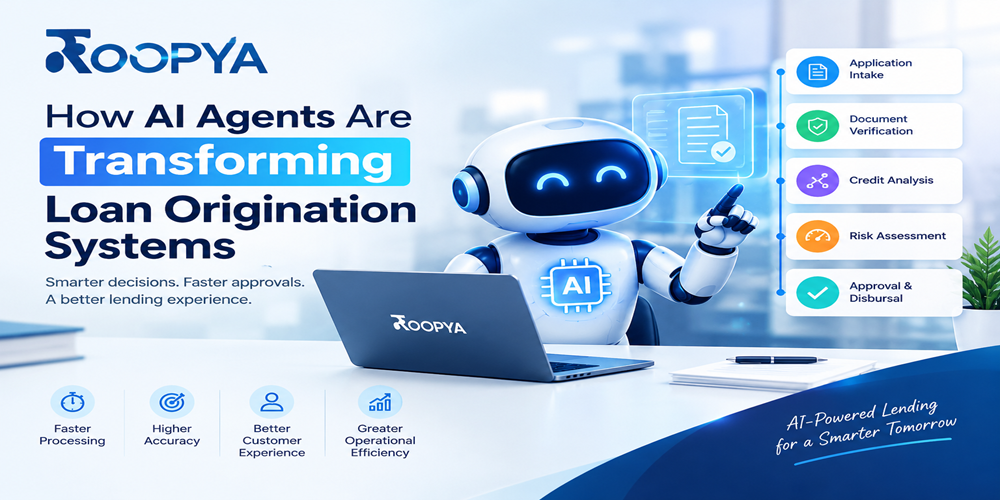
Discover how AI agents are transforming loan origination systems for banks and NBFCs with faster approvals, smarter underwriting, and less fraud.
Loan origination has always been the slowest, most paperwork-heavy part of lending. A borrower fills out an application, uploads documents, waits for a human underwriter to check income, pull a credit report, verify identity, and run compliance checks — and days (sometimes weeks) pass before anyone hears back. For banks and NBFCs, that delay is expensive: applicants drop off mid-process, underwriters get buried in repetitive verification work, and operating costs climb even as approval volumes stay flat.
AI agents are changing that equation. Unlike older rule-based automation, which simply followed a fixed script, AI agents can reason, pull data from multiple sources, make judgment calls within set limits, and hand off to a human only when a case genuinely needs one. In 2026, lenders aren’t just using AI to score applications faster — they’re using networks of specialized AI agents that work in parallel across the entire origination journey, from the first form field to the final disbursal.
This guide explains what AI agents actually do inside a modern Loan Origination System (LOS), why banks and NBFCs are adopting them, where the real risks lie, and how a lender can start using them responsibly.
What Is an AI Agent in Loan Origination?
An AI agent is software that can perceive information, decide on an action, and execute that action with some degree of autonomy — not just answer a question, but complete a task. In a Loan Origination System, that might mean:
- Reading a submitted pay slip, extracting the figures, and cross-checking them against bank statement data — without a human re-typing anything.
- Asking an applicant a follow-up question only when their income profile looks irregular (for example, a self-employed applicant with variable monthly income).
- Running a fraud check, a compliance check, and a creditworthiness check at the same time, rather than one after another.
- Flagging a file for human review the moment it falls outside the lender’s approved risk parameters.
This is different from the chatbot or basic automation most lenders already use. A chatbot answers FAQs. A rules engine executes a fixed if-this-then-that workflow. An AI agent, by contrast, can weigh several data points together, explain its reasoning, and adapt its next step based on what it finds — while staying inside guardrails the lender has defined.
Why Loan Origination Was Ready for This Shift
Traditional loan origination systems were built around sequential, manual checkpoints: document collection, then verification, then underwriting, then compliance sign-off, then disbursal. Each checkpoint typically needed a person to open a file, read it, and pass it along. That structure made sense when data was scarce and had to be gathered by hand. It doesn’t hold up well against three realities lenders face today:
- Borrower expectations have changed. Applicants who can open a bank account or book a flight in minutes don’t tolerate a five-day wait for a personal loan decision.
- Data has multiplied. Bank statements, GST filings, UPI transaction history, utility and rent payments, payroll data, and bureau scores are all available digitally — but stitching them together manually is slow and error-prone.
- Volume keeps growing while margins stay thin. Banks and NBFCs want to grow loan books without proportionally growing underwriting headcount.
AI agents address all three by compressing verification time, consuming many data sources simultaneously, and scaling without a linear increase in staff.
How AI Agents Work Across the Origination Journey
A useful way to understand the impact is to walk through the origination funnel stage by stage and see where an agent now does work that used to sit with a person.
1. Application Intake and Data Capture
Instead of a static form, an intake agent can run a conversational interview that adapts to the applicant’s answers. If someone identifies as salaried, it asks for payslips and Form 16. If they say they’re self-employed, it switches to requesting bank statements and GST returns instead. This single change — adjusting the document ask to the applicant’s profile — meaningfully reduces back-and-forth and abandoned applications, because people aren’t asked for paperwork that doesn’t apply to them.
The same agent can read uploaded documents using OCR and extraction models, pull out the relevant numbers, and populate the application automatically, cutting out manual data entry on both sides.
2. Identity Verification and Fraud Screening
A dedicated fraud and identity agent cross-checks the applicant’s KYC documents, device fingerprint, and behavioral signals (typing patterns, session behavior, geolocation consistency) against known fraud indicators — in real time, before the file ever reaches a human. Because this runs continuously rather than as a single checkpoint, it also catches fraud patterns that only become visible partway through the application, not just at the start.
3. Credit and Income Assessment
This is where AI agents add the most value for banks and NBFCs operating in markets with a large population of thin-file or new-to-credit borrowers. Rather than relying solely on a bureau score, an underwriting agent can combine:
- Bureau data (CIBIL, Experian, Equifax, CRIF)
- Bank statement cash-flow analysis
- Alternative data such as utility payments, rental history, and UPI transaction patterns
- Business financials and GST filings for MSME and self-employed applicants
By weighing these together, the agent can support a credit decision for applicants who would be rejected by bureau-score-only models simply because they lack a long credit history — without necessarily taking on more risk, since consistent payment behavior across several data sources is still evidence of repayment ability.
4. Parallel Processing Instead of Sequential Handoffs
Perhaps the biggest structural change is that AI agents don’t have to work one after another. A credit-assessment agent, a compliance agent, a fraud agent, and a pricing agent can all run against the same file simultaneously, each specialized in its own task, then converge their outputs for a final decision or for human review. This parallelization is a major reason approval timelines have compressed from days to minutes (and in simple cases, seconds) for lenders who have adopted this architecture.
5. Compliance and Regulatory Checks
An agent can be trained to check a file against KYC/AML requirements, lending policy limits, state or sector-specific regulatory rules, and internal risk appetite — flagging anything that doesn’t fit rather than letting it pass silently. Done well, this also produces an audit trail: a log of what data was checked, what rule was applied, and why a decision was reached, which matters enormously for regulated lenders.
6. Pricing and Offer Generation
Once risk is assessed, an agent can generate a tailored loan offer — amount, tenure, and interest rate — based on the applicant’s risk profile, rather than offering a single standard rate card to everyone. Some lenders pair this with a human-in-the-loop copilot: the agent drafts the offer, and a credit officer reviews and approves it before it goes out, especially for higher-value or higher-risk loans.
7. Disbursal and Post-Approval Servicing
Agents don’t stop at approval. They can trigger e-signature workflows, disbursal instructions, and welcome communications automatically, and then hand off to servicing agents that answer borrower questions, send repayment reminders, and flag early signs of financial stress — all logged and explainable, so a human can step in quickly when something falls outside normal parameters.
The Real Benefits for Banks and NBFCs
Faster decisions. Processes that took three to five business days can now be completed in minutes, because verification steps that used to be sequential now run in parallel and much of the manual data entry is eliminated.
Lower cost per application. Automating document review, verification, and first-pass risk assessment reduces the manual effort per file, which matters most for high-volume, lower-ticket products like personal loans and small-business working capital.
Broader, fairer credit access. By incorporating alternative data, lenders can responsibly extend credit to thin-file borrowers — young professionals, gig workers, recent movers to a city, or small businesses without a long formal credit history — who would otherwise be invisible to a bureau-score-only model.
Fewer abandoned applications. A conversational, adaptive intake process that only asks for relevant documents reduces the friction that causes people to quit halfway through a form.
Consistency at scale. An agent applies the same underwriting logic to every file, every time, which reduces the variability that comes from different human underwriters making different judgment calls on similar applications.
Better fraud detection. Continuous, multi-signal monitoring catches fraud patterns that a single-point manual check would likely miss.
The Risks and Challenges Lenders Need to Plan For
No responsible article on this topic should skip the hard parts. AI agents introduce new categories of risk that lenders need to manage deliberately.
Explainability and adverse action. Regulators generally require lenders to give applicants a specific, accurate reason when a loan is denied. If an AI model’s decision process is opaque, producing a compliant adverse-action notice becomes difficult. Lenders need models — or at least a decision layer — that can produce clear, auditable reasons for every outcome.
Bias and discriminatory outcomes. Alternative data and machine learning models can unintentionally encode bias if they’re trained on historical data that reflects past discriminatory lending patterns. Regulators in multiple jurisdictions have already taken enforcement action against lenders over AI-driven underwriting that produced disparate outcomes across protected groups. Regular fairness audits aren’t optional.
Model drift. Borrower behavior, fraud tactics, and economic conditions change. A model that performed well a year ago can degrade quietly if it isn’t monitored and retrained. This requires ongoing governance, not a one-time deployment.
Over-reliance on automation for servicing. AI agents used in customer-facing servicing roles (chatbots, repayment assistants) have, in some documented cases, mishandled legal-rights requests or debt-collection communications that carry specific regulatory requirements. Lenders deploying conversational agents in servicing need strict guardrails, grounded responses, verbatim logging, and a clear, fast path to a human.
Data privacy and consent. Pulling in bank statement data, UPI history, and other alternative sources requires clear borrower consent and well-governed data-sharing agreements — both to meet regulatory requirements and to maintain borrower trust.
Integration with legacy systems. Most banks and NBFCs are not building a Loan Origination System from a blank slate. Agentic AI has to integrate with existing core banking systems, credit bureaus, and compliance tooling, which is often the slowest and most expensive part of adoption, not the AI itself.
A Practical, Low-Risk Way to Start
Lenders don’t need to automate the entire origination journey on day one. A phased approach works better and is far easier to govern:
- Start with low-risk automation. Document parsing, data extraction, and intake-form automation carry little regulatory risk and deliver quick, visible time savings.
- Run new models in shadow mode first. Before letting an AI agent influence a real decision, run it in parallel with the existing process, compare its outputs against human decisions, and check for accuracy, bias, and drift.
- Keep a human in the loop for consequential decisions. Especially early on, use AI agents as copilots that draft a recommendation for a credit officer to review and approve, rather than fully autonomous approval for every loan type.
- Build the audit trail from day one. Every agent decision should log what data it used, what rule or model drove the outcome, and why — this is far easier to build in from the start than to retrofit later.
- Set clear escalation rules. Define exactly when a file must leave the AI agent’s hands and go to a human — unusual income patterns, borderline credit scores, high loan amounts, or any flag the agent itself isn’t confident about.
What to Look for in an AI-Enabled Loan Origination System
If you’re a bank or NBFC evaluating LOS platforms, it helps to know which capabilities actually indicate mature AI-agent architecture versus a basic automation layer with AI branding. A few things worth checking:
- Configurable guardrails, not black-box decisions. You should be able to define exactly which decisions an agent can make autonomously, which require human sign-off, and what thresholds trigger escalation — and change those rules without engineering help every time policy shifts.
- Multi-source data orchestration. The platform should connect natively to credit bureaus, bank-statement analysis providers, GST and MSME data sources, and alternative data feeds, rather than requiring a separate integration project for each one.
- Built-in audit logging. Every agent decision should be traceable: what data it used, what model or rule drove the outcome, and why. If a regulator or an applicant asks why a loan was declined, the answer should be immediate, not a reconstruction exercise.
- Bias and performance monitoring. Look for dashboards that track approval-rate parity across demographic segments, model drift over time, and false-positive/false-negative rates on fraud screening — not just overall throughput metrics.
- Lenders should be able to turn individual agents on incrementally — document parsing first, then fraud screening, then credit assessment — rather than an all-or-nothing switch.
Where This Is Heading
The direction is clear: loan origination is moving from a single, monolithic workflow to a set of specialized AI agents, each handling one part of the journey, coordinating with each other, and escalating to humans only when needed. For banks and NBFCs, the lenders who benefit most won’t be the ones who automate the fastest — they’ll be the ones who automate carefully, with explainability, fairness, and human oversight built in from the start.
Platforms like Roopya are built around exactly this shift: giving banks and NBFCs a modern Loan Origination System where AI agents handle the repetitive, data-heavy work, while credit, compliance, and risk teams keep control over the decisions that matter most.
Frequently Asked Questions
What is the difference between an AI agent and traditional automation in loan origination?
Traditional automation follows a fixed, rule-based script. An AI agent can reason across multiple data sources, adapt its next action based on what it finds, and make bounded judgment calls, escalating to a human when a case falls outside its authority.
Can AI agents replace loan underwriters?
Not entirely, and not responsibly. AI agents are best used to handle repetitive verification and first-pass risk assessment, while human underwriters review borderline, high-value, or complex cases, and retain final authority on consequential decisions.
Do AI agents make loan approvals faster?
Yes. Because multiple agents can assess credit, fraud, compliance, and pricing in parallel instead of in sequence, and because manual data entry is largely eliminated, approval timelines that used to take days can often be completed in minutes.
Are AI-driven loan decisions fair and compliant?
They can be, but only with deliberate governance — regular bias and fairness audits, explainable decision logic, clear adverse-action reasoning, and ongoing model monitoring. Without these safeguards, AI models can encode and scale existing biases.
What data do AI agents use to assess creditworthiness?
Typically a combination of credit bureau data, bank statement cash-flow analysis, and alternative data such as utility payments, rental history, UPI transaction patterns, and (for businesses) GST filings and financial statements.
Is AI in loan origination only for large banks?
No. NBFCs and smaller lenders often adopt AI-driven origination tools specifically because it lets them compete on speed and reach without building a large underwriting team, making it especially relevant for fast-growing or digital-first lenders.
How should a lender start adopting AI agents in its LOS?
Start with low-risk automation like document parsing, run new models in shadow mode before they influence real decisions, keep a human in the loop for consequential approvals, and build an audit trail and clear escalation rules from the outset.