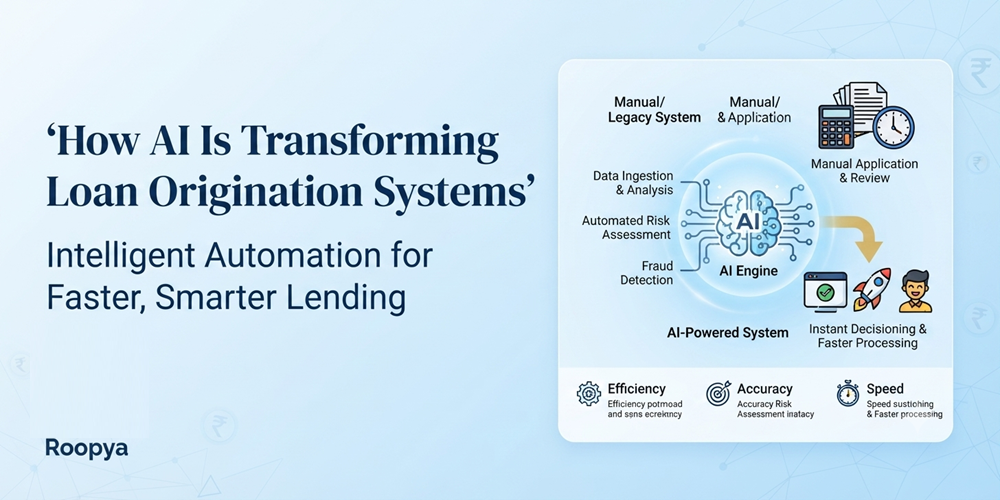
AI is redefining loan origination for banks & NBFCs — faster underwriting, smarter credit scoring & fraud detection. See how Roopya.money's LOS helps you adapt.
Loan origination has always been the most operationally intensive part of lending. It is where a customer’s intent to borrow either turns into a fast, transparent, and fair credit decision — or gets buried under paperwork, manual checks, and days of waiting. For decades, banks and NBFCs treated this friction as unavoidable. Today, it isn’t. Artificial intelligence is rewriting what a Loan Origination System (LOS) can do, compressing timelines from days to minutes and turning static, rule-based workflows into adaptive, self-improving decision engines.
For lenders evaluating their technology stack in 2026, understanding how AI is reshaping loan origination isn’t optional — it’s the difference between staying competitive and losing market share to digital-first lenders who can approve a loan before a traditional bank has finished verifying a single document.
What Is a Loan Origination System, and Why Does It Matter?
A Loan Origination System is the software backbone that takes a borrower from application to disbursement. It typically covers:
- Application intake and data collection
- KYC and identity verification
- Credit assessment and underwriting
- Document verification and validation
- Risk scoring and approval workflows
- Compliance checks and regulatory reporting
- Disbursement and handoff to loan servicing
Every one of these stages was historically a manual checkpoint, staffed by credit officers, verification teams, and compliance analysts. That model worked when loan volumes were modest and customers tolerated multi-day turnaround times. Neither condition holds anymore. Digital lending volumes have exploded, borrower expectations have shifted toward instant decisioning, and regulators now expect more rigorous, auditable risk assessment — not less. AI is the only practical way to satisfy all three demands simultaneously.
The Core Problems with Traditional Loan Origination
Before looking at what AI changes, it’s worth being precise about what was broken:
1. Slow, sequential workflows. Traditional LOS platforms process applications in linear stages — intake, then verification, then underwriting, then approval — with each stage waiting on the previous one and on human review.
2. Thin, inflexible credit models. Conventional underwriting leans heavily on credit bureau scores and a handful of static variables like income and existing debt. This works reasonably well for borrowers with an established credit history, but it systematically excludes thin-file and new-to-credit customers who may be perfectly creditworthy.
3. Manual document handling. Income proofs, bank statements, identity documents, and collateral papers are still verified by hand in a large share of institutions, which is slow, inconsistent, and prone to error.
4. Fraud that slips through static rules. Rule-based fraud checks (“flag if income exceeds X” or “flag if PAN doesn’t match name”) catch known patterns but miss novel fraud typologies, especially synthetic identities and coordinated fraud rings.
5. High cost per loan. Every manual touchpoint adds cost. For small-ticket loans in particular, the cost of manual processing can erode or eliminate the margin on the loan itself.
AI addresses each of these directly — not as a bolt-on feature, but as a structural redesign of how origination works.
How AI Is Transforming Loan Origination Systems
1. Smarter, More Inclusive Credit Scoring
Machine learning models can ingest far more signal than a traditional bureau score — bank transaction patterns, utility and telecom payment history, GST filings for MSMEs, e-commerce behavior, and even psychometric or app-usage data where regulation permits it. This is what enables alternative credit scoring: assessing creditworthiness for borrowers who have little or no formal credit history but demonstrate financial discipline through other data trails.
For NBFCs targeting underserved segments — gig workers, small merchants, first-time borrowers — this isn’t a nice-to-have. It’s the mechanism that unlocks an entirely new addressable market while keeping default rates in check, because the models are trained to find genuine signal in data that a human underwriter would never have time to review manually.
2. Automated Document Processing with OCR and NLP
AI-powered Optical Character Recognition (OCR) combined with Natural Language Processing (NLP) can now extract, classify, and validate data from PAN cards, Aadhaar, bank statements, salary slips, ITRs, and GST returns in seconds. Beyond simple extraction, these systems cross-verify extracted data against other application fields and external databases, flagging mismatches automatically.
What used to require a document verification team combing through PDFs and scanned images now happens as a background process the moment a document is uploaded — with far higher consistency than manual review, since the model applies identical validation logic to every single document.
3. Real-Time Fraud and Risk Detection
Fraud detection has moved from static rule engines to behavioral and pattern-based AI models. These systems build a profile of “normal” application behavior and flag deviations — unusual application velocity from a single device, inconsistent geolocation signals, mismatched biometric data, or subtle patterns that correlate with historical fraud cases even when no single field looks suspicious on its own.
Crucially, these models improve continuously. Every confirmed fraud case (and every false positive) becomes training data, so the system’s ability to distinguish genuine applicants from bad actors sharpens over time — something a fixed rule set can never do on its own.
4. Faster, More Consistent Underwriting Decisions
AI-driven underwriting engines can evaluate an application against dozens of risk variables simultaneously and return a decision — approve, decline, or refer for manual review — in seconds rather than days. This doesn’t eliminate human underwriters; it changes their role. Instead of manually reviewing every file, credit teams focus their expertise on the edge cases the model flags as ambiguous, which is a far better use of specialized human judgment.
The consistency gain matters as much as the speed gain. Human underwriters, even well-trained ones, show measurable variance in how they assess similar files depending on caseload, time of day, and individual risk tolerance. A well-calibrated model applies the same logic every time, which improves fairness and makes outcomes easier to audit.
5. Predictive Portfolio and Default Risk Analytics
AI doesn’t stop adding value once a loan is disbursed. Predictive models continuously score the existing loan book for early warning signs of delinquency — payment behavior drift, changes in bureau data, macroeconomic signals — allowing collections and risk teams to intervene early rather than reactively. This shifts risk management from a quarterly reporting exercise to a continuous, forward-looking discipline.
6. Conversational AI and Self-Service Journeys
Chatbots and voice assistants, powered by NLP, now handle a large share of routine borrower interactions: application status updates, document re-upload requests, eligibility pre-checks, and basic query resolution. This reduces call center load while giving borrowers instant answers at any hour — a meaningful competitive advantage in a market where borrowers increasingly compare lenders on speed and convenience, not just interest rate.
7. Dynamic, Risk-Based Pricing
Rather than applying a handful of fixed rate slabs, AI models can generate borrower-specific pricing that reflects a more granular risk assessment. This lets lenders extend competitive rates to genuinely low-risk borrowers who might otherwise be lumped into a broader, higher-rate bracket, while still pricing appropriately for higher-risk segments — improving both competitiveness and portfolio yield.
8. Regulatory Compliance and Auditability
Compliance has historically been treated as a constraint on speed. AI is turning it into an accelerant. Automated systems can run KYC/AML checks, sanctions-list screening, and regulatory documentation checks in real time, and — importantly — log every decision variable and model input, creating an audit trail that’s often more thorough than manual compliance reviews. For regulators increasingly focused on explainability, this level of granular logging is becoming a genuine advantage rather than a burden.
Measurable Benefits for Banks and NBFCs
Put together, these AI capabilities translate into outcomes that matter directly to a lender’s bottom line and competitive position:
- Turnaround time (TAT): Origination cycles that once took 3–7 days can shrink to minutes or hours for many loan categories.
- Cost per loan: Automated verification and decisioning cut the manual labor cost embedded in each application, improving unit economics — especially for small-ticket loans.
- Portfolio quality: More granular risk models and continuous monitoring reduce both bad-loan approvals and the false rejection of creditworthy applicants.
- Customer experience and conversion: Faster decisions and self-service journeys reduce drop-off during the application process, which is often the single biggest source of lost business in digital lending funnels.
- Scalability: AI-driven origination lets a lender handle a large increase in application volume without a proportional increase in headcount.
Challenges Lenders Should Plan For
Adopting AI in loan origination is not a plug-and-play exercise, and it’s worth being candid about the friction points:
- Data quality and availability. Alternative credit models are only as good as the data feeding them; incomplete or inconsistent data undermines model accuracy.
- Model explainability. Regulators and internal risk committees increasingly require lenders to explain why a model made a particular decision, which pushes lenders toward interpretable models or robust explainability layers rather than pure “black box” systems.
- Bias and fairness. Models trained on historical data can inherit historical biases; responsible deployment requires ongoing fairness testing, not a one-time check.
- Integration with legacy core banking systems. Many banks and NBFCs still run on older core systems, and AI-driven LOS platforms need to be built (or configured) to integrate cleanly rather than sit as a disconnected add-on.
- Change management. Credit and underwriting teams need retraining on how to work alongside AI-driven decisioning rather than being replaced wholesale by it.
None of these are reasons to delay adoption — they’re reasons to choose an origination platform that’s been built with these realities in mind from the start.
Where This Is Headed
The next phase of AI in loan origination is likely to be defined by a few converging trends: generative AI assisting underwriters with natural-language summaries of complex applications, agentic AI workflows that can autonomously route an application through multiple verification steps without human handoffs, and deeper integration of open banking and account aggregator data, which will keep expanding the pool of borrowers who can be assessed accurately without a lengthy credit history. Lenders that build flexible, AI-native origination infrastructure now will be far better positioned to adopt each of these advances as they mature, rather than having to re-architect their systems from scratch.
How Roopya.money Fits In
Roopya.money is built as a modern Loan Management System (LMS) for banks and NBFCs that need exactly this kind of adaptable, AI-ready origination and lending infrastructure — one that automates document handling, supports data-driven credit assessment, and gives lending teams full visibility and control over the loan lifecycle from application to closure. As AI capabilities in lending continue to mature, having a flexible LMS foundation makes it dramatically easier to plug in new risk models, verification tools, and decisioning logic without disrupting operations.
Conclusion
AI is no longer an experimental layer sitting on top of loan origination — it has become the operating logic of modern lending. From alternative credit scoring and automated document verification to real-time fraud detection and predictive portfolio risk, AI is compressing timelines, expanding financial inclusion, and giving lenders sharper, more consistent risk judgment than manual processes ever could. Banks and NBFCs that treat this as a strategic infrastructure decision — not a feature checklist — will be the ones setting the pace of digital lending over the next several years.
5. FAQ Section
Q1. What is an AI-powered Loan Origination System (LOS)? An AI-powered LOS uses machine learning and automation to handle application intake, document verification, credit assessment, fraud detection, and underwriting decisions — reducing manual work and cutting approval times from days to minutes.
Q2. How does AI improve credit scoring for new-to-credit borrowers? AI models can analyze alternative data — bank transactions, utility payments, GST filings, and other financial behavior — to assess creditworthiness for borrowers who lack a traditional credit history, expanding access to credit responsibly.
Q3. Can AI fully replace human underwriters in loan origination? No. AI handles high-volume, routine decisioning and flags edge cases for human review, letting credit teams focus their expertise on complex or ambiguous applications rather than replacing human judgment altogether.
Q4. Is AI-based loan underwriting compliant with regulatory requirements? Yes, when implemented correctly. AI systems can log every input and decision variable, creating a detailed audit trail, and can be built with explainability layers so lenders can justify individual credit decisions to regulators.
Q5. How does AI help detect loan fraud? AI fraud detection models analyze behavioral and data patterns — such as application velocity, device and geolocation signals, and document inconsistencies — to flag suspicious applications in real time, and they improve continuously as they process more cases.
Q6. What is the biggest benefit of AI in loan origination for NBFCs specifically? For NBFCs, the biggest benefit is often the ability to serve thin-file and underserved borrowers profitably, since alternative data-driven credit scoring and automated processing lower the cost of assessing and originating smaller-ticket loans.
Q7. Does adopting AI in loan origination require replacing our existing LMS? Not necessarily. A well-architected LMS like Roopya.money is designed to integrate AI-driven credit assessment, document automation, and risk scoring into existing lending workflows without requiring a full system replacement.