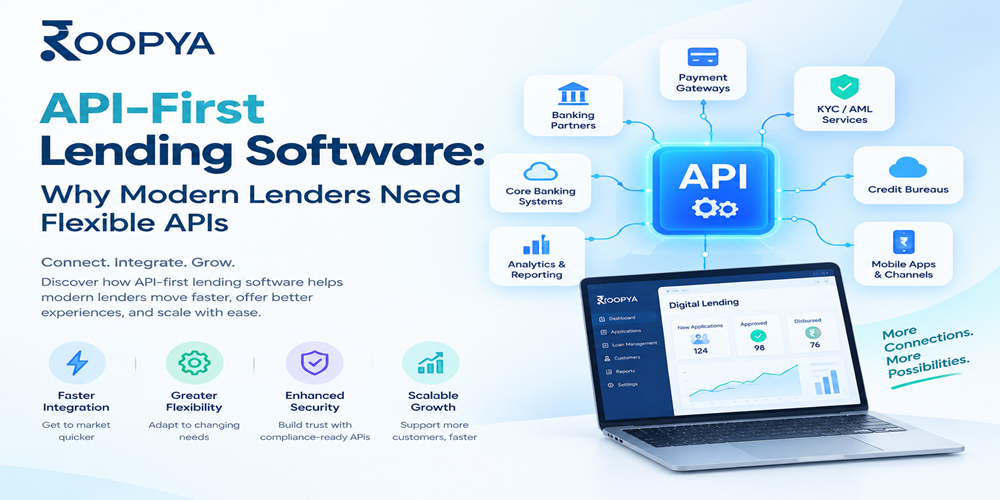
Learn why API-first lending software helps NBFCs, banks and fintechs launch faster, integrate easily and scale. See key APIs, benefits and a buyer checklist.
Lending has always been a data business, but for years the software behind it was built like a fortress: closed, monolithic and hard to change. That worked when a lender’s world was a branch, a paper file and a handful of internal systems. It does not work when a borrower applies from a phone, a partner app or a merchant checkout and expects an answer in minutes.
A single loan today can touch a credit bureau, an identity verification service, a bank statement analyser, an e-mandate provider, a payment gateway and a fraud engine before the first instalment is due. Every one of those touchpoints is an integration. When lending software treats integration as an afterthought, each new partner becomes a project measured in months. When it treats integration as the foundation, each new partner becomes a configuration measured in days.
That difference is the heart of API-first lending software. This guide explains what API-first really means, why flexible APIs have become a business necessity for NBFCs, banks and fintech lenders, which capabilities to look for, and how to evaluate a platform before you commit.
What Is API-First Lending Software?
API-first lending software is a platform designed so that every function, from creating a customer record to posting a repayment, is exposed through a documented application programming interface before anything else is built. The user interface, whether an operations dashboard, borrower portal or mobile app, is simply one more client consuming those same APIs.
This is different from software that added an API later. In a traditional system the screens came first, and an API was bolted on to satisfy an integration request. The result is usually a thin, inconsistent layer that covers a fraction of the product. In an API-first platform, the API is the product. Anything a user can do in the interface, a partner system can do programmatically, under the same rules, permissions and audit trail.
A few traits separate genuinely API-first platforms from marketing claims:
- Complete coverage: origination, underwriting, disbursal, servicing and collections are all reachable through APIs, not just a few read-only endpoints.
- Consistent design: predictable REST conventions, clear versioning and uniform authentication and error handling across modules.
- Event notifications: webhooks that push status changes, such as application approved or payment failed, to your systems in real time.
- Sandbox and documentation: a test environment that lets your team build without waiting for the vendor.
- Configuration over customisation: products, rules and workflows are set through configuration, not custom code written for each client.
Why Legacy Lending Systems Struggle in a Connected Market
Lenders that feel stuck are rarely stuck because of their people or strategy. They are stuck because of architecture. Legacy loan management software tends to show the same problems.
- Slow partner onboarding: adding a new bureau, KYC provider or payment partner means a change request, a development queue and a release cycle. A week of work becomes a quarter.
- Rigid products: when loan products are hard-coded, a new tenure, interest method or fee structure needs vendor involvement, so good ideas get forced into old templates.
- Data silos: when origination, servicing and collections exchange files overnight, nobody has a current view of the borrower. Collections teams call customers who have already paid.
- Hidden integration cost: point-to-point connections look cheap on day one, but each needs monitoring and re-testing whenever either side changes.
- Vendor lock-in: closed systems make it difficult to extract your own data or swap a component, so switching costs become a reason to tolerate poor service.
The Business Case: Key Benefits of Flexible APIs
1. Faster time to market
With APIs, a lender assembles a journey from proven building blocks instead of building each block. Launching a product becomes a matter of configuring loan parameters, choosing underwriting data sources and connecting a front end. Teams that once measured launches in quarters can measure them in weeks, which matters when you are competing for a partner’s customers or a seasonal demand spike.
2. Best-of-breed data and services
No single provider is best at everything. One bureau may have stronger coverage in a segment, another data source may estimate income better, and a third may offer cheaper verification for small tickets. Flexible APIs let you mix providers, route requests by cost or performance, and add a fallback when a service is down.
3. Scalability without rebuilds
Loan volumes are rarely smooth. A festive season or a new partnership can multiply applications overnight. API-driven platforms on modern cloud infrastructure scale by handling more calls, not by re-architecting workflows. Usage-based pricing also means you do not carry the cost of capacity you are not using.
4. Better customer experience
Borrowers judge lenders by how easy it feels to apply, get approved and repay. APIs let you embed the loan journey where the customer already is and run background checks invisibly, so the customer fills fewer fields. Real-time decisions, instant e-mandate registration and automated status messages all depend on systems talking to each other without a human relay.
5. Lower operating cost
Every manual step, whether re-keying data, downloading a bureau report or reconciling payments in a spreadsheet, is a cost and a source of error. When systems exchange data automatically, straight-through processing becomes possible for low-risk cases, and your team’s time goes to exceptions and judgement calls.
6. Regulatory agility
Reporting formats, disclosure requirements and digital lending guidelines evolve. An API-first architecture separates compliance-sensitive logic from the presentation layer, so a new mandatory disclosure or reporting field can be applied centrally and flow through every channel at once.
Essential API Capabilities to Look For
Not all APIs are equal. When you assess a lending platform, look for depth across the entire loan lifecycle.
- Origination APIs: create leads and applications, upload documents, capture consent, trigger KYC and bureau pulls, and check application status.
- Decisioning APIs: run policy rules, scorecards and fraud checks and return an explainable decision, ideally in real time.
- Disbursal APIs: initiate payouts, verify beneficiary accounts and confirm settlement status.
- Servicing APIs: fetch repayment schedules, outstanding balances, foreclosure amounts and statements, and post payments.
- Collections APIs: push overdue accounts into workflows, log promises to pay and sync agent activity.
- Reporting APIs: extract portfolio, regulatory and accounting data for BI tools, ERPs and data warehouses.
- Webhooks and events: real-time notifications so external systems react instantly.
Beyond endpoint coverage, assess quality. Look at rate limits, idempotency (safe retries so the same payment is never posted twice), pagination, versioning policy, uptime commitments and how breaking changes are communicated. These details decide whether integration is smooth or painful in production.
API-First Meets No-Code: Flexibility for Business and Technology Teams
A common misunderstanding is that API-first is only for developers. In practice, the strongest platforms pair open APIs with no-code configuration. Developers use the APIs to connect systems, while credit, product and operations teams use visual tools to configure products, rules and workflows without raising a ticket.
Consider a business rule engine. If a credit manager wants to tighten approval criteria for a segment after seeing higher early delinquencies, a no-code rule engine lets them update the rule, test it and publish it. The API layer ensures every channel, whether web, app or partner integration, applies the new rule immediately because they all call the same decisioning service.
Real-World Use Cases for Flexible Lending APIs
- Embedded finance: retailers, marketplaces and payroll platforms want to offer credit inside their own experience. APIs expose application, eligibility and repayment functions so the loan feels native to the partner while the lender keeps control of underwriting and compliance.
- Lending service providers and distribution partners: APIs replace email attachments and spreadsheets with automated, auditable flows for lead submission, application tracking and disbursal reconciliation, with access controlled by partner and product.
- Co-lending: co-lending requires precise data sharing on eligibility, allocation, disbursal and repayment. Consistent APIs keep both lenders synchronised and reduce reconciliation disputes.
- ERP, CRM and analytics integration: APIs and events turn the loan system into a live data source for finance, sales and risk teams instead of a silo exported manually every month.
Security, Compliance and Governance in an API-Driven Stack
Opening systems through APIs raises the importance of security discipline. Ask every vendor how they handle the following:
- Authentication and authorisation: token-based access, scoped permissions and role-based controls so each partner or user sees only what they should.
- Encryption: data encrypted in transit and at rest, with secure key management.
- Audit trails: logs of who called what, when and with what result, essential for internal control and regulatory review.
- Consent management: capture and store borrower consent for data access and honour revocation.
- Monitoring and rate limiting: protection against abuse and alerts on unusual patterns.
- Change management: predictable versioning, so a vendor update never silently breaks your integrations or compliance reporting.
Governance matters internally too. Keep an inventory of the APIs you consume, review partner access regularly and document who owns each integration.
Common Mistakes Lenders Make When Adopting API-First Software
- Treating “has an API” as “is API-first”: a handful of endpoints is not the same as full lifecycle coverage. Test the actual API against your real journey before trusting the label.
- Ignoring the operating model: APIs do not fix unclear ownership. Decide who owns rules, products, integrations and vendor relationships before go-live.
- Over-customising early: if every workflow is custom-built, you recreate the rigidity you were trying to escape. Configure first and customise only where it creates real advantage.
- Skipping monitoring: integrations fail quietly. Track error rates, latency and provider uptime from the first day so problems surface before borrowers notice.
- Forgetting the exit plan: confirm that you can export your data and swap providers without rebuilding your workflows.
A Practical Checklist for Evaluating API-First Lending Platforms
Use these questions when comparing vendors:
- Coverage: can every action available in the interface be performed through an API?
- Documentation: is there developer documentation with examples and a sandbox?
- Pre-built integrations: how many bureaus, KYC, payment and fraud providers are already connected, and how quickly can a new one be added?
- Configurability: can business users create products, rules and workflows without vendor code changes?
- Events: are webhooks available for key lifecycle events?
- Reliability: what are the uptime commitments, response times and rate limits?
- Data ownership: can you export your data easily in an open format?
- Pricing: is pricing transparent and usage-based, or loaded with upfront fees and custom-development charges?
- Support: who helps when an integration fails late at night, and how are new APIs prioritised?
Ask for a proof of concept that exercises real integrations, not a slide deck. A short pilot with your actual bureau, KYC and payment providers will reveal more than any brochure.
How to Roll Out an API-First Lending Stack
- Map the journey: document your loan lifecycle, list every system and data source involved, and highlight the slowest and most error-prone handoffs.
- Start with one product: choose a single well-understood product rather than migrating everything at once.
- Connect core data sources: integrate identity verification, bureau, bank data and fraud checks first, since they drive both speed and risk quality.
- Configure rules and test: encode your credit policy in the rule engine and test it against historical applications.
- Pilot, then scale: run a controlled launch, monitor approval rates, turnaround times and early repayment behaviour, then add products and partner channels.
How Roopya Approaches API-First Lending
Roopya is built around this philosophy. The platform provides a no-code unified lending infrastructure covering origination, loan management, collections and early warning, exposed through an open REST API architecture so lenders can connect it with CRMs, ERPs and other business tools. Roopya offers 300+ pre-integrated APIs across credit bureaus, verification services and payment gateways, 20+ pre-configured loan products and a self-configurable business rule engine, with pay-as-per-use pricing.
For lenders, that means the integration groundwork is largely done before the project begins, business teams can adjust products and rules themselves, and technical teams can extend the platform through APIs where needed. Explore the Loan Origination Platform, the Loan Management System and the Embedded Finance pages to see how the pieces fit together, or request a demo for a walkthrough built around your use case.
The shift to API-first lending is not about technology fashion. It is about whether your organisation can respond when a partner asks for an integration, a regulator changes a rule, a segment starts performing differently or a competitor launches a faster journey. Lenders who can configure, connect and change quickly will compound advantages over those who wait for release cycles.
If you are evaluating platforms, start with the API. Ask to see it, test it and integrate with it before you sign. The quality of the API is the quality of your future flexibility.
Ready to see what a flexible, API-first lending stack looks like in practice? Book a Roopya demo and explore how the platform can fit your lending model, your partners and your growth plans.
Frequently Asked Questions
What is API-first lending software?
API-first lending software is a loan origination and management platform where every function is available through documented APIs before any user interface is built. Dashboards, apps and partner systems all use the same APIs, so anything you can do on screen you can also automate.
How is API-first different from a traditional loan management system?
Traditional systems are screen-first and add limited APIs later, which makes integrations slow and fragile. API-first platforms treat integration as the foundation, so connecting bureaus, payment gateways or partner apps is largely configuration rather than custom development.
Who benefits most from API-first lending platforms?
NBFCs, banks, microfinance institutions, fintech lenders and loan service providers benefit most, especially those launching new products, working with distribution partners, offering embedded finance or scaling volumes quickly.
Do we need a development team to use an API-first platform?
Not necessarily. Platforms that combine open APIs with no-code configuration let business teams set up products, rules and workflows themselves, while developers are needed only for custom integrations with your own systems.
Is API-first lending software secure?
It can be, provided the vendor offers token-based authentication, role-based access, encryption in transit and at rest, audit logs, consent management and rate limiting. Ask for these specifics during evaluation.
Can API-first platforms support embedded finance and co-lending?
Yes. APIs let partner apps trigger applications, check eligibility and show repayment details, and they keep data synchronised between co-lending partners for allocation, disbursal and reporting.
How long does it take to integrate a bureau or KYC provider?
With pre-built connectors it is often a matter of configuration rather than development, but timelines still depend on the provider’s onboarding process and your internal compliance approvals.
What should I ask a vendor before choosing an API-first lending platform?
Ask for full API documentation, a sandbox, the list of pre-integrated providers, webhook support, uptime commitments, security controls and data export options. Then run a proof of concept using your own bureau, KYC and payment partners.