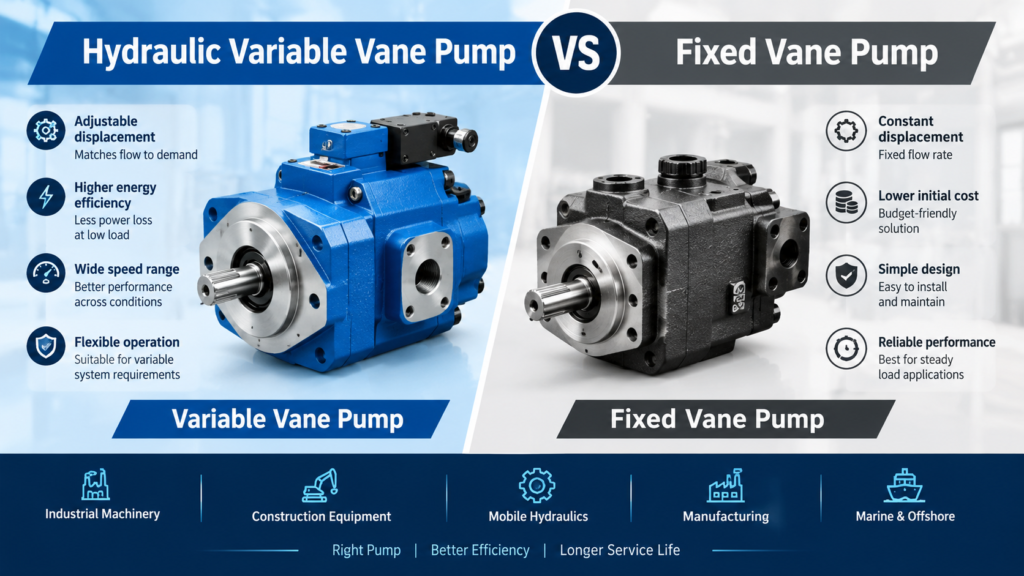
Selecting an energy-efficient Hydraulic Variable Vane Pump requires more than comparing purchase prices or nominal flow ratings. For industrial buyers, the real question is whether the pump can match changing machine demands without wasting power, overheating hydraulic oil, or creating maintenance problems.
Specifications to Check Before Selecting a Hydraulic Variable Vane Pump
A Hydraulic Variable Vane Pump adjusts its displacement to suit hydraulic demand, depending on its design and control arrangement. Its energy-saving potential depends on how the pump operates within the complete hydraulic circuit.
Pressure, Flow and Operating Speed
Document the machine’s required working pressure, flow rate, operating speed, and duty cycle. Record peak demand separately from normal operating demand. Sizing the pump around a brief peak without reviewing typical operation can result in an unnecessarily large selection.
Displacement and Control Arrangement
Confirm the pump’s displacement range and pressure- or flow-control arrangement against the application. A variable-displacement design does not automatically guarantee lower energy consumption; circuit design, control settings, and machine operating patterns all influence results.
Fluid Compatibility and Installation
Check the specified hydraulic fluid, viscosity range, inlet conditions, mounting arrangement, shaft connection, and port dimensions against the manufacturer’s documentation. An overlooked inlet restriction or incompatible connection can create installation and operating problems even when the main ratings appear suitable.
Ask the supplier for a datasheet covering the exact model. Do not approve a substitute based only on a similar product name or nominal displacement.
Objective: Criteria for Evaluating Suppliers
When comparing Hydraulic Variable Vane Pump suppliers, assess their ability to establish specification compliance before discussing price.
- Technical documentation: Check model-specific pressure, flow, speed, displacement, and fluid requirements. A credible response identifies the exact model and its documented operating limits; vague assurances without supporting data deserve scrutiny.
- Application understanding: Explain the machine’s duty cycle and expected load variations. A useful supplier response addresses actual operating conditions rather than recommending a pump solely from the existing unit’s nameplate.
- Sample and approval process: Ask whether a sample or technical drawing can be reviewed before a bulk order. Sampling may add time and cost, but skipping approval increases the risk of discovering a mounting or connection mismatch after dispatch.
Benefits of Energy-Efficient Pump Selection
Choosing the right Hydraulic Variable Vane Pump can improve operating economics when the machine’s demand changes during its working cycle.
- Lower avoidable power consumption: Matching output to demand can reduce energy wasted by supplying excessive flow, depending on the circuit design and control settings.
- Better heat management: Reducing unnecessary hydraulic power losses may limit heat generation. Actual oil temperature still depends on system pressure, flow, cooling capacity, and operating conditions.
- More predictable operating costs: Comparing expected energy use, maintenance requirements, and purchase price helps procurement teams evaluate total ownership cost instead of choosing the lowest initial quotation.
Availability and Sourcing Considerations in India
For Indian buyers, sourcing decisions should account for the supplier’s location, the delivery destination, and the urgency of the machine’s maintenance schedule. A supplier closer to the receiving factory may simplify coordination, but proximity alone does not establish stock availability or a shorter lead time.
About N.T Associates
At N.T Associates, we work with industrial hydraulic products for B2B buyers. Our website lists Hydraulic Variable Vane Pump among our product offerings. We are based at Plot No. 1, Shop No. 1, Bonjha, Patel Marg, Ghaziabad – 201001, Uttar Pradesh, India. Buyers can review our product information and contact us to discuss application requirements before finalising a selection.
Request Product Information
We invite procurement teams to share their operating requirements so we can discuss the appropriate product information. Please include the required quantity, operating pressure, flow rate, pump speed, existing model or dimensions, hydraulic fluid, application, target market, packaging requirements, delivery location, and any sampling needs.
Contact us at +91-76786-03764 or ntat@rocketmail.com. Please request confirmation of applicable specifications, MOQ, and lead time before issuing the purchase order.
Conclusion
Selecting an energy-efficient Hydraulic Variable Vane Pump starts with understanding how a machine consumes hydraulic power across its working cycle. Buyers comparing Hydraulic Variable Vane Pump Manufacturers should review documented operating limits, control arrangements, and total ownership costs to make informed purchasing decisions. Before approving a supplier, resolve specification gaps and agree on inspection and delivery requirements. The strongest sourcing decision balances energy efficiency with compatibility, maintainability, and dependable procurement planning.
FAQs
1. How does a Hydraulic Variable Vane Pump save energy?
It can adjust displacement to match changing flow demand, reducing unnecessary hydraulic power consumption when system conditions and control settings support this operation.
2. Which specifications should buyers confirm before ordering?
Confirm pressure, flow, speed, displacement, fluid compatibility, mounting dimensions, shaft connection, and control arrangement against the model datasheet.
3. Is a variable vane pump suitable for every hydraulic system?
No. Its benefits depend on the duty cycle, circuit design, and load profile. A constant-demand application may not justify the additional purchase cost.
4. How can buyers compare Hydraulic Variable Vane Pump suppliers?
Compare technical documentation, application assessment, specification compliance, sample approval arrangements, quality records, and written commercial terms.
5. Can an existing pump be replaced with a different model?
Potentially, but matching nominal flow alone is insufficient. Verify pressure limits, mounting, shaft dimensions, ports, control settings, and fluid requirements before approving a substitute.