An ecommerce website needs regular maintenance, reliable functionality, strong security, and continuous improvements to support business growth. However, when your current developer repeatedly misses deadlines, struggles to resolve technical issues, or fails to meet changing requirements, your online store can suffer.
Knowing when to hire ecommerce developers to replace your current technical support can help you avoid prolonged disruptions, improve store performance, and prepare for future growth. Before making a decision, identify the warning signs, assess whether the problems can be resolved, and plan a transition that protects your website, customer data, and search engine rankings.
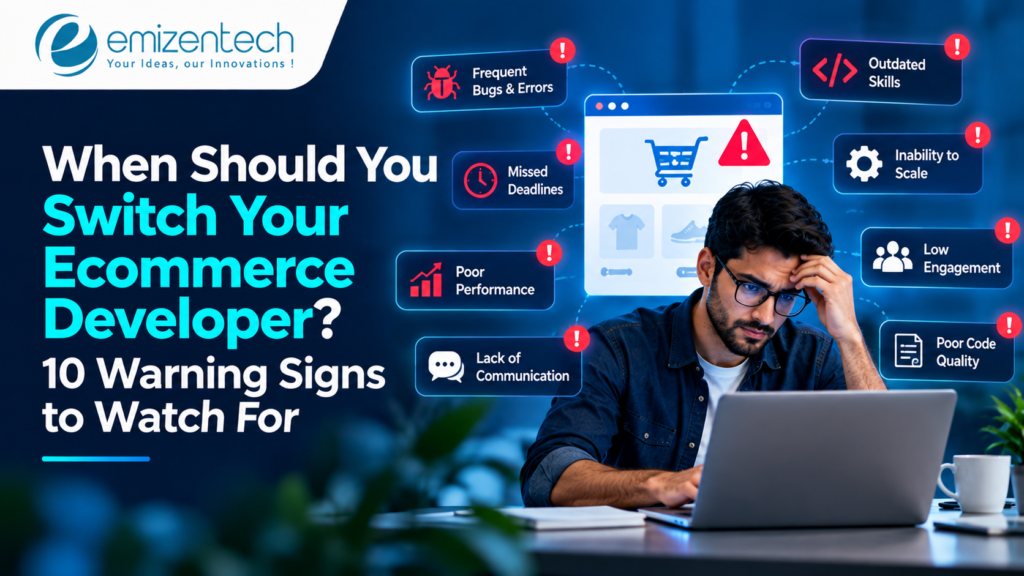
10 Warning Signs You Should Switch Your Ecommerce Developer
Not every development issue means you need to replace your current professional, but ongoing problems can signal that your store needs better technical support. Before deciding to hire ecommerce developers, review these 10 warning signs to determine whether your current developer can meet your business requirements.
1. Repeatedly Missed Deadlines
Project delays can affect product launches, marketing campaigns, seasonal promotions, and planned store improvements. If your developer regularly misses agreed deadlines without providing clear explanations or revised timelines, it may indicate poor project management or unrealistic commitments.
Occasional delays can happen, but repeated failures should not become standard practice. Review the original project scope, agreed milestones, and communication history before deciding whether the working relationship can improve.
2. Recurring Bugs and Technical Issues
Frequent checkout errors, broken product filters, payment failures, and malfunctioning features can frustrate customers and lead to lost sales. If the same problems continue appearing after multiple fixes, your developer may be addressing symptoms instead of identifying the underlying causes.
A capable ecommerce developer should investigate recurring errors, test solutions, and explain how issues will be prevented from happening again. Persistent technical problems may justify a second opinion or a change in development support.
3. Poor Communication and Lack of Transparency
Clear communication helps businesses understand project progress, technical challenges, costs, and upcoming decisions. If your developer rarely responds, provides vague updates, or avoids explaining delays, managing the website becomes unnecessarily difficult.
Look for a professional who communicates progress consistently, documents important decisions, and explains technical matters in business-friendly language. If repeated attempts to improve communication fail, switching developers may help restore accountability.
4. Declining Website Performance
Slow-loading product pages, poor mobile usability, and inefficient checkout processes can negatively affect the customer experience. These issues may also reduce conversions and make it harder for customers to complete purchases.
Before changing developers, review website performance metrics and identify the source of the problem. If your current developer cannot diagnose or resolve performance bottlenecks, consider bringing in someone with stronger experience in ecommerce optimization.
5. Security and Maintenance Are Being Neglected
Ecommerce stores handle sensitive customer information and transactions, making security an ongoing responsibility. Outdated software, delayed security updates, weak access controls, and unreliable backups can expose your business to avoidable risks.
Your developer should follow appropriate security practices, maintain supported software versions, and establish a clear backup and recovery process. If essential maintenance is repeatedly ignored, treat the issue seriously and secure your website before planning a transition.
6. Your Business Needs Have Outgrown Their Skills
As your ecommerce business grows, you may need advanced integrations, custom checkout functionality, automated inventory management, or support for multiple sales channels. A developer who handled your initial store setup may not have the expertise required for these more complex requirements.
Assess whether your current developer can support your technical roadmap. If they repeatedly struggle with new requirements or recommend solutions that limit future growth, consider hiring professionals with relevant platform and integration experience.
7. Unexpected Costs Keep Increasing
Development expenses can increase when requirements change, but frequent unexplained charges and estimates that consistently exceed the original budget deserve attention. Poor planning, unclear project scope, and inadequate cost communication can make it difficult to control spending.
Review your contract, invoices, and change requests to understand where the additional costs originate. Before switching developers, request a detailed breakdown of outstanding work and compare it with an independent estimate to determine whether a replacement offers better value.
8. Poor SEO and Website Migration Practices
Changes to an ecommerce website can affect organic search visibility when technical SEO requirements are overlooked. Incorrect redirects, broken internal links, missing metadata, and unnecessary URL changes can lead to indexing problems and lost traffic.
Your developer should understand how technical changes affect search engines and coordinate with your SEO team when necessary. If repeated development changes create SEO issues without proper testing or corrective action, consider switching to a professional who can protect both website functionality and organic performance.
9. Lack of Documentation and Website Ownership Clarity
Your business should maintain control over its domain, hosting, source code, administrative accounts, and essential integrations. Missing documentation or restricted access can make it difficult to maintain the website or transfer responsibilities to another developer.
Check whether you have the necessary credentials, technical documentation, backup files, and information about third-party integrations. Resolve ownership and access issues before ending the existing arrangement, and review your contract to understand any applicable intellectual property or handover obligations.
10. They Cannot Support Your Long-Term Business Goals
Your ecommerce strategy may eventually require personalization, automation, conversion rate optimization, new payment methods, or expansion into additional markets. If your developer focuses only on basic maintenance and cannot support these priorities, your business may outgrow the relationship.
Discuss your future requirements and ask for a practical technical roadmap. If the developer cannot demonstrate the relevant experience or provide a credible plan, finding a more suitable development partner may help you move forward.
Should You Switch Your Ecommerce Developer or Try to Fix the Relationship?
Not every problem requires replacing your developer. Sometimes, unclear requirements, unrealistic deadlines, or poorly defined responsibilities are the real causes of project difficulties.
Start by discussing the problems, agreeing on measurable expectations, and setting deadlines for improvement. If communication improves and the developer resolves outstanding issues, continuing the relationship may be practical.
However, repeated failures, serious security concerns, unresolved contractual issues, or a persistent lack of technical expertise may justify a change. Make the decision based on documented performance, business risk, and the cost of continuing with the current arrangement.
How to Switch Ecommerce Developers Without Disrupting Your Store
A planned transition can reduce operational risks and help maintain a consistent customer experience. Follow these steps before transferring development responsibilities.
1. Audit Your Existing Website
Document current technical issues, unfinished features, performance concerns, and outstanding development tasks. This gives the incoming developer a clear understanding of the website’s condition and helps establish priorities.
2. Secure Access to Essential Assets
Confirm administrative access to your domain, hosting, ecommerce platform, source code repository, analytics accounts, and third-party services. Create and verify backups before making significant changes, and review account ownership to ensure your business retains control.
3. Document Features and Integrations
Prepare an inventory of plugins, APIs, payment gateways, inventory systems, custom functionality, and recurring maintenance tasks. Complete documentation reduces handover delays and helps prevent unnecessary redevelopment.
4. Evaluate and Hire a Replacement
When you hire ecommerce developers, assess their platform expertise, ability to work with existing code, troubleshooting skills, communication practices, and experience with similar projects. Ask candidates how they would audit your current store before recommending major changes.
5. Test Before Deploying Changes
Agree on a transition timeline and test essential workflows before releasing updates. Verify checkout, payment processing, inventory synchronization, customer accounts, mobile usability, and SEO-critical elements to reduce the risk of disruption.
What Should You Check Before Hiring Your Next Ecommerce Developer?
Choosing a replacement based only on hourly rates can lead to similar problems later. Evaluate candidates against the requirements that matter most to your business.
- Platform expertise: Experience with your existing ecommerce platform and its technical limitations.
- Problem-solving ability: A structured approach to debugging, performance optimization, and code maintenance.
- Communication: Clear updates, realistic timelines, and documented deliverables.
- Security and SEO knowledge: An understanding of website security, technical SEO, and safe deployment practices.
- Ongoing support: Defined responsibilities for maintenance, troubleshooting, and future improvements.
A technical assessment of your current store can also help you compare candidates on practical ability rather than relying solely on claims or portfolios.
How Much Does It Cost to Switch Ecommerce Developers?
The cost of switching depends on your store’s complexity, existing technical issues, and the scope of the handover. A well-documented website with maintainable code may require relatively little transition work, while a store with custom integrations, recurring bugs, or missing documentation may need a more extensive audit.
Potential expenses include technical assessments, code fixes, documentation, integration updates, redevelopment, and ongoing maintenance. Request a written estimate that separates essential repairs from optional improvements, and compare the cost of switching with the cost and risks of continuing the existing arrangement.
Conclusion
Switching your ecommerce developer may be necessary when repeated delays, unresolved technical problems, poor communication, or limited expertise begin affecting business performance. However, the transition should be based on a clear assessment of your current website, business requirements, and future growth plans.
Before making a change, secure your digital assets, document existing functionality, and evaluate replacement candidates carefully. EmizenTech provides ecommerce development services to help businesses build, maintain, and scale online stores with solutions aligned with their technical and operational requirements. Choosing the right development partner can help establish a more reliable foundation for long-term ecommerce growth.
Frequently Asked Questions
1. When should I replace my ecommerce developer?
Consider replacing your developer when repeated delays, recurring bugs, poor communication, security gaps, or limited technical expertise continue affecting your store despite clear feedback and reasonable opportunities to improve.
2. Can I change ecommerce developers without rebuilding my website?
Yes. A complete rebuild is usually unnecessary if the existing website is maintainable and the new developer can work with its codebase, platform, and integrations. A technical audit can establish whether repairs or redevelopment are needed.
3. How do I transfer my ecommerce website to a new developer?
Secure access to your domain, hosting, source code, administrative accounts, and integrations. Create backups, document existing functionality, agree on a handover plan, and test critical workflows before deploying changes.
4. Will switching ecommerce developers affect my SEO rankings?
Changing developers alone does not automatically affect rankings. However, poorly managed website updates, incorrect redirects, broken links, and indexing errors can harm organic visibility. Review technical SEO requirements before and after the transition.
5. Should I hire a freelancer or a dedicated ecommerce development team?
A freelancer may suit smaller projects with limited technical requirements, while a dedicated team can provide broader expertise and ongoing support for complex stores. Choose the model that matches your workload, budget, project scope, and long-term goals.