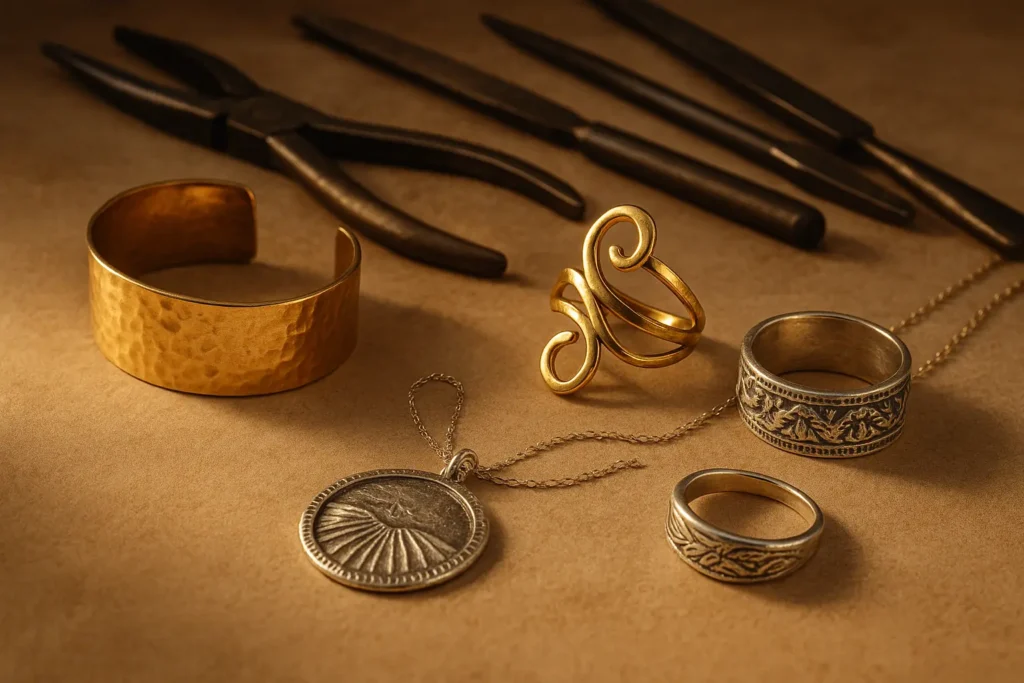
Walk through any craft fair or scroll any online marketplace and you’ll see the word “handmade” everywhere. It’s on delicate gemstone bracelets, chunky pendants, and everything in between. But the word doesn’t always mean what shoppers hope it means.
In the United States, there’s no single, universal legal definition of “handmade” for jewelry. Some sellers use it for pieces designed, assembled, and finished by one person. Others use it loosely for mass-produced items with a quick finishing touch. That gap is why many buyers of handcrafted artisan jewelry feel unsure about what they’re getting.
The good news is that you don’t need a gemology degree to protect yourself. Real artisan work leaves clues in the materials, the construction, the imperfections, and the way the maker talks about the piece. This guide walks through those clues.
Handmade, Handcrafted, and Handmade-Looking Are Not the Same
Three terms get blurred together:
- Handmade: a person made the piece, usually with hand tools or simple equipment.
- Handcrafted: a person made it with skill and intention, shaping design decisions at each step.
- Handmade-looking: the piece was designed to look rustic or artisanal but was produced in a factory.
Authentic artisan jewelry sits in the first two groups. The third is where most disappointment happens.
Start With the Seller, Not the Jewelry
The strongest evidence that a piece is handmade often has nothing to do with the piece itself. It comes from the seller.
Look for a Real Maker Story
A genuine artisan can usually tell you who they are, where they work, and how they make things. Look for an About page that names the studio, describes the process, and explains where the inspiration comes from. Vague phrases like “premium quality craftsmanship” with no detail about a person or place are a weak signal.
A good example is Cosmic Eye Creations, a small artist studio that describes its work as being made in its own studio in Santa Fe, NM, and notes that the team often vends at local markets and community events. That kind of specific, checkable detail is what you want from any maker: a place, a process, and a face behind the work.
Check for Consistent Product Descriptions
Artisans tend to describe their pieces in specific terms. Instead of “beautiful necklace,” you’ll see the stone type, bead size, length, clasp style, and what the cord or chain is made of. Specifics take effort to write, and they’re hard to fake across dozens of listings.
For instance, a well-written product page might tell you a necklace is 19½ inches long, strung on jewelry cable with a stainless steel lobster claw clasp, and accented with faceted gemstones. If you can picture exactly how the piece is built, the seller probably knows exactly how they built it.
Ask Questions and Pay Attention to the Answers
Message the seller. Ask how long a piece takes to make, where the stones are sourced, or whether they can adjust the length. Makers usually enjoy these questions. Resellers often give vague answers, or none at all.
Inspect the Piece Itself
Once you have the jewelry in hand (or high-resolution photos), these physical checks help.
Look for Small, Human Variations
Machine-made jewelry is uniform. Every link, bead hole, and pendant bail matches the last. Handcrafted pieces show gentle variation:
- Slightly different spacing between beads
- Natural differences in color or pattern between stones
- Subtle asymmetry in wire loops or shaped components
- Small differences in finish from one piece to the next
These are not flaws. They’re evidence that human hands, not a mold, shaped the work. Natural stones make this especially visible. Two amethyst beads from the same strand can differ in color depth, and a piece of charoite or abalone will show swirling patterns that no two pieces share.
Examine the Construction Details
Flip the piece over and look at the parts most buyers ignore:
- Wire wraps and loops: Neat, consistent wraps suggest skilled handwork. Messy or glued connections can signal shortcuts.
- Knots and stringing: Quality stringing is tight and deliberate. Strong jewelry cable and secure crimps matter for durability.
- Clasps and findings: Sturdy clasps like lobster claws, solid jump rings, and well-attached bails indicate a maker who cares about longevity.
- Backs and edges: Clean, finished backs on pendants suggest attention to detail.
Check Surface Marks and Finishing
Hand-finished metal may show faint tool marks, subtle hammer texture, or slight polishing differences. Cast or stamped factory pieces often show perfectly repeated patterns and a sprue mark or seam where the mold was separated.
Keep in mind that a clean finish doesn’t mean a piece is factory-made. Skilled artisans polish carefully. The goal is to look for signs of repeatability. If a hundred pendants are pixel-identical, a mold was involved.
Test the Weight and Feel
Mass-produced costume pieces are often light, thin, and hollow. Quality artisan work tends to feel balanced and intentional. Gemstone beads usually feel cool to the touch and slightly heavy, while glass or plastic imitations warm up quickly in your hand. This is a rough guide, not a lab test, but it’s a useful first impression.
Verify the Materials
Jewelry can be truly handmade and still be made with poor materials. Real artisans are open about what goes into each piece.
Gemstones: Natural, Treated, or Imitation?
Gemstones are where buyers most often get confused. A trustworthy maker will tell you which stone it is and ideally something about its quality or origin. Useful questions include:
- Is the stone natural, treated, or lab-created?
- Is it the stone named in the listing, or a look-alike dyed to resemble it?
- Where is the stone typically found?
Be cautious about prices that seem too low for the stone named. Rare minerals command higher prices for a reason. Charoite, for example, is known to be found only near the Chara River in Siberia, so a bargain-bin “charoite” necklace deserves a second look.
Seller descriptions that include educational details, such as a stone’s mineral family, typical colors, and quality grade, usually come from someone who handles the stones personally.
Metals: Know What You’re Buying
Look for clear metal descriptions: sterling silver, gold-filled, solid gold, or stainless steel. Vague labels like “silver-tone,” “alloy,” or “metal” tell you very little.
Stainless steel deserves a mention because it’s popular in artisan work for practical reasons. It resists rust and tarnish and doesn’t turn brassy because it isn’t a plated alloy. A maker who builds a necklace entirely from stainless steel, including the clasp and findings, is making a deliberate durability choice you can verify in the description.
Be Wary of Unverified Claims
If a listing claims a stamp, hallmark, or certification, look for it in the photos or ask for it. Don’t assume. And if a seller makes broad claims about “healing” or “energy” properties, treat those as cultural or symbolic traditions rather than scientific facts. Reputable sellers describe such meanings as beliefs and symbolism, not guarantees.
Compare the Signs: Handmade vs. Mass-Produced
This table gives you a quick reference when you’re shopping.
| What to Check | Likely Handcrafted | Likely Mass-Produced |
|---|---|---|
| Consistency | Small natural variations from piece to piece | Every piece looks identical |
| Product description | Specific stones, sizes, lengths, and materials | Vague wording like “premium quality” |
| Seller information | Named studio, maker story, location, process | No clear business identity |
| Photos | Original photos taken of the actual piece | Stock images reused across many shops |
| Findings and clasps | Chosen for durability and described clearly | Generic, unspecified, or flimsy |
| Customization | Often available on request | Rarely offered |
| Pricing | Reflects materials and labor | Unusually low for the claimed materials |
| Backstory | Inspiration, process, and sourcing explained | Generic marketing language |
No single row proves anything on its own. The pattern across several rows is what counts.
Red Flags That a Piece May Not Be Truly Handmade
Watch for these warning signs:
- Identical photos across multiple sellers. If the same image appears on several unrelated shops, it’s likely a wholesale product.
- Huge inventory with no maker information. One artisan can’t produce thousands of unique pieces a week.
- Very fast production claims. If a “custom” piece ships in a few hours, it may be pre-made.
- Inconsistent location claims. A seller says “made in the USA” but the details don’t add up. Origin claims in the U.S. are regulated by the Federal Trade Commission, and a seller should be able to explain them.
- No contact information. A real studio usually provides a way to reach the maker directly.
- Overly perfect stones at very low prices. Natural gemstones vary. Flawless, identical, bargain-priced stones may be dyed, reconstituted, or imitation.
If you’re shopping for Native American-made jewelry specifically, be aware that the federal Indian Arts and Crafts Act makes it illegal to market goods as Native American-made when they are not. Ask sellers to be explicit about who made the piece.
Questions to Ask Before You Buy
You don’t need to interrogate every seller. A few well-chosen questions will tell you a lot:
- Who made this piece, and where?
- What materials are used, including the clasp, wire, or cord?
- Are the stones natural, and how are they sourced or graded?
- Can you make this in a different length or with different stones?
- What is your return, repair, or resizing policy?
Pay attention to how the answers feel, not just what they say. Artisans tend to answer with enthusiasm and detail. Resellers tend to answer with generic phrases or to avoid the question.
Why Custom Orders Are One of the Best Proof Points
If you want the clearest possible evidence that a piece is made by a person, ask for something that doesn’t exist yet.
A custom request, such as a specific stone, a different bracelet size, or a personalized anklet, forces a conversation with the maker. Factory operations can’t easily do this. Artisans can, because they control the whole process from design to finished product.
This is a core part of what Cosmic Eye Creations offers. The studio takes custom orders for necklaces, bracelets, and anklets, letting customers work with an artist to choose personalized materials and gemstones for men and women. Beyond jewelry, the studio also creates laser-engraved and personalized items, including cutting boards, keychains, and wood signs. If you’ve been looking for handcrafted artisan jewelry made around your own preferences, a custom order is a direct way to confirm there’s a real maker on the other end.
Handmade Doesn’t Mean Flawless, and That’s Okay
Some buyers expect handmade pieces to look perfect. In reality, perfection is more often a sign of machine production. Handcrafted work has character: a slightly different bead pattern, a stone with an unexpected swirl, a wire loop with a personal touch.
Value your pieces for what they are:
- Personal: Made with intention rather than at scale
- Unique: Even repeated designs vary slightly
- Repairable: A maker who built it can usually fix or adjust it
- Meaningful: Often tied to a story, place, or inspiration
Pricing deserves the same realistic view. Handmade jewelry often costs more than factory pieces because it involves materials, skill, and time. Yet it doesn’t have to be expensive. Prices vary widely depending on the stones, metals, and complexity involved. Simple gemstone bracelets sit at one end, and larger statement necklaces with premium stones sit at the other. What matters is that the price makes sense for what’s described.
A Quick Buyer’s Checklist
Before you check out, run through this list:
- The seller has a named business, a location, and a way to be contacted
- Photos look original and show the actual piece
- The description specifies materials, dimensions, and findings
- Stones and metals are identified clearly
- Small natural variations appear, rather than perfect uniformity
- The maker is open to questions or custom requests
- Pricing is consistent with the materials described
If most of these boxes are checked, you’re likely looking at the real thing.
Conclusion
Spotting genuine artisan jewelry comes down to a handful of habits: learn who the maker is, inspect the construction, ask about the materials, and be cautious of anything that looks too uniform, too cheap, or too vague. Handmade pieces tell their story through small variations, clear descriptions, and makers who are happy to talk about their process.