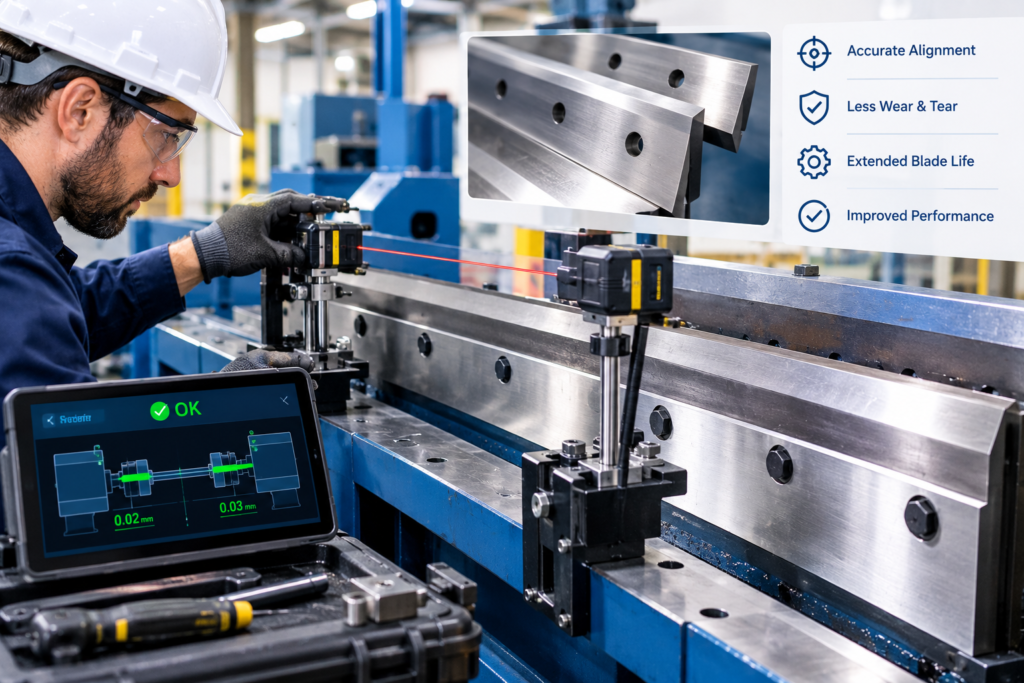
Industrial shearing operations depend on accurate machine setup, consistent cutting force, and properly maintained tooling. Even when a machine uses high-quality components, alignment problems can affect cutting accuracy, increase wear, and lead to unexpected maintenance. Regular alignment checks help identify these issues before they cause serious damage. For manufacturers working with shear blades , maintaining correct machine alignment is an important part of achieving reliable cutting results and extending tool service life.
Machine alignment is not limited to positioning the blades correctly. It also involves checking the relationship between the upper and lower blades, machine frame, blade holders, guides, and other components that influence the cutting process. Understanding these relationships allows operators and maintenance teams to reduce avoidable stress on the blades and maintain consistent production quality.
Understanding Machine Alignment in Industrial Shearing
Machine alignment refers to the correct positioning and relationship of machine components according to the equipment manufacturer’s specifications. In industrial shearing machines, the upper blade must move in a controlled relationship with the lower blade to separate the material effectively.
When components are incorrectly positioned, the blade clearance may become uneven across the cutting length. This can cause one section of the blade to experience more pressure than another. As a result, the machine may produce inconsistent cuts, excessive burrs, or visible edge deformation.
Alignment issues can develop gradually through normal operation. Repeated loading, vibration, loose fasteners, component wear, and improper maintenance may affect the positioning of critical parts. Regular inspections help identify these changes before they significantly affect cutting performance.
1. Maintaining Consistent Blade Clearance
Blade clearance is the gap between the cutting edges of the upper and lower blades. The appropriate clearance depends on factors such as material type, thickness, hardness, and machine design.
If the machine is misaligned, clearance may vary from one end of the cutting area to the other. A gap that is too small in one section can increase friction and cutting force, while an excessive gap elsewhere may produce rough edges, burrs, or material distortion.
Regular alignment checks help confirm that blade clearance remains consistent with the machine manufacturer’s recommendations and the material being processed.
Operators should inspect the clearance at multiple points along the blade length rather than checking only one location. Any variation outside the permitted range should be investigated before production continues. Correcting the underlying alignment issue can help distribute cutting forces more evenly and reduce unnecessary stress on shear blades.
2. Reducing Uneven Blade Wear
Uneven wear is a common indication that a shearing system may not be operating under balanced conditions. When the blades do not meet the material consistently, certain sections may experience higher loads, friction, or repeated impact.
Over time, this uneven loading can contribute to localized dulling, edge chipping, and premature wear. It may also reduce the amount of usable service life available before sharpening or replacement becomes necessary.
Machine alignment inspections help maintenance teams identify conditions that contribute to uneven wear. Checking blade seating, mounting surfaces, fasteners, guides, and the relationship between the upper and lower blades can reveal potential causes.
When wear patterns appear concentrated in particular areas, operators should investigate the machine setup instead of assuming that sharpening alone will solve the problem. Correcting alignment before reinstalling a sharpened blade can help prevent the same issue from recurring.
3. Improving Cutting Accuracy and Edge Quality
The quality of a sheared edge depends on several factors, including blade sharpness, material properties, cutting clearance, and machine condition. Alignment plays an important role because it helps maintain predictable interaction between the cutting edges.
Misaligned components can produce inconsistent cutting conditions across a single sheet or strip. Some sections may have clean edges, while others show burrs, deformation, or irregular separation.
These defects can create additional work during deburring, finishing, welding, or assembly. In applications with tight dimensional tolerances, inconsistent cutting can also contribute to rejected parts.
Routine machine alignment checks help maintain uniform cutting conditions. Combined with proper blade maintenance and suitable operating settings, these checks support more repeatable results and reduce the likelihood of quality variations during production.
4. Preventing Excessive Mechanical Stress
Shearing generates substantial forces as the blades penetrate and separate metal. The machine frame, blade holders, fasteners, and guiding components must work together to manage these loads.
When the machine is incorrectly aligned, forces may not be distributed as intended. Certain components can experience additional stress, and the blades may be subjected to uneven loading or unwanted contact.
These conditions can increase the risk of edge damage, blade deformation, fastener loosening, and wear in supporting components. In severe cases, continued operation with incorrect alignment may cause costly equipment damage.
Maintenance personnel should therefore examine alignment after significant repairs, blade replacement, machine relocation, or events involving unusual impact or vibration. Following the manufacturer’s inspection procedures helps verify that components remain within their specified tolerances.
5. Checking Blade Holders and Mounting Surfaces
Accurate alignment depends on more than the blade edges themselves. Blade holders and mounting surfaces must also provide stable, consistent support.
Dirt, metal chips, burrs, damaged seating surfaces, or uneven clamping can prevent a blade from sitting correctly. Even a small obstruction beneath the blade may affect its position and alter clearance along the cutting line.
During scheduled maintenance, technicians should inspect mounting surfaces and remove contamination using approved procedures. They should also check for damaged fasteners, signs of movement, and visible wear in the blade holder.
Fasteners must be tightened according to the manufacturer’s specified sequence and torque requirements. Improvised adjustments can introduce additional alignment problems or create unsafe operating conditions.
Clean seating surfaces and secure mounting help maintain the intended position of shear blades throughout the production cycle.
6. Establishing a Practical Alignment Inspection Routine
A consistent inspection schedule makes it easier to identify developing problems before they affect production. The frequency of checks should reflect machine usage, operating conditions, material characteristics, and the manufacturer’s recommendations.
A practical inspection routine may include the following steps:
- Review machine documentation: Confirm the manufacturer’s alignment tolerances, clearance requirements, and inspection procedures.
- Inspect before setup: Check blade holders, mounting surfaces, fasteners, and visible machine components before beginning a production run.
- Measure blade clearance: Use approved measuring methods at multiple points along the cutting length.
- Look for warning signs: Examine cut edges and blade surfaces for uneven wear, chipping, burrs, and inconsistent cutting results.
- Record inspection findings: Document measurements, adjustments, maintenance work, and recurring defects.
- Recheck after maintenance: Verify alignment after blade changes, repairs, or adjustments that may affect component positioning.
Before carrying out an inspection or adjustment, personnel must follow the machine’s lockout procedures and ensure that hazardous movement and stored energy are controlled. Alignment measurements and adjustments should be performed by trained personnel using suitable tools.
7. Using Wear and Production Data to Identify Problems
Inspection records can help maintenance teams recognize patterns that might otherwise go unnoticed. For example, repeated edge damage in the same section of a blade may indicate a local clearance or mounting issue.
Likewise, an increase in burr formation, more frequent sharpening, or a sudden decline in cut quality may signal a change in machine alignment.
Tracking these indicators alongside production volume and material specifications helps teams distinguish normal tool wear from problems related to machine setup. It also supports more informed decisions about maintenance timing and component replacement.
Rather than waiting for a blade to fail, manufacturers can use inspection history to identify when further investigation is needed. This approach can reduce unplanned interruptions and improve maintenance planning.
The Role of Proper Alignment in Blade Service Life
Protecting industrial tooling requires attention to the entire shearing system. High-quality blades cannot consistently deliver their intended performance if the machine operates with incorrect clearance, unstable mounting, or uneven loading.
For manufacturers such as Maxwell Slitter Industries , machine setup and blade performance are important considerations when discussing the reliability of industrial cutting operations. Proper alignment practices complement suitable blade selection, careful installation, appropriate operating parameters, and routine inspection.
Although alignment checks cannot eliminate every cause of blade wear, they help control several preventable sources of damage. Their value is particularly clear in production environments where cutting accuracy, repeatability, and equipment availability are important.
Conclusion
Machine alignment checks are an essential part of maintaining reliable industrial shearing equipment. They help maintain consistent blade clearance, reduce uneven wear, improve edge quality, and limit unnecessary mechanical stress. They also help maintenance teams identify developing problems before they result in extensive damage or production delays.
By following manufacturer specifications, inspecting mounting surfaces, measuring clearance correctly, and documenting maintenance findings, operators can create more stable cutting conditions. Combining these practices with proper sharpening, suitable blade selection, and safe operating procedures helps manufacturers protect their shear blades and maintain dependable production performance over time.