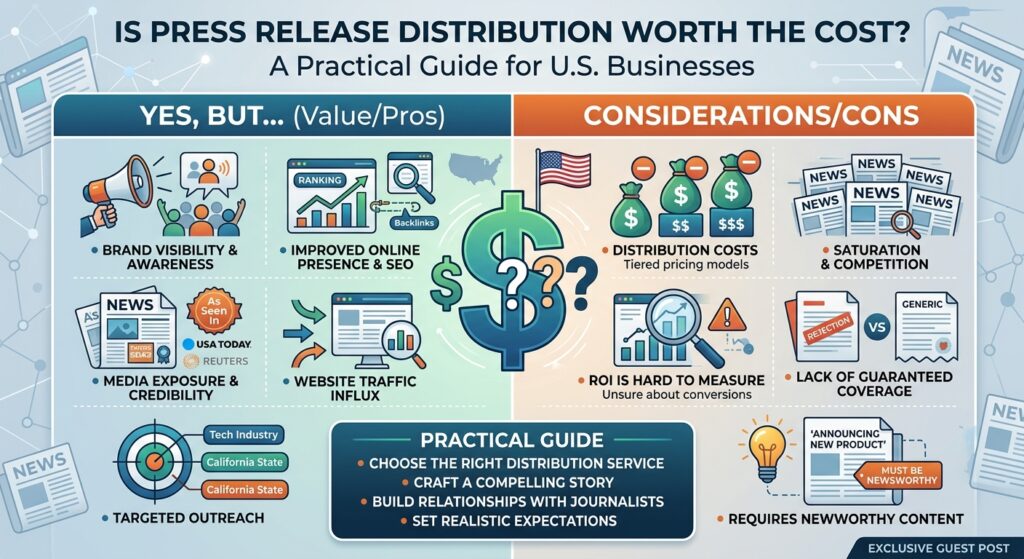
For businesses, nonprofits, startups, and organizations in the United States, a press release can be a useful way to communicate a significant announcement. However, writing the release is only one part of the process. Organizations also have to decide whether distributing it through a wire service or media distribution platform is worth the expense.
That raises an important question: Is press release distribution worth the cost?
The answer depends on the purpose of the announcement, the intended audience, the distribution network, and what the organization expects to achieve. A press release should not be treated as a guaranteed way to generate news coverage, backlinks, website traffic, or sales. Instead, it is better understood as a structured communication tool that can make newsworthy information easier for journalists, publications, industry professionals, and other interested audiences to discover.
Understanding press release pricing, distribution models, audience targeting, and realistic outcomes can help businesses make a more informed decision.
What Is Press Release Distribution?
Press release distribution is the process of sending a completed news announcement to a network of media outlets, journalists, databases, websites, and other publishing channels.
Distribution services vary considerably. Some primarily provide online publication and syndication, while others offer access to larger newswire networks, geographic targeting, industry-specific distribution, multimedia options, or reporting dashboards.
A typical release may announce:
- A new product or service
- A company expansion
- A merger or acquisition
- An executive appointment
- A research finding
- A major partnership
- An investment or funding announcement
- A nonprofit initiative
- A significant event
- A corporate milestone
The key consideration is whether the announcement contains information that an external audience would reasonably consider newsworthy.
Google’s guidance on helpful content similarly emphasizes original, useful information and content created primarily for people rather than search-engine manipulation.
Is Press Release Distribution Worth the Cost?
For some organizations, yes. For others, no.
The value of distribution depends less on simply getting a release published and more on whether distribution supports a clearly defined communication objective.
For example, a publicly traded company announcing an important corporate development may have a stronger reason to use a broad distribution network than a small business announcing an ordinary discount.
Likewise, a company expanding into several U.S. states may benefit from geographic distribution, while an organization with an international audience may need broader geographic coverage.
The most useful question is therefore not:
“Will distributing this press release make money?”
A better question is:
“Does this announcement justify paying to place it in front of the audiences that matter to us?”
If the answer is yes, distribution may be worthwhile.
What Are You Actually Paying For?
Press release pricing can be confusing because distribution providers do not all charge for the same things.
A basic package may cover distribution to an online network. More comprehensive packages can include additional geographic regions, industry targeting, multimedia, expanded word counts, monitoring, or reporting.
Common cost factors include:
Distribution Reach
The broader the distribution network, the more expensive a service can become. National U.S. distribution generally serves a different purpose from regional distribution.
Geographic Targeting
A business serving customers in Texas may not need a nationwide campaign. Conversely, a company entering several national markets may require wider distribution.
Industry Targeting
Some services provide specialized distribution options for sectors such as technology, healthcare, finance, energy, or consumer products.
Multimedia
Photos, videos, logos, documents, and other multimedia elements can sometimes involve additional fees.
Word Count
Some providers include a specific release length within their base price and charge additional amounts for longer releases.
Reporting
Distribution reports may show information such as publication locations, estimated reach, clicks, or engagement metrics. These reports can help organizations evaluate performance, although they should not automatically be interpreted as evidence of media coverage.
Published 2026 industry pricing examples show how widely costs can vary. Some lower-cost distribution services advertise prices in the tens or hundreds of dollars, while major U.S. wire services often use customized or non-public pricing structures.
Understanding Press Release Pricing
There is no universal price for distributing a press release.
At the lower end, businesses may find services designed primarily for online syndication or basic publication. Mid-range options can provide broader media distribution and targeting. Premium newswire services may charge considerably more, particularly when national distribution, multimedia, geographic targeting, and other additions are involved.
This makes comparing services based only on the headline price misleading.
For example, a $100 distribution package and a $1,000 package may not be competing products. One might offer basic online syndication, while the other provides access to a substantially different distribution network.
Before purchasing, businesses should examine:
- Where the release will be distributed
- Whether the service offers U.S. national or regional distribution
- Which media outlets are actually included
- Whether journalist targeting is included
- Whether multimedia costs extra
- Whether there are word-count restrictions
- What analytics are provided
- Whether additional fees apply
- Whether the service clearly distinguishes syndication from earned media coverage
The last point is particularly important.
Distribution Does Not Guarantee Media Coverage
One of the most common misunderstandings about press releases is the assumption that distribution automatically results in journalists writing independent stories.
It does not.
A press release distribution service can make an announcement available to media professionals and publishing networks, but a journalist still decides whether the information deserves editorial attention.
A genuinely newsworthy announcement has a better chance of attracting interest than a release containing routine promotional claims.
For example, “Local Business Announces 10% Weekend Discount” is unlikely to have the same editorial value as “Regional Healthcare Organization Opens New Community Clinic Serving Underserved Area.”
The difference is not simply the quality of the writing. It is the underlying news value.
When Distribution Can Be a Good Investment
Press release distribution can make sense when an organization has a meaningful announcement and needs structured exposure.
Major Corporate Announcements
Mergers, acquisitions, investments, leadership changes, and significant expansion plans can justify formal distribution.
New Research or Data
Original research, surveys, reports, or industry findings may have value beyond the organization itself.
Geographic Expansion
Companies entering new markets may use distribution to communicate their expansion to regional or national audiences.
Significant Partnerships
A partnership can be newsworthy when it produces a meaningful change for customers, communities, or an industry.
Public or Community Initiatives
Nonprofits, universities, municipalities, and businesses may distribute releases when announcing initiatives with broader public relevance.
Time-Sensitive Announcements
A formal distribution channel can also be useful when an organization needs its announcement publicly available at a particular time.
When Distribution May Not Be Worth the Cost
There are also situations where paying for distribution may produce limited value.
A press release may not be appropriate for:
- Minor internal company updates
- Routine promotions
- Ordinary product discounts
- Announcements with no meaningful audience
- Content created primarily to obtain backlinks
- Repetitive company updates with little new information
- Claims that cannot be supported with evidence
If an announcement is not genuinely newsworthy, paying to distribute it more widely does not necessarily make it more newsworthy.
In those circumstances, a company blog, email newsletter, social media post, customer communication, or direct journalist outreach may be more appropriate.
Global Press Release Distribution: When Does It Make Sense?
Global Press Release Distribution can be useful for organizations whose audiences, operations, investors, partners, or customers extend beyond the United States.
However, global distribution should not automatically mean distributing the same announcement everywhere.
Different countries have different media environments, languages, business cultures, and regulatory considerations.
A U.S. technology company launching in Europe, for example, may need different messaging for European audiences than for American readers.
Before choosing global distribution, organizations should consider:
- Which countries are strategically important
- Whether the announcement is relevant internationally
- Whether localization or translation is necessary
- Which languages should be used
- Whether regional media targeting is available
- Whether international distribution is included in the quoted price
- Whether local journalists would consider the announcement newsworthy
Global distribution is therefore most useful when the announcement itself has international relevance.
How to Measure Whether Distribution Worked
Businesses should establish success criteria before distributing a release.
Possible measurements include:
Publication
Where did the release appear, and were those placements expected?
Referral Traffic
Did readers visit the organization’s website after seeing the announcement?
Engagement
Did the release generate meaningful clicks, downloads, inquiries, or other actions?
Media Interest
Did journalists contact the organization for additional information?
Brand Visibility
Did the announcement increase awareness among a relevant audience?
Business Outcomes
For some announcements, the ultimate objective may involve investor interest, partnership inquiries, recruitment, event attendance, or another measurable business outcome.
However, these outcomes should not be attributed automatically to a press release without appropriate tracking.
UTM parameters, dedicated landing pages, referral analytics, and campaign-specific tracking can make measurement more reliable.
How to Improve the Value of a Press Release
Distribution works best when the underlying release is useful and credible.
A strong release should answer the basic questions a reader has:
- What happened?
- Who is involved?
- When did it happen?
- Where is it relevant?
- Why does it matter?
- What evidence supports the announcement?
- Where can readers find additional information?
The headline should communicate the main development without exaggerated claims.
The opening paragraph should quickly establish the news.
Supporting paragraphs can provide relevant context, quotes, data, background, and details.
Organizations should also verify names, dates, statistics, financial figures, product claims, and quotations before publication.
This emphasis on accuracy supports the broader principles of E-E-A-T—experience, expertise, authoritativeness, and trustworthiness. Google states that trust is the most important aspect of E-E-A-T and recommends making authorship and expertise clear where appropriate.
The Importance of Transparency
Organizations should also distinguish factual announcements from advertising.
If promotional or sponsored content is presented in a way that could mislead readers about its commercial nature, transparency becomes important. The Federal Trade Commission emphasizes that advertising should not deceptively appear to be independent editorial content and that necessary disclosures should be clear and prominent.
For that reason, businesses should avoid implying that paid distribution equals independent editorial endorsement.
A release being distributed or republished does not necessarily mean that a publication independently investigated or endorsed every claim in it.
How to Decide Whether to Pay for Distribution
A simple decision framework can help.
Step 1: Identify the news.
If you cannot explain why someone outside the company should care, reconsider whether a press release is the right format.
Step 2: Define the audience.
Determine whether the announcement matters locally, nationally, internationally, or to a particular industry.
Step 3: Establish the objective.
Decide whether the goal is awareness, media discovery, public information, traffic, stakeholder communication, or another measurable outcome.
Step 4: Compare distribution options.
Look beyond the headline price. Compare geographic reach, industry targeting, multimedia allowances, reporting, and additional fees.
Step 5: Set realistic expectations.
Distribution can increase exposure, but it cannot guarantee independent media coverage or business results.
Step 6: Measure the outcome.
Track relevant metrics and compare the results against the original objective.
The Role of Specialized Distribution Providers
Businesses researching distribution options may encounter both large international newswire companies and specialized providers. Each can serve different communication needs.
For example, Vertex Newswire is one provider that businesses may encounter when researching press release distribution options. The important consideration is not simply the provider’s name but whether its distribution model, audience reach, pricing structure, and reporting capabilities match the organization’s specific announcement.
When evaluating any provider, businesses should review its current terms directly rather than relying solely on third-party descriptions or outdated pricing information.
Final Verdict: Is Press Release Distribution Worth the Cost?
Press release distribution can be worth the cost when the announcement is genuinely newsworthy, the intended audience is clearly defined, and the distribution network matches the communication objective.
It is less likely to be worthwhile when the release exists primarily for promotional purposes, search-engine manipulation, or the expectation of guaranteed media coverage.
The most important factor is therefore not how much a business spends. It is whether the distribution provides access to an audience that has a legitimate reason to care about the announcement.
For U.S. businesses, the best approach is to evaluate distribution as part of a broader communications strategy rather than as a standalone marketing shortcut. Compare press release pricing, understand what each package actually includes, choose geographic reach based on real audience needs, and measure results against clearly defined objectives.
Ultimately, a well-written, evidence-based announcement distributed to a relevant audience is more valuable than an expensive distribution package built around unrealistic expectations. When the news itself is strong and the distribution strategy is appropriate, paying for distribution can be a practical communications investment. When those conditions are absent, the same budget may be better directed toward more targeted channels.