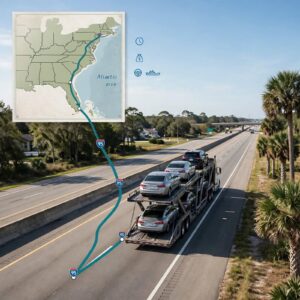
New Jersey to Florida car shipping is one of the most heavily traveled vehicle routes in the country. Thousands of cars move down Interstate 95 every year, carrying retirees, relocating families, students, and buyers who found a better deal in the Sunshine State. For most people, the real question is not whether to ship a car but whether shipping beats driving once you count the full cost.
This guide answers that question with numbers, walks through what affects your price from North Jersey to the Keys, and explains how to avoid the common problems that catch first-time shippers off guard.
The Route at a Glance
| Detail | What to Expect |
| Typical distance | About 900 to 1,300 miles, depending on cities |
| Typical transit time | 3 to 7 days after pickup (some shipments finish faster) |
| Typical open transport cost | About $800 to $1,350 |
| Typical enclosed transport cost | About $1,450 to $2,200 |
| Main highway | Interstate 95, with I-85 and I-75 variations |
| Carrier availability | Very high, especially in fall and spring |
These figures are planning estimates based on published route guides, so confirm them with a live quote.
Why This Corridor Is So Busy
Several groups keep the New Jersey to Florida lane full:
- Snowbirds. Many New Jersey residents spend winters in Florida and need a vehicle waiting for them.
- Relocating families and retirees. Florida remains a top destination for people leaving the Northeast.
- Remote workers. Flexible jobs have fueled moves from North and Central Jersey to Tampa, Orlando, and the Gulf Coast.
- College students. Move-in and move-out periods create seasonal surges.
- Military and government moves. Transfers between Mid-Atlantic and Florida installations are common.
- Vehicle buyers. Florida’s used-car market draws buyers from across the Northeast, particularly those who want vehicles with less winter wear.
Heavy demand means abundant carriers, which generally helps with pickup speed and pricing. It also means popular seasons get crowded.
How Much Does New Jersey to Florida Car Shipping Cost?
Published guides vary, but open-carrier shipments on this route most often land between about $800 and $1,350. Here are realistic planning ranges for common city pairs:
| Route | Approx. Distance | Typical Open Transport Range |
| Newark, NJ to Jacksonville, FL | About 920 miles | $780 to $1,050 |
| North Jersey to Orlando, FL | About 1,050 miles | $900 to $1,150 |
| North Jersey to Tampa, FL | About 1,100 miles | $950 to $1,200 |
| North Jersey to Miami, FL | About 1,260 miles | $1,050 to $1,350 |
| South Jersey or Atlantic City to Miami, FL | About 1,200 to 1,250 miles | $950 to $1,300 |
| North Jersey to Naples or Fort Myers, FL | About 1,230 to 1,260 miles | $1,000 to $1,300 |
Enclosed transport generally costs noticeably more, sometimes 50% to 75% above open rates.
What Moves Your Price
Distance. Jacksonville is much closer than Key West, and the price follows.
Trailer type. Open is the standard and cheapest. Enclosed offers extra protection.
Vehicle size. SUVs, minivans, and trucks cost more than compact sedans.
Season. Late fall southbound and spring northbound are the busiest periods. Booking against the direction of traffic is often cheaper.
Pickup and delivery location. Dense areas such as Newark and Jersey City, and gated Florida communities, can make truck access harder.
Vehicle condition. A non-running car needs winching and adds cost.
Flexibility. A wider pickup window gives carriers room to plan and can lower your rate.
Fuel and market demand. Diesel prices and carrier supply change each week.
Drive or Ship? A Worked Example
Many people assume driving is free once the car is paid off. It is not. Here is an illustrative comparison for a one-way trip from North Jersey to Orlando in a typical sedan. The numbers are rough assumptions, so replace them with your own.
| Cost Item | Driving Yourself (Illustrative) | Shipping the Car |
| Fuel (about 1,050 miles) | $120 to $180 | Included |
| Tolls along the route | $40 to $100 | Included |
| Hotel (1 to 2 nights) | $120 to $300 | None |
| Meals on the road | $60 to $150 | None |
| Return trip (flight or one-way travel) | $100 to $300 | $100 to $300 (to reach your destination) |
| Wear on tires, brakes, oil | $50 to $150 | None |
| Days off work | 2 to 3 days | Minimal |
| Estimated total | About $500 to $1,200 plus time | About $900 to $1,150 plus a flight |
The point is not that shipping always wins. Driving can be cheaper if you are traveling anyway and have time. But once you add lodging, meals, wear, time off, and the stress of 1,000 miles of highway, shipping is often closer than expected, and it makes sense for many people.
Who Should Ship Instead of Drive?
- People moving two vehicles. Drive one, ship the other.
- Snowbirds and older drivers. Flying down is easier on the body than three days of driving.
- Anyone on a tight schedule. Shipping lets you arrive on your own timeline.
- Buyers of out-of-state vehicles. It beats an extra round trip.
- Drivers with older or unreliable cars. A breakdown on I-95 costs far more than shipping.
How Long Does It Take?
Two timelines matter:
- The pickup window. After booking, loading is usually scheduled within a few days, depending on demand.
- Transit time. Trucks can legally drive only so many hours a day, so a 1,100-mile trip usually takes 3 to 7 days.
| Route Type | Typical Transit Time |
| New Jersey to Jacksonville or northern Florida | 2 to 5 days |
| New Jersey to Orlando, Tampa, or central Florida | 3 to 6 days |
| New Jersey to Miami, Fort Myers, or southern Florida | 3 to 7 days |
Weather and traffic matter too. Nor’easters in winter, hurricane season from June to November, and I-95 construction can all affect timing. A reliable company tells you early when something changes.
Pickup Realities in New Jersey
New Jersey pickups come with their own quirks:
- Tight streets and dense areas. In towns like Newark, Jersey City, Hoboken, and many older suburbs, a full-size carrier may not fit. Expect a nearby meeting spot, such as a large lot or a wide road.
- Parking and permits. If your car is parked on the street, make sure the driver has room to load and that restrictions do not block access.
- Rush-hour traffic. Pickups during peak hours on the Turnpike or parkway can be slow, so ask for a mid-morning or early-afternoon window.
- Winter conditions. Snow and ice can slow loading and travel.
Delivery Realities in Florida
- Gated communities. Many retirement and golf communities restrict large trucks or require gate codes. Share details with your coordinator in advance.
- Heat and storms. Summer thunderstorms and hurricane season can cause delays.
- Someone to receive the car. If you are still traveling, name a neighbor, family member, or property manager who can inspect and sign.
Open vs. Enclosed Transport
Open transport is the standard choice for most drivers. It is affordable, widely available, and safe for daily drivers, SUVs, and trucks.
Enclosed transport is worth considering when:
- The vehicle is a classic, exotic, luxury, or collector car.
- You want protection from road salt, rain, sun, and debris along a 1,000-mile trip.
- The finish is delicate or the car sits low to the ground.
If you are not sure, ask your coordinator to recommend based on your vehicle and budget.
Pre-Shipping Checklist
- Wash the car. A clean surface makes the inspection accurate.
- Photograph everything. Capture every panel, the roof, wheels, and interior.
- Remove personal items. Belongings are generally not insured and add weight.
- Keep fuel around a quarter tank. This reduces weight while leaving enough for loading.
- Check the battery, tires, and fluids. Cold weather is hard on batteries.
- Note leaks or mechanical issues. Tell your coordinator in advance.
- Remove E-ZPass or SunPass transponders. This prevents toll charges while the car is on the truck.
- Disable alarms. This avoids false alerts.
- Secure loose parts. Fold mirrors, retract antennas, and remove racks.
- Hand over a spare key.
- Name a delivery contact. If you cannot be there, choose someone who can inspect and sign.
The Bill of Lading
At pickup, you and the driver inspect the car and record its condition on the bill of lading. At delivery, compare the vehicle against that report before you sign. If you see new damage, write it down, photograph it, and contact your shipper right away. Do not rush, even after a long trip.
Insurance and Licensing: What to Ask
Before booking, request these in writing:
- Proof that the carrier is licensed and insured.
- The cargo coverage amount and any deductible.
- Exclusions, such as personal items or pre-existing damage.
- How claims are handled and who to call.
Also check whether your personal auto policy adds protection during transit. Verbal promises are not enough.
Registration Notes for New Florida Residents
If you are relocating, you will need to title and register your vehicle in Florida and update your insurance. Rules and timelines change, so confirm current requirements with the Florida Department of Highway Safety and Motor Vehicles and the New Jersey Motor Vehicle Commission. Snowbirds who keep their home-state registration should also check any rules about how long a vehicle can stay in Florida.
Red Flags in a Quote
Be cautious if a company:
- Quotes a price far below every other estimate.
- Demands a large deposit with unclear terms.
- Will not give you a written agreement.
- Pressures you to book immediately.
- Dodges questions about licensing or insurance.
- Promises an exact delivery hour on a 1,100-mile trip.
- Offers no contact person during transit.
Why Customers Choose Rapid Auto Shipping for New Jersey to Florida Car Shipping
At Rapid Auto Shipping, we focus on making this I-95 run simple and predictable:
- Clear, upfront quotes. We explain what is included, so there are no surprises at delivery.
- Licensed, insured carriers. We work with vetted professionals and answer insurance questions in writing.
- Honest timelines. We separate pickup windows from transit time and flag weather or traffic delays early.
- Flexible scheduling. We work around flight dates, snowbird timelines, and move deadlines.
- Open and enclosed options. We match the service to your vehicle and budget.
- Real communication. You get updates and a person to call.
- Every vehicle type. Sedans, SUVs, trucks, motorcycles, and classic cars.
We serve Newark, Jersey City, Paterson, Elizabeth, Trenton, Princeton, Cherry Hill, and Atlantic City, as well as Jacksonville, Orlando, Tampa, Fort Lauderdale, Miami, Naples, Fort Myers, and communities across Florida.
Booking in 7 Steps
- Request a free quote. Share your cities, vehicle details, and ideal dates.
- Choose your service. Pick open or enclosed.
- Review the written terms. Confirm the pickup window and policies.
- Prepare your car and arrange access.
- Meet the driver and sign the bill of lading.
- Track your shipment. Stay in touch with your coordinator.
- Inspect and sign at delivery.
Frequently Asked Questions About New Jersey to Florida Car Shipping
- How much does it cost to ship a car from New Jersey to Florida?
Most open-carrier shipments run roughly $800 to $1,350, depending on your cities, vehicle, and season. Enclosed shipping costs more. A free quote gives you an exact price.
- How long does it take?
Usually 3 to 7 days after pickup, with some shorter or longer depending on season, weather, and location.
- When should I book?
One to four weeks ahead is common. During peak snowbird periods, in late fall and spring, book earlier. Booking your return trip at the same time can help you avoid the rush.
- Is it cheaper to drive or ship?
It depends. Once you count fuel, tolls, lodging, meals, wear, time off work, and the cost of getting home, shipping is often closer than expected.
- Can I ship a car that doesn’t run?
Yes. Tell your coordinator in advance so the driver brings a winch. An added fee usually applies.
- Can I leave belongings in the car?
Most carriers discourage it because personal items are typically not insured and add weight. Ask about the policy first.
- Will the truck enter my gated community?
Sometimes not. Tell your coordinator ahead of time so you can arrange a nearby meeting point.
- Is my vehicle insured during transport?
Licensed carriers carry cargo insurance. Ask for proof and review what it covers.
- Do I need to be there for pickup and delivery?
You or a trusted representative should be present to inspect the vehicle and sign the bill of lading.
- Should I remove my E-ZPass?
Yes. Remove it or shield it so you are not charged for tolls while your car rides on the truck.
Ready to Ship Your Car from New Jersey to Florida?
Skip the I-95 traffic, the tolls, and the hotel nights. With licensed carriers, transparent pricing, and honest communication from pickup to delivery, Rapid Auto Shipping makes New Jersey to Florida car shipping simple.
Request your free, no-obligation quote today and get your vehicle on its way south.