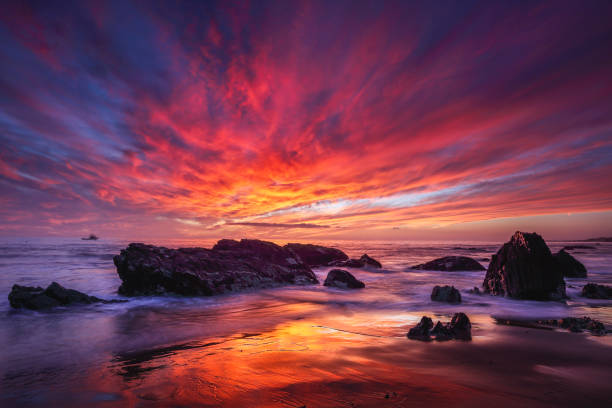
Hands down one of the most intense sunsets I have ever experienced. The moderate tide that washed through the uniquely carved and sculpted rocks at this unusual Southern California beach really showcased the drama of the flow and movement and exquisite beauty that unfolded on this October evening.
A great sunset isn’t just about the sky — it’s about the landscape underneath it. The most beautiful sunsets in the world tend to share a few things in common: a wide, unobstructed western horizon, a dramatic foreground, and often, water, sand, or stone that catches and reflects the changing light. Here’s a look at where that combination comes together best.
What Actually Makes a Sunset “Beautiful”
Before diving into specific destinations, it helps to understand what separates a good sunset from a forgettable one. Clear or partly cloudy skies with some high-altitude moisture tend to produce the most vivid colors, since scattered light needs particles to reflect off. Elevation matters too — watching from a cliff, a dune, or a rooftop gives you a wider, uninterrupted view of the horizon than watching from ground level. And the foreground matters just as much as the sky itself: silhouetted mountains, ancient temples, or a caldera full of whitewashed buildings all turn a nice sunset into an unforgettable one.
Santorini, Greece: The Classic Choice
Few sunsets are as photographed as the one over Oia, where the sun drops behind the volcanic caldera and lights up the whitewashed buildings in gold and pink. It’s crowded for good reason — the combination of dramatic geography and Cycladic architecture is genuinely hard to beat.
Uluru, Australia
Australia was ranked the world’s best country for sunsets in a recent global ranking, scoring highly for its dark skies, warm temperatures, and dramatic natural landscapes. Uluru is the country’s standout sunset destination, with the massive sandstone monolith shifting through deep orange, red, purple, and blue as the light changes.
The Sahara and Namib Deserts
Desert sunsets deliver a different kind of drama — vast, uninterrupted horizons where the sun seems to sink directly into the sand. The combination of dust and dry air in these environments often produces some of the most intensely colored skies anywhere in the world.
Bagan, Myanmar
Watching the sun set over thousands of ancient temples rising out of the plains is one of the most singular sunset experiences available anywhere, particularly if you can get elevated above the temple rooftops for the view.
Maldives and Phuket
Overwater sunsets, where the sun sinks directly into a calm horizon with no land in sight, offer a simplicity that’s hard to replicate elsewhere — just sky, water, and color, often reflected perfectly on a still lagoon.
Why Timing and Season Matter
The “best” sunset at any of these locations still depends heavily on timing — season, weather patterns, and even air quality can dramatically affect how vivid a given evening’s colors turn out. Checking seasonal weather patterns for your specific destination before you travel is worth the extra research if a great sunset is a priority for your trip.
Planning a Trip Around Sunset Viewing
If chasing beautiful sunsets is a genuine priority for your travels, it’s worth building your itinerary around known viewpoints — a specific cliff, rooftop bar, or beach — rather than hoping to stumble onto a good one. For a deeper look at the best places in the world to watch the sunset, including more destination-specific guidance, further resources are available to help plan your trip.
Bottom Line
The world’s most beautiful sunsets share a common formula — open horizons, dramatic foregrounds, and the right atmospheric conditions — but where you find that formula varies enormously, from Santorini’s caldera to Uluru’s desert plains to Bagan’s temple-studded horizon. Wherever you go, arriving early and choosing your vantage point deliberately makes all the difference.